A fashion founder can start with one AliExpress supplier, forward orders from Shopify, and avoid buying 500 units before knowing whether anyone wants the product. That flexibility is the reason dropshipping works as a testing model. The problem appears after the product starts working.
One viral TikTok post can turn three daily orders into dozens. The supplier may run out of the best color, packaging may change, two products in the same customer order may arrive in separate parcels, and no one checks the item before it leaves China. At that point, AliExpress fulfillment is no longer only a shipping question. It becomes an inventory, QC, packaging and customer-experience problem.
The right time to move beyond dropshipping is not a fixed order number. It is the point where control over stock, product consistency, branding and multi-SKU orders becomes more valuable than the flexibility of holding no inventory.
Quick Answer
- AliExpress is useful for testing products without a large inventory commitment.
- Supplier-direct dropshipping works best while demand is uncertain.
- Move toward owned fulfillment when repeat sales are stable, stockouts hurt growth, packaging matters, QC issues repeat, or customers buy multiple SKUs together.
- A China warehouse can receive products from several suppliers, inspect them, consolidate them, apply brand packaging and ship one customer order.
- AliExpress Choice shows why fulfillment matters at scale: Alibaba says the model integrates sales, payment, logistics, warehousing, delivery and after-sales support.
What Does AliExpress Fulfillment Actually Mean?
Alibaba Group describes AliExpress as a global retail ecommerce platform that enables consumers to buy directly from manufacturers around the world. For a small fashion store, the simplest operating model is supplier-direct: the customer orders, the supplier receives the order, and the supplier ships the parcel.
That is not the same operating model as brand-controlled fulfillment. In a warehouse model, the brand or its fulfillment partner holds inventory, knows what is physically available, checks incoming goods, controls packaging, picks multiple SKUs into one order, and manages dispatch from a single inventory system. The product may still come from the same China supplier; what changes is who controls the process after production.
AliExpress Is Good at Product Testing
Testing demand before committing cash to inventory can be rational, especially for accessories, jewelry, bags, basic apparel and trend-driven products. If a style does not sell, the founder has learned something without being left with hundreds of units in a warehouse. That is a different risk profile from private-label production, where fabric, trims, labels and MOQ commitments can tie up cash before launch.
The mistake is treating a testing model as a permanent supply chain. Once one SKU sells repeatedly, demand is no longer hypothetical. The question shifts from “Can I sell this?” to “Can I keep it in stock, consistent and properly packaged?”
For brands moving from product testing into controlled sourcing, Silk Road’s value-added services can connect supplier communication, QC, packaging, kitting and inventory work before the product enters normal fulfillment.
Dropshipping and Fulfillment Solve Different Problems
Dropshipping solves the “I do not want inventory yet” problem. Fulfillment solves the “I now need control” problem. Those are not competing ideas; they can be different stages of the same brand.
Supplier-direct shipping gives the supplier control over stock availability, dispatch, packaging and often the exact parcel experience. Brand fulfillment moves those decisions into one warehouse process. That matters when a clothing customer expects the correct size, a jewelry buyer expects the right box and gift bag, or a bundle contains products that came from different suppliers.
Why Consolidation Changes the Customer Experience
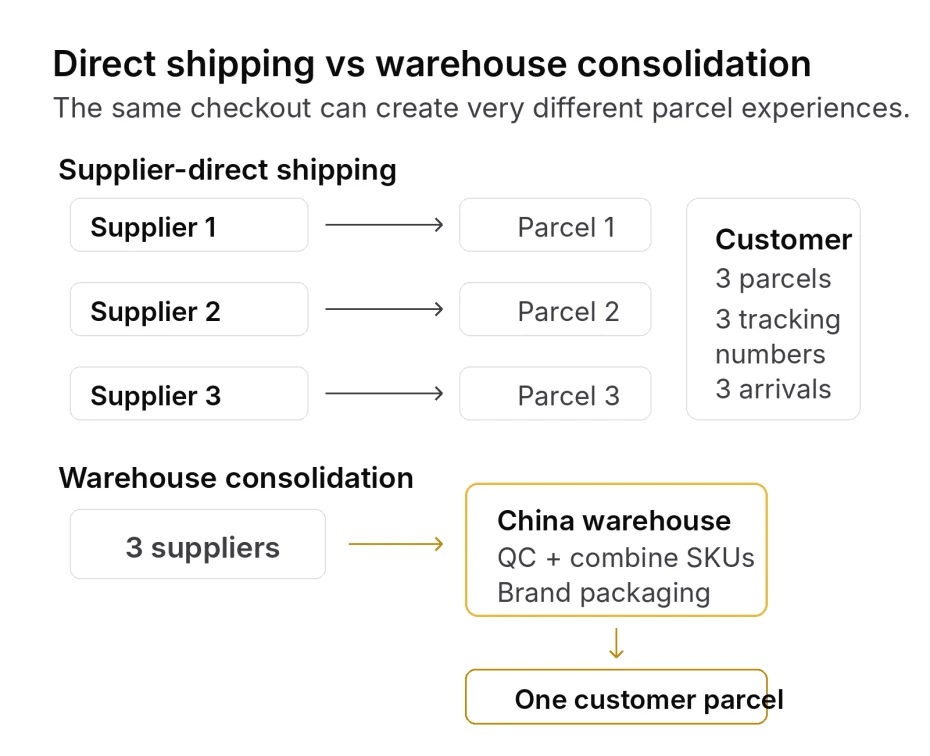
Imagine a customer buys one hoodie, one cap and one necklace. Under a supplier-direct model, three suppliers can create three parcels, three tracking numbers and three delivery moments. One item may arrive in branded-looking packaging while another arrives in a plain mailer. The customer sees one checkout, but the back end behaves like three separate businesses.
With consolidation, the suppliers ship inventory to one China warehouse first. The warehouse can check quantities, inspect visible defects, apply labels or packaging, map each size and color to the right SKU, and combine items into one customer parcel. This is where fashion fulfillment starts to feel different from generic parcel forwarding.
Silk Road’s fashion fulfillment operation is built around style, color and size-level inventory rather than treating every garment as a generic unit. Its order fulfillment workflow then handles the receiving, storage, picking, packing and shipment stage.
AliExpress Choice Shows Why Fulfillment Matters at Scale
AliExpress itself has moved toward tighter fulfillment control through Choice. Alibaba Group describes Choice as a hybrid or fully entrusted model in which the platform takes on more of the shopping experience, including customer acquisition, pricing, logistics, warehousing, delivery and after-sales support.
The lesson is not that every brand should copy Choice. It is that fulfillment becomes strategic once ecommerce moves beyond listing a product. Alibaba says Choice uses export warehouses, parcel consolidation and Cainiao cross-border shipping - the same underlying logic growing DTC brands eventually face.
When Should a Fashion Brand Move Beyond AliExpress Dropshipping?
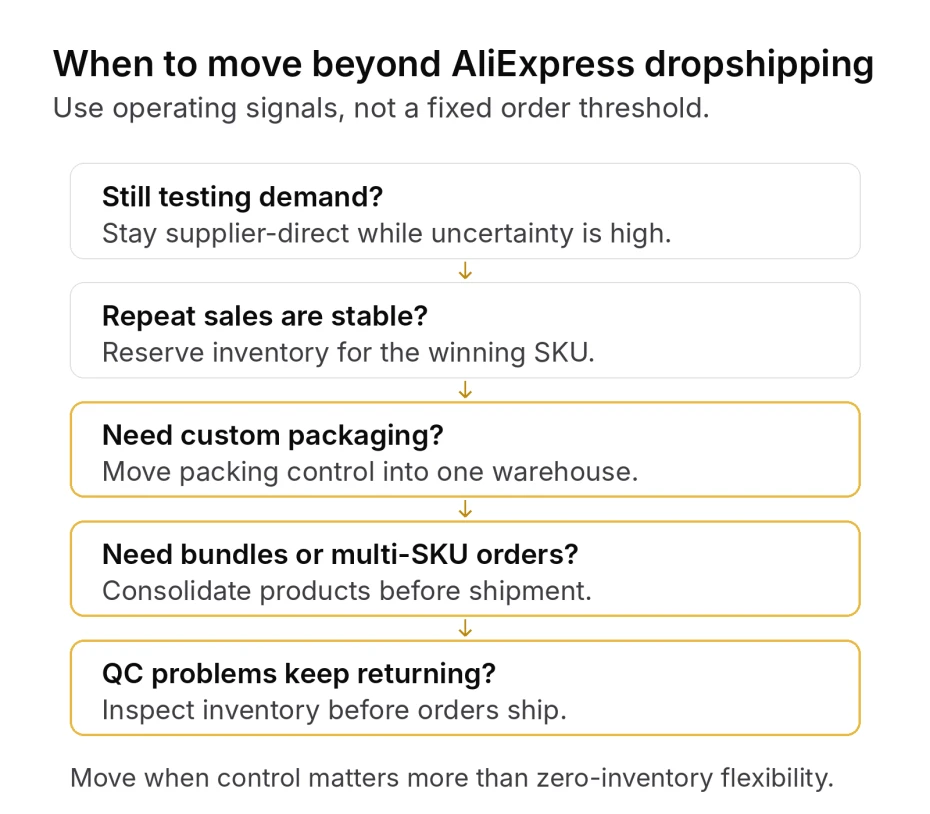
There is no universal threshold such as 50 or 100 orders per day. A low-volume jewelry brand with gift packaging may need warehouse control earlier than a higher-volume store selling one simple accessory. Watch the operating signals instead.
Repeat sales are stable. If the same SKU sells every week, holding a planned quantity can reduce the risk that the supplier suddenly runs out of the winning color or size.
You need custom packaging. Brand cards, boxes, dust bags, tissue, garment bags and bundles are easier to control when inventory passes through one packing station.
Customers buy more than one SKU. Multi-item baskets make supplier-direct shipping more fragmented and can multiply tracking numbers.
Quality problems repeat. If plating, stitching, shade, labels or sizing vary between batches, inventory-level QC before dispatch becomes more valuable.
You need reliable inventory visibility. A Shopify product page cannot promise availability confidently if the supplier’s stock changes without notice.
From AliExpress Product Testing to Private Label
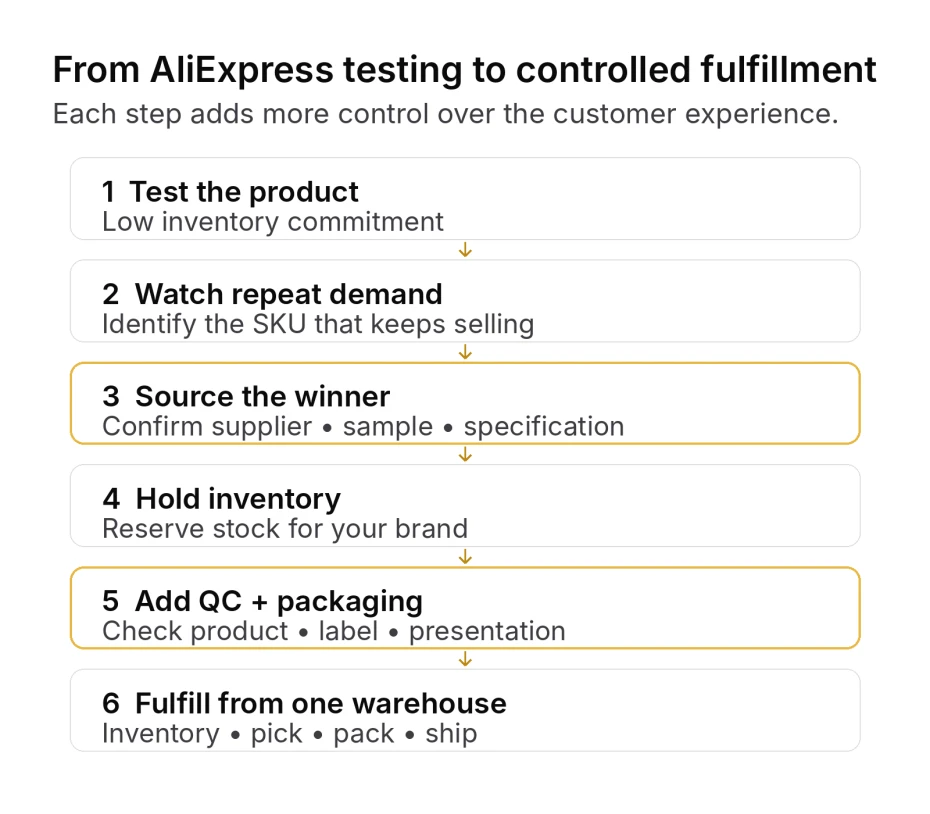
A winning AliExpress product does not have to stay an AliExpress product forever. Once demand is proven, a brand can source a supplier for a more controlled version, approve a sample, add its own labels or packaging, produce a planned quantity, inspect the bulk goods and move them into a China warehouse. The transition is product testing → supplier sourcing → sample → bulk production → QC → inventory → fulfillment.
The important point is that customization changes the job. Changing fabric, fit, plating, color, zipper, embroidery, label or packaging creates production variables that should be documented and checked. A supplier listing is no longer the production standard. The approved sample and written specification become the standard.
For brands manufacturing or sourcing in China, Silk Road’s broader fulfillment and sourcing services can keep supplier coordination, QC and warehouse receiving in the same country. The fulfillment-center model can then be compared with moving inventory overseas first, depending on destination, parcel weight, shipping cost, duties, returns and delivery expectations.
Frequently Asked Questions
Can AliExpress handle fulfillment for a fashion brand?
AliExpress suppliers can ship customer orders directly, and AliExpress Choice uses a more integrated logistics and warehousing model. But brand-controlled fulfillment is different: the brand needs its own inventory visibility, QC standard, packaging process and SKU control. Whether supplier-direct shipping is enough depends on how much control the brand needs.
When should I stop dropshipping from AliExpress?
Stop treating supplier-direct shipping as the default when repeat demand is stable and operational problems start affecting growth. Common signals include stockouts, inconsistent packaging, repeated QC issues, multi-SKU baskets, bundles, private-label requirements or the need to know exactly how much inventory is available.
Can I move an AliExpress winning product into private label?
Yes, but that becomes a sourcing and product-development project rather than simple dropshipping. Confirm the supplier or manufacturer, approve a physical sample, document specifications, agree on MOQ and packaging, inspect bulk production and decide where inventory will be stored before customer orders are released.
Is China fulfillment always better than an overseas warehouse?
No. China fulfillment can reduce the extra movement between factory and overseas warehouse, but the right model depends on destination, order volume, parcel weight, shipping cost, duties, returns and customer delivery expectations. Some brands use China fulfillment first and regional stock later as demand becomes more predictable.
Use AliExpress to Learn, Then Build Control
AliExpress can be an efficient way to test a product without committing heavily to inventory. Once a fashion brand knows what sells, the priorities change. The next stage is less about finding another listing and more about controlling stock, product quality, packaging, SKU accuracy and the customer order. Moving into fulfillment does not mean the testing stage was wrong; it means the brand has learned enough to justify a more controlled supply chain. For products already sourced in China, keeping QC, consolidation and inventory close to suppliers can make that transition easier before the brand decides whether regional stock is also needed.