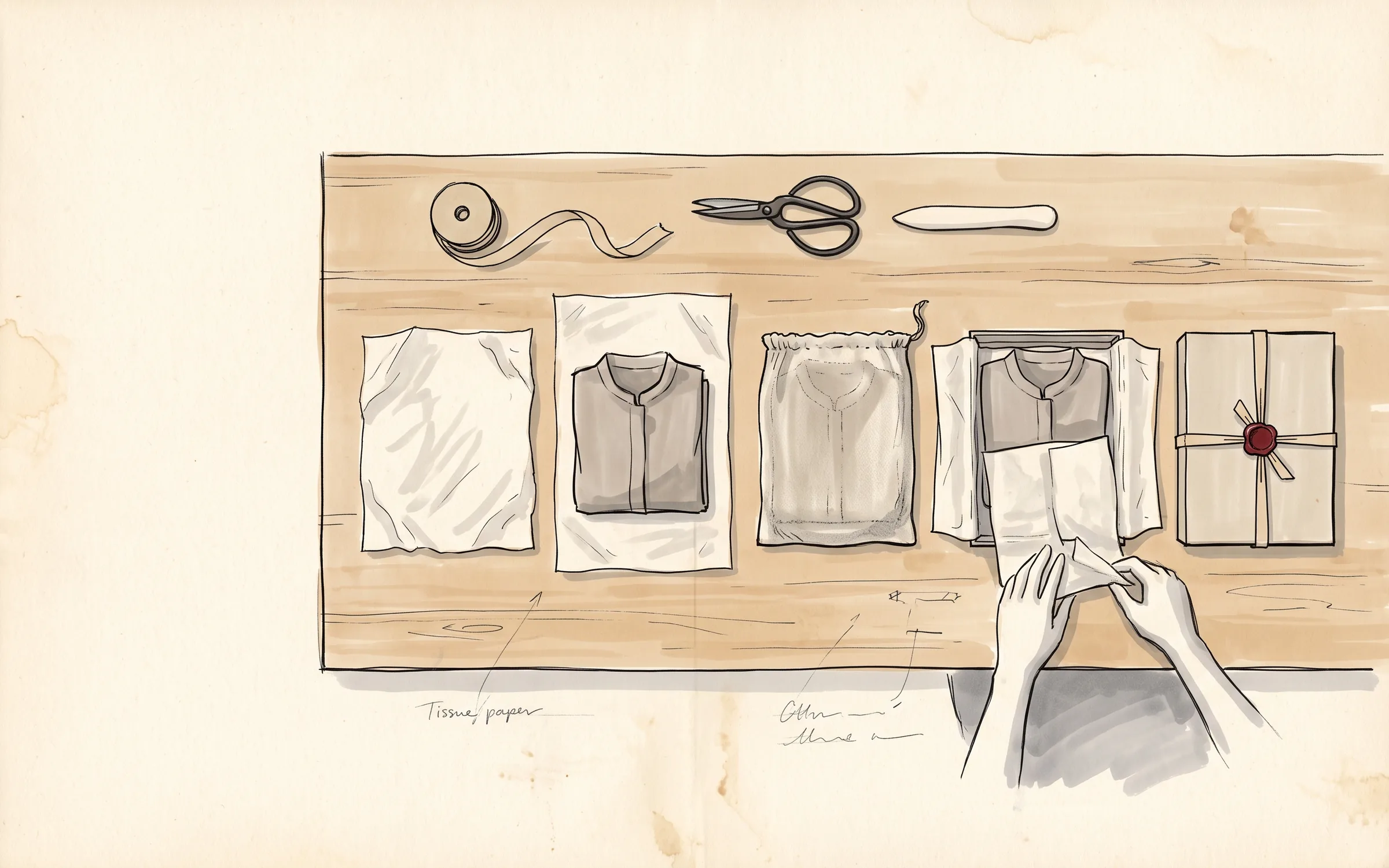
A customer can love the hoodie and still feel disappointed when it arrives in an oversized, crushed box with loose tissue paper and a plastic bag that looks unrelated to the brand.
The opposite can also happen. A beautifully printed rigid box creates a premium unboxing moment, but it may take three times the warehouse space of a mailer and increase the parcel's billable weight on every international order.
That is why fashion packaging should not be treated as decoration added after production. For a DTC fashion brand, packaging sits between brand experience and fulfillment economics. It has to protect the product, present it properly, fit the warehouse workflow, and avoid adding unnecessary shipping cost.
Shopify's 2026 packaging design guide cites a 2025 survey of 6,000 consumers in which 95% said protective packaging was a priority and 59% said packaging influences whether they will buy again. Shopify's product packaging design guide The lesson for fashion founders is simple: packaging can support retention, but only when the experience still works operationally.
Quick Answer
Fashion packaging should protect the product, reinforce the brand, and remain efficient to store, pick, pack, and ship.
Packaging cost includes more than the box or mailer: warehouse labor, storage, dimensional weight, damage risk, and packaging inventory all matter.
Apparel, jewelry, footwear, and accessories need different packaging because the physical risks and presentation standards are different.
Premium packaging does not need to be oversized; unnecessary volume can raise international shipping costs.
Packaging should be planned before bulk production ends so factories, packaging suppliers, barcodes, and warehouse SOPs align.
Brands selling into the EU should now account for the Packaging and Packaging Waste Regulation, which generally began applying on 12 August 2026.
What Fashion Packaging Actually Needs to Do
Fashion packaging is the combination of product-level and shipping materials used to protect, identify, present, and deliver fashion products. That can include garment bags, tissue paper, dust bags, shoe boxes, jewelry boxes, inserts, stickers, mailers, and outer cartons.
For ecommerce, the packaging has two jobs at once. The inner packaging shapes the product reveal; the outer packaging has to survive a network of warehouse handling, sorting facilities, vehicles, and aircraft.
DHL's 2026 packaging guide recommends choosing external packaging based on the shipment's size, weight, shape, and fragility because every handling point introduces another opportunity for damage. DHL Supplies & Packaging Guide.
This is where fashion fulfillment differs from generic pick-and-pack. A folded T-shirt, plated necklace, structured handbag, and sneaker box do not need the same protection or presentation.
Packaging Should Match the Fashion Product
| Category | Typical Packaging | Main Risk | Operational Priority |
|---|---|---|---|
| Apparel | Garment bag, tissue, mailer/box | Wrinkles, moisture, wrong variant | Fold standard, SKU check, compact pack |
| Jewelry | Dust bag, box, protective mailer | Scratches, missing pieces, presentation | Component check, secure small-item packing |
| Footwear | Shoe box + shipper | Box crushing, pair/size mismatch | Protect retail box without excess volume |
| Accessories | Pouch/box + outer pack | Shape damage, fragile components | Right-sized protection and presentation |
The best packaging is therefore not one universal branded box. It is a packaging system that protects each category without making the fulfillment operation unnecessarily complex.
Premium Packaging Can Quietly Increase Fulfillment Cost
The visible cost of packaging is easy to understand: the price of the mailer, box, tissue, insert, sticker, or dust bag.
The hidden cost is larger. Packaging affects storage space, the number of warehouse touches, packing time, the number of packaging SKUs the warehouse must manage, and the chargeable weight of the parcel.
DHL explains that international carriers commonly compare actual weight with volumetric, or dimensional, weight and charge using the higher figure. Lightweight products such as textiles can therefore become expensive when shipped in packaging that occupies far more space than the product needs. DHL's volumetric weight guide.
For a fashion founder, this creates a useful rule: premium should come from the experience, not from empty space. A well-designed mailer, tissue wrap, sticker, and insert may feel more intentional than a large rigid box filled with air.
This is also why order fulfillment should be involved before packaging is finalized. The warehouse can tell you whether a concept is easy to pack, whether carrier labels fit cleanly, and whether the finished parcel is unnecessarily large.
Packaging Itself Becomes Inventory
Fashion founders often calculate garment inventory carefully and treat packaging as an unlimited supply.
It is not.
Imagine a brand uses three mailer sizes, two tissue colors, separate jewelry and apparel inserts, seasonal thank-you cards, shoe shippers, dust bags, and gift packaging. The warehouse is now managing another set of physical SKUs with their own reorder points, MOQs, storage requirements, and stockout risk.
If the custom mailer runs out during a product drop, the warehouse either stops shipping or substitutes something the brand did not approve. If 5,000 seasonal inserts remain after the campaign ends, the brand has dead packaging inventory.
A better setup standardizes the base system and adds complexity only where customers actually notice it. Silk Road's branded packaging and kitting services are designed around fashion-specific materials such as tissue, mailers, dust bags, and inserts rather than treating packaging as a generic carton decision.
The same principle applies to value-added services: every additional assembly or kitting step should have a clear brand or commercial purpose.
Design the Unboxing Experience Around the Warehouse Workflow
A packaging mockup can look excellent on a design table and fail at 500 orders a day.
Suppose every clothing order requires: fold garment, wrap tissue twice, seal with sticker, add one care card, add one founder note, insert into branded box, close with custom tape, place inside a protective shipping carton.
That is not one packaging decision. It is a sequence of warehouse actions.
At low volume, extra touches may be manageable. During a drop, Black Friday, or an influencer spike, the same process may become the bottleneck that delays dispatch.
Before approving custom packaging, test the full SOP:
How many seconds or steps does one order require?
Can one worker pack it consistently without interpreting the design?
What changes for multi-item orders?
What happens when a gift set and a single garment share the same order?
Where does the shipping label go without covering the brand?
Can packaging materials be replenished quickly?
A good fashion packaging design should be repeatable. If the result depends on one experienced packer remembering twelve details, the process is not yet designed.
Plan Packaging With the Factory, Not After Production
Packaging is often cheaper and easier to solve while the product is still close to the factory.
For brands manufacturing in China, packaging decisions may involve garment dimensions after folding, polybag size, hangtag placement, barcode labels, dust bags, jewelry boxes, tissue, custom mailers, and outer shipping protection.
If those decisions happen only after 2,000 units arrive at the warehouse, the fulfillment team may discover that the garment fold does not fit the mailer, the barcode is hidden inside retail packaging, or a rigid box pushes the shipment into a higher dimensional-weight bracket.
Connecting sourcing and fulfillment earlier reduces those handoffs. Silk Road's Shenzhen model keeps factories, packaging suppliers, QC, and warehouse operations inside the same China supply chain. The Shenzhen fulfillment center can receive production close to where it is made, while packaging specifications can be coordinated before the product is already on the other side of the world.
Sustainable Fashion Packaging Now Has a Compliance Dimension
Sustainability is no longer only a brand-positioning discussion, especially for fashion brands selling into Europe.
The EU Packaging and Packaging Waste Regulation (PPWR) generally began applying on 12 August 2026. The European Commission says the regulation covers packaging regardless of material or origin and introduces requirements around packaging design, recyclability, waste prevention, and reuse, with several major measures phased in over the coming years. European Commission packaging waste overview.
The Commission also states that future measures will reduce unnecessary packaging and empty space. Under the regulation, a 50% maximum empty-space ratio for grouped, transport, and ecommerce packaging is scheduled for 2030 or three years after the relevant implementing rules enter into force, whichever is later. EU PPWR guidance.
For a fashion brand, the practical takeaway is not to remove all presentation. It is to avoid building a premium identity around wasteful volume that may become harder to justify commercially and regulatorily.
Sustainable packaging also has to survive fulfillment. A thinner mailer that tears and forces a replacement shipment is not automatically a better environmental or financial outcome.
How to Choose Fashion Packaging Without Overengineering It
A useful packaging decision can be made in seven steps:
Define the product risk: wrinkles, scratches, crushing, moisture, fragile components, or presentation.
Choose the smallest protective format that still presents the product correctly.
Calculate material cost and the warehouse steps needed to pack it.
Check the packed dimensions, not just the product dimensions.
Test single-item and multi-item orders.
Set packaging SKUs, reorder points, and approved substitutions before launch.
Run a physical shipping test before placing a large custom-packaging order.
For Shopify fashion brands, packaging rules should also be connected to order logic. A single necklace, two hoodies, and a mixed apparel-and-jewelry order may need different packing rules even though all three orders come through the same storefront. Silk Road's Shopify fulfillment setup keeps product and variant data connected to the warehouse, which makes these rules easier to execute consistently.
The goal is not to make every parcel impressive at any cost. It is to make the customer feel that the packaging belongs to the product and brand they bought.
Frequently Asked Questions
What is fashion packaging?
Fashion packaging includes the product and shipping materials used to protect, identify, present, and deliver apparel, jewelry, footwear, and accessories. It can include garment bags, tissue, dust bags, shoe boxes, jewelry boxes, inserts, mailers, and outer cartons. In ecommerce, good packaging must balance presentation with warehouse and shipping efficiency.
Does custom clothing packaging increase shipping cost?
It can. The material itself adds cost, but oversized boxes can also increase dimensional weight. International carriers may charge based on the higher of actual and volumetric weight, so lightweight clothing packed in a large box can cost more to ship than the same product in right-sized packaging.
What packaging is best for a clothing brand?
There is no single best format. Foldable apparel often works efficiently in a garment bag or tissue wrap inside a mailer, while structured or premium products may need a box. The right choice depends on product protection, brand positioning, parcel dimensions, packing time, destination, and how often customers order multiple items.
Should fashion brands use sustainable packaging?
Yes, when the material protects the product and fits the brand's market and compliance requirements. Sustainability should be evaluated across material use, recyclability, parcel size, damage risk, and transport efficiency rather than by choosing a material based on one environmental claim alone.
What Fashion Founders Should Remember
Fashion packaging is not just an unboxing decision. It affects how the customer perceives the brand, how fast the warehouse can work, how much packaging inventory you hold, how well the product survives delivery, and how much space the parcel occupies in international transport.
The strongest packaging systems are intentional rather than excessive. They protect the product, communicate the brand, stay easy to repeat at scale, and avoid paying to ship empty space.
If your products are manufactured in China, it is worth designing packaging while production, sourcing, QC, and fulfillment are still connected. Solving the package before inventory reaches the warehouse is usually easier than redesigning the process after thousands of units are finished.