Pilates creates a useful activewear opportunity, but a successful legging is harder to manufacture than it looks. A sample can feel soft and still fail when the waistband rolls, a light colour turns transparent under stretch, or bulk fabric recovers differently from the approved sample.
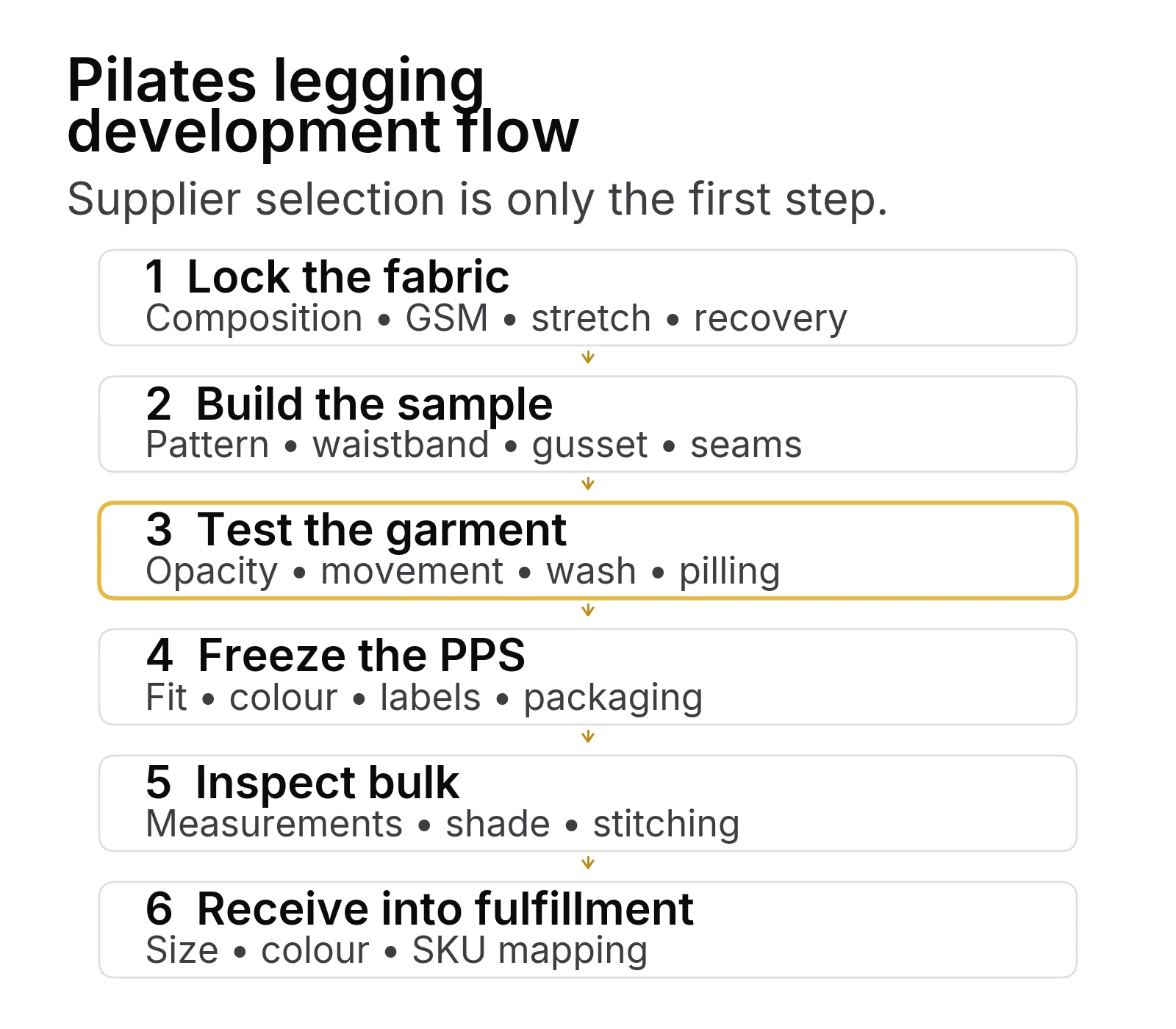
Choosing a yoga pants manufacturer in China should start with product requirements, not a supplier directory. Composition, GSM, stretch, recovery, opacity, pilling, seams, waistband construction, grading and colour consistency all affect how the finished legging performs.
Pilates remained ClassPass’s most-booked workout globally in 2025. For a fashion brand, the opportunity is to build activewear that survives the movement, washing and SKU complexity behind the trend.
Quick Answer
- Choose a manufacturer based on fabric, construction, fit and quality-control capability - not only unit price or a catalogue sample.
- Lock the production fabric before approving the final legging, because a small change in weight or stretch recovery can change opacity, compression and waistband behaviour.
- Test light and dark colourways separately; the same fabric construction can appear more transparent in cream, stone or pale grey.
- Use the approved pre-production sample as the physical standard for bulk manufacturing, then inspect the finished run against it.
- Plan inventory by style, size, colour and inseam from the start, because one legging style can quickly become dozens of SKUs.
Why Pilates Is Creating a Bigger Activewear Opportunity
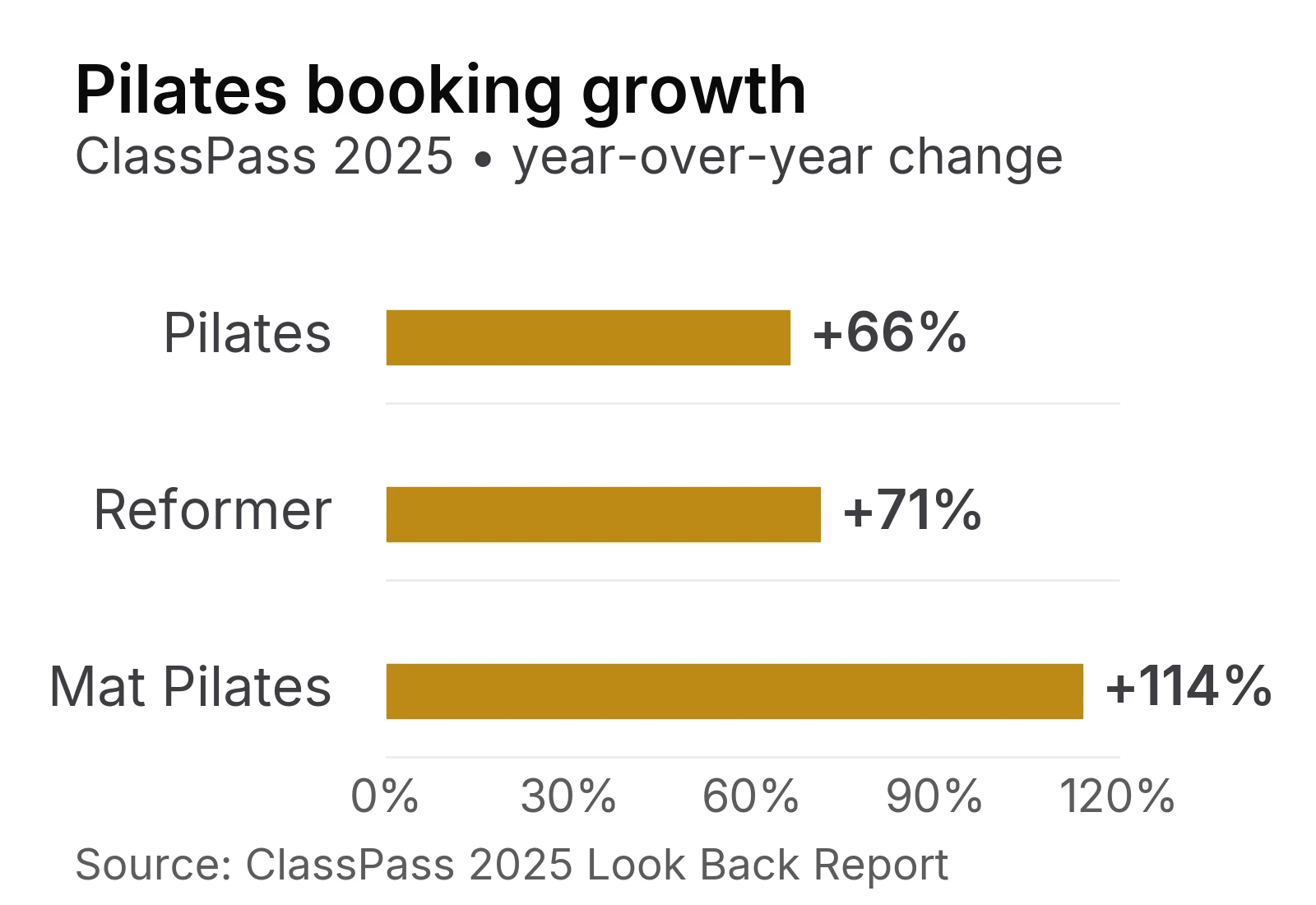
The ClassPass 2025 Look Back Report found that Pilates remained the most-booked workout globally for a third consecutive year. Overall Pilates reservations grew 66% year over year, while Reformer Pilates grew 71% and Mat Pilates 114%. ClassPass also recorded more than 15 million Pilates reservations and over 27 million searches for “Pilates” during the year.
For a fashion founder, the trend supports a clearer product point of view: studio-focused fabrics, secure high-rise waistbands, controlled stretch, coordinated colours and matching sets that can move between reformer, mat and everyday wear.
A Pilates Legging Is Not Just a Generic Yoga Pant
Pilates exposes construction problems quickly. Deep hip flexion, leg extension, rotation and repeated bending put pressure on the waistband, crotch, seams and fabric recovery. A legging that looks correct standing still can slide down, become transparent or distort once the wearer moves through a session.
Product decisions need to be specific. A high-rise waistband only works if the fabric and elastic recover properly. Gussets, flat seams and front-seam choices also affect comfort and pattern engineering, so these details belong in the tech pack and sample process rather than being left to factory interpretation.
Silk Road’s services for fashion brands connect factory sourcing, tech-pack review, sample management, MOQ negotiation and QC in the same China-based supply chain. That is useful for activewear because fabric, fit and production follow-up need to stay connected.
What Fabric Should Pilates Leggings Use?
There is no single correct composition. Nylon or polyamide with elastane is common for soft hand feel, stretch and recovery, while polyester-elastane can suit more performance-oriented products. Brushed finishes can feel premium, but they make pilling and long-term appearance worth testing.
Do not brief a factory with “I want a Lululemon-like fabric.” Define fibre composition, GSM, stretch, recovery, opacity, finish, colour, shrinkage and care performance. If sustainability claims matter, verify fibre sourcing and certification rather than relying on a supplier description.
OEKO-TEX STANDARD 100 is one useful reference for chemical safety: OEKO-TEX describes it as a label for textiles tested for harmful substances, with testing that covers components from yarn and fabric through buttons and accessories. Certification does not tell you whether a legging fits well or is squat-proof, but it can answer a different question about harmful-substance testing.
Test “Squat-Proof” Performance Instead of Trusting the Claim
“Squat-proof” is not a useful supplier answer unless the brand defines how it will be checked. Test the garment on-body, under bright light, through deep flexion, and after washing. Also check what happens when the fabric is stretched close to its limit.
Colour matters too. Black may appear fully opaque while cream, blush or light grey made from the same fabric construction reveals more under stretch. That means opacity approval should happen by colourway, not once for the entire style. The same logic applies to dye transfer, pilling and shade consistency.
This is where value-added QC and production follow-up can matter: the goal is to catch fabric, label, colour or workmanship problems in China before they become customer returns in another market.
Why a Perfect Sample Can Still Fail in Bulk Production
One good sample proves that one good sample can be made. Bulk production tests repeatability. The mill may send a slightly different fabric lot, the cutting room may change tension, the sewing line may use a different operator, or the factory may substitute a similar material after the approved fabric runs short.
For leggings, small changes can have visible consequences: a waistband may roll, recovery may weaken, the garment may become more transparent, or measurements may drift after washing. The pre-production sample should therefore represent the final material and construction, and the bulk inspection should compare finished garments with that approved reference.
A recent SGS update on China’s knitted yoga garment standard shows how many variables matter in this category. FZ/T 74005-2025, scheduled to take effect in 2028, includes fibre content, colourfastness, pilling, dimensional change after washing, seam rupture, elastic elongation and recovery. Even when a brand does not use the standard directly, the test list shows that activewear quality goes well beyond appearance.
MOQ and SKU Count Can Grow Faster Than Founders Expect
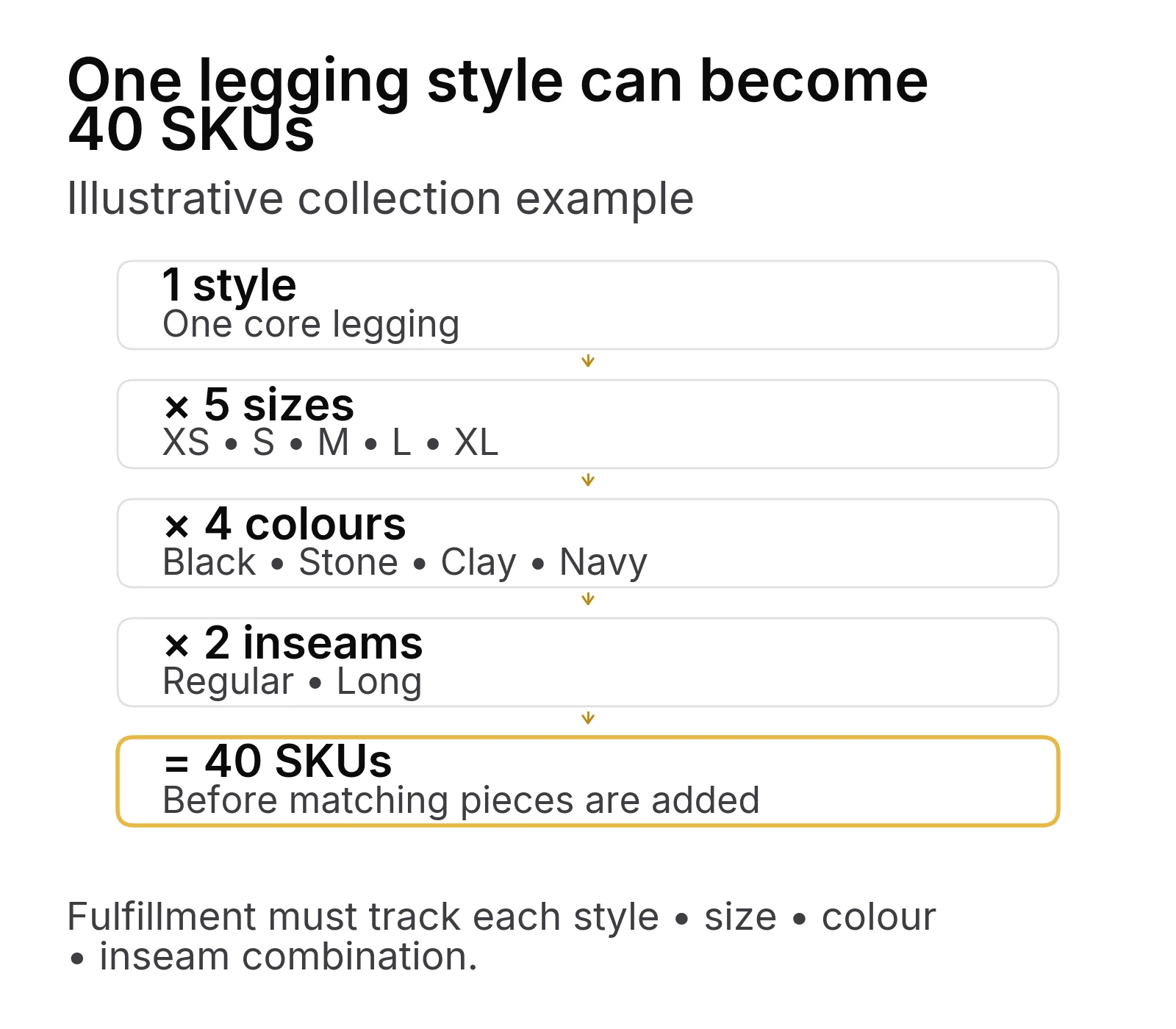
One pair of leggings can become a large inventory matrix quickly. Five sizes across four colours create 20 SKUs; two inseam lengths make 40 before a matching bra, shorts or seasonal colour drop is added.
This matters before the purchase order is placed. Fabric MOQ may apply by colour, labels may have their own MOQ, and the factory may require minimum quantities per size or style. A low total MOQ is not useful if it forces the brand to overbuy slow sizes while underbuying the sizes that actually sell.
Fulfillment Starts With Correct Variant Mapping
Activewear fulfillment becomes a product problem when the warehouse does not understand fashion variants. Cream leggings in Medium are not interchangeable with Stone leggings in Medium, and a matching set fails if pieces come from different colour batches. The SKU structure must preserve style, colour, size and inseam from factory carton to customer order.
Silk Road’s fashion fulfillment operation is organised around style, colour and size-level inventory rather than one generic stock number. Its order fulfillment workflow receives inventory from factories, stores each SKU, picks the correct variant, packs to the brand’s SOP and ships the customer order.
For brands producing in China, keeping early inventory close to the factory can simplify rework, replenishment and supplier coordination. As demand becomes predictable in a major market, regional inventory can be added when economics and delivery expectations justify it.
Silk Road’s fulfillment-center model uses Shenzhen as the primary hub and adds regional stock when demand has earned a place there, rather than moving inventory overseas simply because a local warehouse exists.
Frequently Asked Questions
How do I choose a yoga pants manufacturer in China?
Start with the product specification, then evaluate whether the supplier can reproduce it consistently. Check activewear experience, fabric sourcing, sample quality, MOQ, production controls, communication and whether bulk inspection can happen before shipment. A low quote is only useful when the factory is quoting the same fabric, construction and quality standard.
What fabric is best for Pilates leggings?
There is no universal best fabric. Nylon or polyamide with elastane is common for soft hand feel and recovery, while polyester-elastane can work well for performance-oriented products. The brand should define composition, GSM, stretch, recovery, opacity, finish, shrinkage, pilling and care performance instead of choosing only by fibre name.
How should I test if leggings are squat-proof?
Test opacity on-body under strong light and through deep flexion, not only by stretching a fabric swatch by hand. Check light and dark colourways separately, test the intended size range, and repeat the check after washing. If the product is sold with an opacity claim, the brand should have a repeatable internal standard for approving it.
Should Pilates brands fulfill directly from China?
It can make sense when products are manufactured in China and the brand wants QC, supplier coordination and one global inventory pool close to production. The right model still depends on parcel weight, destination, shipping cost, duties, returns and delivery expectations. Regional inventory can be added later when market demand becomes predictable.
Build the Legging Before You Scale the Collection
Pilates creates an attractive activewear opportunity, but the product has to perform before the collection scales. Start with fabric, movement and fit standards; prove construction through samples; freeze the production specification; inspect bulk goods; and build SKU logic before inventory reaches the warehouse. A yoga pants manufacturer in China provides capacity, while the brand still controls the decisions that make the legging fit and perform consistently. Keeping sourcing, QC and fulfillment connected helps stop small product issues becoming large returns problems.