A ¥65 hoodie on 1688 can look like a shortcut to launching a fashion brand. Then the founder asks for heavier fabric, a different fit, a custom wash, woven neck and care labels, embroidery, branded packaging, and five sizes. The product is no longer the hoodie shown on the listing. It has become a development project with its own MOQ, sample process, quality standard, and production risks.
1688 was built around China’s domestic wholesale ecosystem. Alibaba Group describes it as China’s leading integrated domestic wholesale marketplace and a product source for Chinese e-commerce. In FY2024, it reported more than one million paying members; its 2024 ESG reporting also said the marketplace had enabled more than 320,000 factories to connect with market demand.
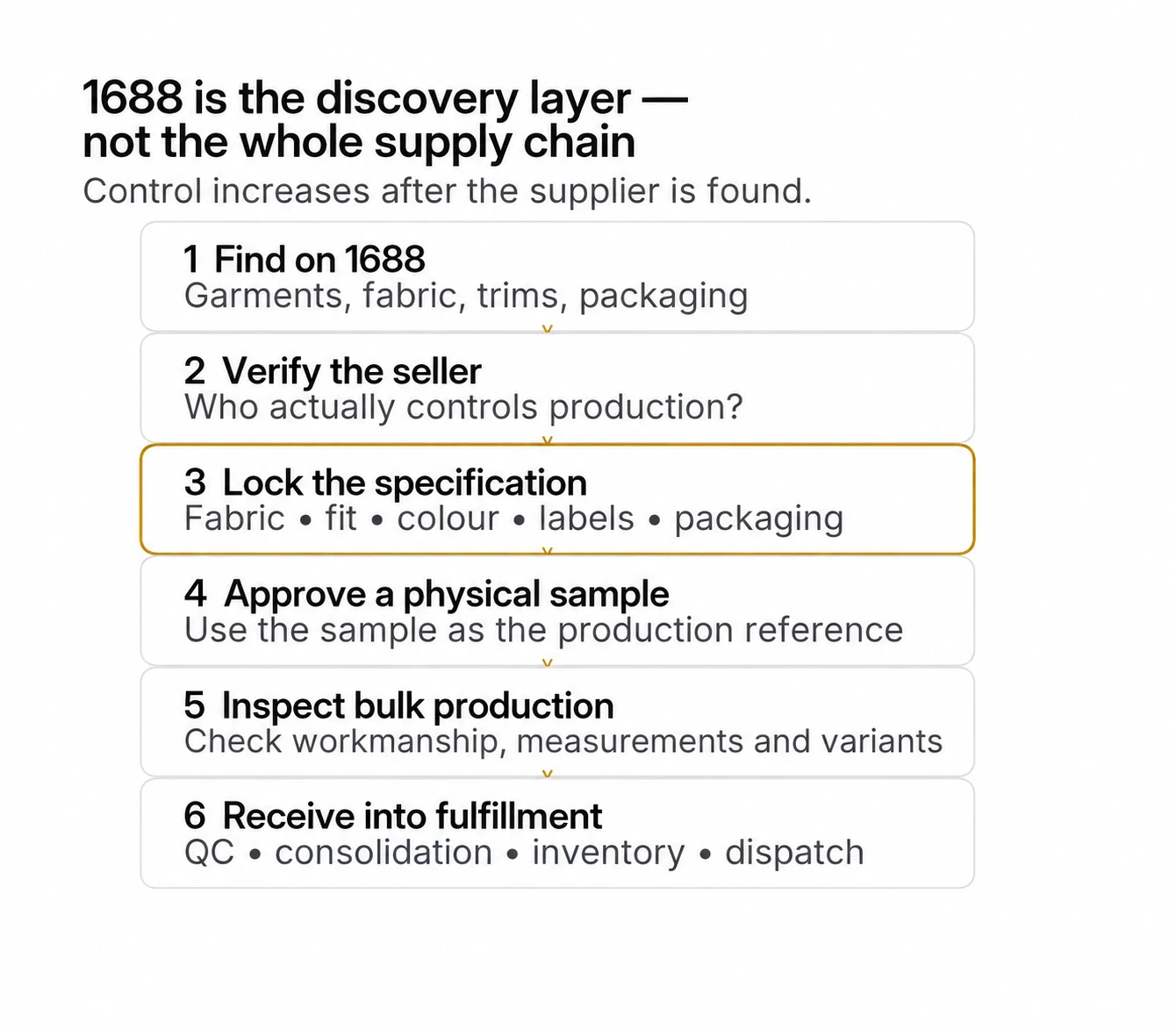
For overseas fashion founders, 1688 can open access to garments, fabrics, trims, packaging, manufacturers, and wholesalers. But listing price is not the same as a brand-ready product. After discovery come supplier verification, specifications, samples, bulk QC, consolidation, and fulfillment.
Quick Answer
- 1688 is a China-focused domestic wholesale marketplace, so it is best treated as a sourcing database rather than a turnkey overseas sourcing service.
- A 1688 seller is not automatically a factory. Alibaba Group’s marketplace ecosystem includes manufacturers, wholesalers, retailers, and brands.
- Compare landed usable product cost, not only the listing price. Sampling, customization, domestic freight, QC, consolidation, shipping, and defects can change the economics.
- Once you change fabric, fit, colour, labels, printing, embroidery, or packaging, you have moved from wholesale purchasing into product development.
- For fashion brands, the practical workflow is 1688 discovery → supplier verification → sample → revision → PPS → bulk production → QC → China warehouse → fulfillment.
What 1688 Is - and Why Fashion Brands Use It
Alibaba Group’s official 1688 business profile describes the platform as China’s leading integrated domestic wholesale marketplace. Its business operations FAQ explains that business buyers use wholesale marketplaces to source products for their own operations or for resale, while sellers can include brands, retailers, wholesalers, and manufacturers.
For a fashion founder, the value is access to domestic suppliers that may not build their sales process around overseas buyers. That is useful when looking for stock apparel, factories, fabrics, trims, packaging, or components close to production.
Alibaba Group’s FY2024 annual report also describes 1688 as connecting domestic factory and wholesaler sellers across categories including clothing and accessories and packaging materials. The implication for fashion brands is simple: 1688 can sit upstream of the garment factory as well as at the finished-product level.
A 1688 Seller Is Not Automatically a Clothing Factory
A listing is not proof that the seller owns every production step. Ask, “Who controls the parts of this product that matter to my collection?” A company may own sewing capacity but outsource dyeing, washing, printing, embroidery, or packaging; a wholesaler may coordinate specialist factories well.
Map the chain before placing a custom order. Who buys the fabric? Who controls washing, printing, labels, and trims? Who can remake goods if QC fails? A legitimate supplier can still be wrong if nobody owns the final standard.
Variant control matters too. One hoodie in five sizes and four colours creates 20 SKUs. If size labels, colourways, carton quantities, or SKU references drift during production, the problem moves directly into warehouse receiving, picking, stock accuracy, and returns.
Why the Lowest 1688 Price Is Not Always the Lowest Cost
A 1688 listing can reflect the seller’s existing fabric, colours, packaging, and domestic wholesale terms. A fashion brand often wants its own measurements, fabric weight, wash, colour standard, branding, labels, packaging, and QC standard.
The better metric is landed usable product cost: what it costs to put one correct, sellable unit into inventory. A ¥28 T-shirt is not really ¥28 after samples, labels, printing, China-side transport, inspection, repacking, consolidation, international shipping, duties, and rework. Some of those costs exist regardless of platform; the mistake is pretending they do not exist when comparing listings.
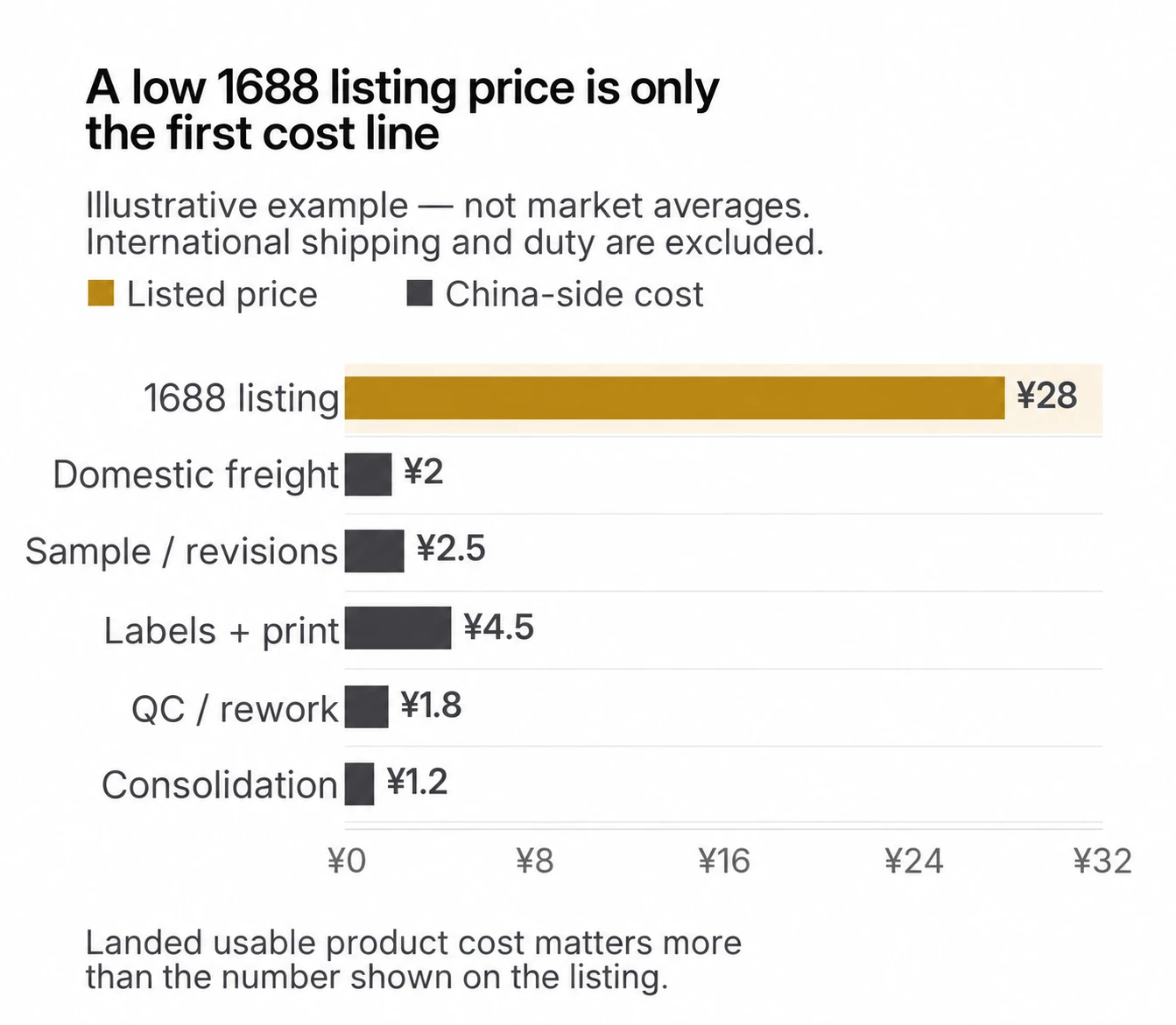
Supplier A can be cheaper on paper and more expensive in practice if shade variation, measurement drift, packaging errors, or late rework delay the launch. Compare two suppliers only when they are quoting the same product specification and the same quality expectations.
Use 1688 for Fabric, Trims and Packaging - Not Only Clothing
A collection depends on more than the sewing factory. The project may also need jersey, rib, zippers, woven labels, care labels, drawcords, hangtags, polybags, tissue, dust bags, or boxes. 1688 can expose suppliers for these inputs as well as the finished garment.
The tradeoff is coordination. Fabric must arrive before cutting, labels need approved information, trims must match the sample, and packaging affects handling and shipping. Cheap components are not useful if they arrive late.
For brands already sourcing in China, Silk Road’s value-added services connect supplier coordination, QC, packaging, kitting, inventory, and international shipping in one operation rather than treating each domestic supplier as a separate project.
When a 1688 Stock Item Becomes Product Development
A stock product is simple when you want it exactly as the seller already makes it. The moment you change the product, the sourcing model changes. Take a ¥65 stock hoodie. Asking for 420gsm cotton, a wider shoulder, a shorter body, a custom wash, Pantone-matched colour, chest embroidery, woven neck label, care label, and branded packaging creates a new production specification.
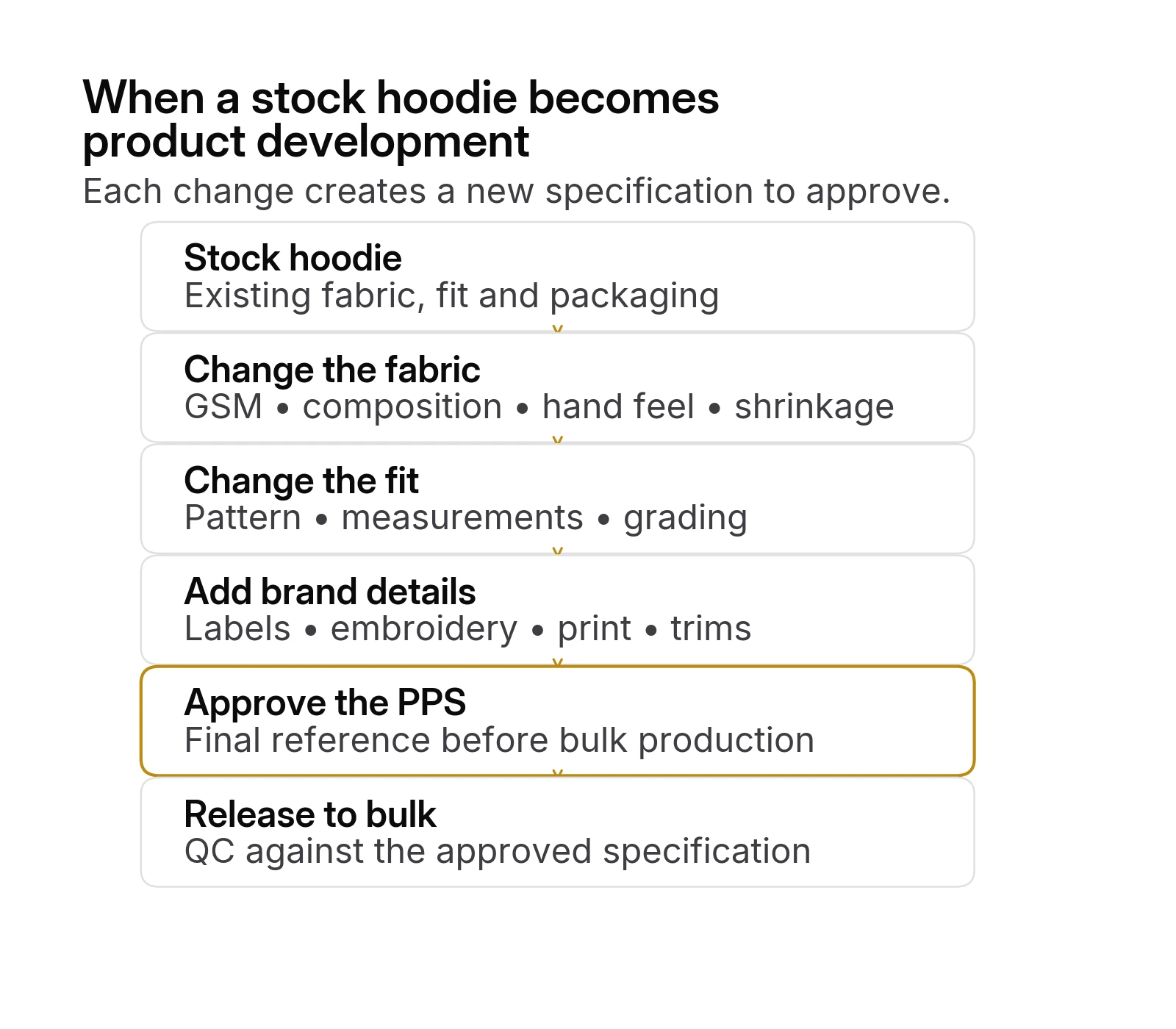
Those changes can alter MOQ, sample fees, pattern work, lead time, fabric booking, finished weight, shipping cost, and QC. At that point the stock listing is no longer the benchmark. The benchmark is the approved sample and the written specification that bulk production must match.
How Fashion Brands Should Manage a 1688 Supplier
1. Define the product. Use a tech pack, measurement chart, fabric specification, colour reference, trim list, artwork, label requirements, and packaging instruction.
2. Separate standard from custom. Ask which parts of the listing price assume the seller’s existing material, colour, fit, minimum order, and packaging.
3. Map the MOQ. Clarify whether minimums apply per style, colour, fabric booking, print, label, or total order.
4. Approve a physical sample. Listing photos are discovery material, not the production standard. Revise until the sample represents what you want to sell.
5. Freeze a PPS. The pre-production sample should reflect the final fabric, trims, labels, artwork, measurements, and packaging before bulk production is released.
6. Inspect before inventory moves. Check workmanship, measurements, shade, labels, packaging, quantities, and variant mapping before the goods leave the production stage.
From 1688 Sourcing to QC, Consolidation and Fulfillment
1688 is an entry point, not the whole supply chain. A brand may buy fabric, labels, packaging, and garments from different suppliers; someone still needs to coordinate delivery, inspect goods, consolidate components, receive inventory, and keep the size-colour matrix accurate.
Silk Road’s fashion fulfillment operation is built around style, colour, and size rather than generic units. Its order fulfillment workflow receives stock directly from factories or suppliers, while the broader fashion 3PL and sourcing service connects production, QC, packaging, inventory, and international dispatch.
For products with proven regional demand, Silk Road also describes a hybrid fulfillment-center model where Shenzhen remains the primary hub and selected inventory can move closer to established markets. The right model still depends on product weight, order volume, destination, duties, returns, and customer delivery expectations.
Frequently Asked Questions
Is 1688 good for finding clothing suppliers in China?
Yes. 1688 is a major domestic wholesale marketplace and can expose fashion brands to manufacturers, wholesalers, packaging suppliers, fabric sellers, and other businesses. Treat it as a sourcing database: samples, specifications, verification, and QC determine whether a seller is suitable for a real collection.
Are 1688 clothing suppliers always cheaper?
No. A listing may reflect a domestic stock specification. Once the brand adds custom fabric, labels, printing, samples, domestic logistics, QC, consolidation, international shipping, duties, and rework, the final usable-product cost may be very different from the number shown online.
Do I need a sourcing agent to buy from 1688?
Not always. Some teams can manage Chinese supplier communication, sampling, commercial terms, domestic delivery, and inspection themselves. Others use a local sourcing or supply-chain partner when they need factory verification, product development, QC, consolidation, or coordination across several suppliers.
Can I build a private-label fashion brand from a 1688 product?
Sometimes. Adding a label to an existing product may be simple; changing fabric, fit, wash, colour, trim, or construction creates new sampling, MOQ, lead-time, and QC requirements. Confirm the seller’s customization limits before treating a stock listing as the basis of your collection.
Use 1688 as Access, Not as the Whole Supply Chain
1688 can give fashion founders deeper access to China’s domestic supplier ecosystem, especially when garments, fabrics, trims, labels, and packaging are sourced close to production. The advantage is access - not automatic quality and not automatic savings. A low domestic wholesale price only becomes valuable when the product matches your specification, passes inspection, arrives on time, and enters inventory ready to sell. Use the platform to discover options, then manage the real work: supplier ownership, samples, PPS approval, bulk QC, consolidation, and the fulfillment model that fits your product and demand.