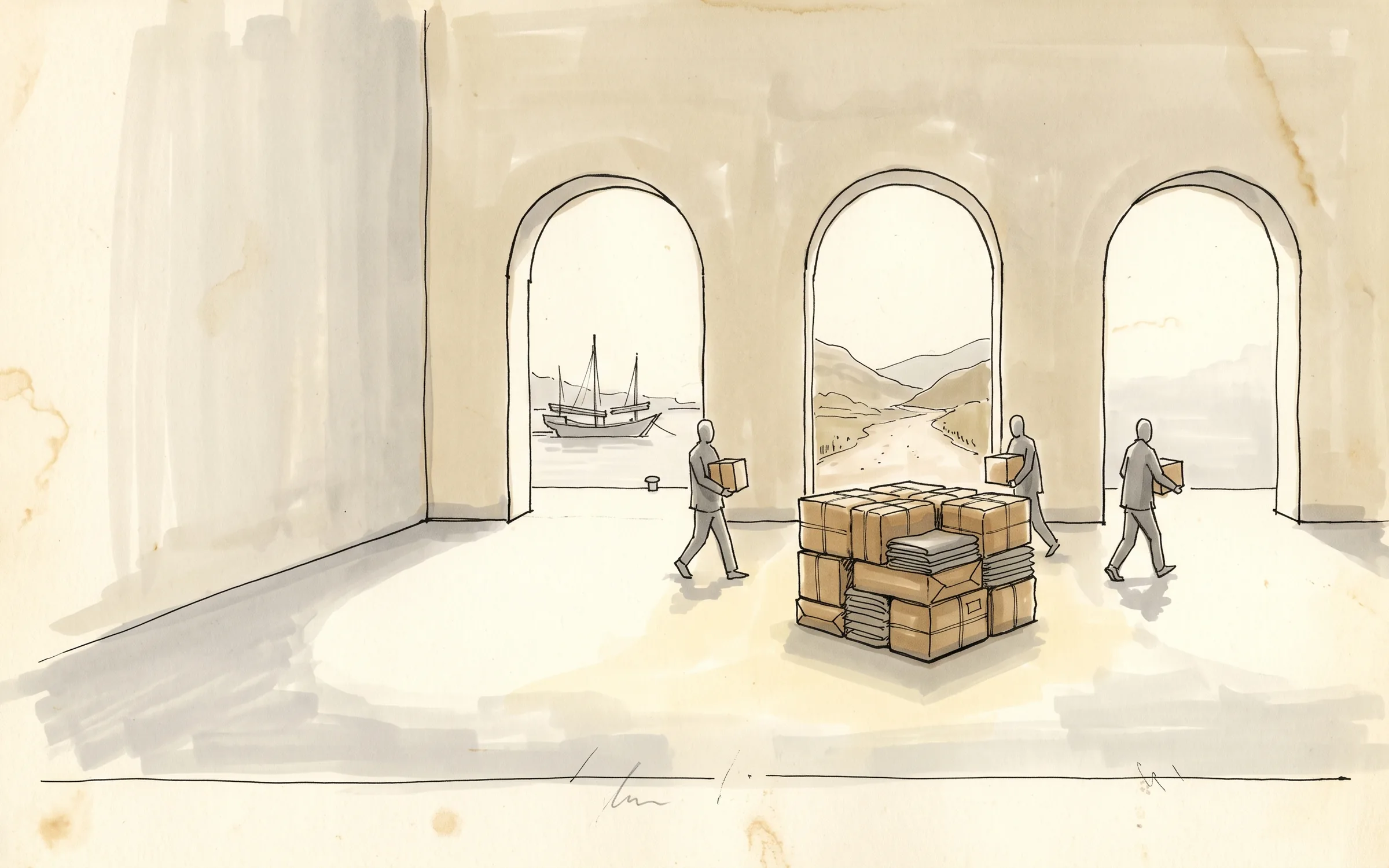
Your supplier finishes 8,000 units in China. Before a single customer order arrives, you are asked to decide where all 8,000 units should live: the United States, the UK, the EU, Australia, or somewhere else.
That decision is easy to underestimate. Once inventory moves by bulk freight into regional warehouses, the brand has already made a market bet. If demand lands somewhere else, stock can be available globally on paper but unavailable where customers actually want it.
A China 3PL changes that decision. Instead of treating China only as the production origin, a brand can use a China-based third-party logistics partner to receive inventory from factories, store it, manage SKUs, pick and pack ecommerce orders, and ship internationally. For brands already manufacturing in China, the real question is not simply whether China fulfillment is cheaper. It is whether keeping inventory close to production creates a better balance of cash flow, delivery speed, market flexibility, QC, and customer experience.
Quick Answer
A China 3PL stores inventory in China and handles receiving, warehousing, order processing, pick and pack, international shipping, tracking, and often returns or value-added services.
The strongest reason to use one is often inventory flexibility: stock can remain in one pool until real customer demand shows which markets need it.
For brands manufacturing in China, a local 3PL can also coordinate more closely with suppliers, packaging partners, and QC teams.
A China 3PL is not automatically best for heavy products, domestic-speed delivery expectations, or brands with very concentrated demand in one country.
Technology matters: Shopify or other ecommerce integrations, WMS accuracy, variant-level inventory, and tracking updates should be tested before onboarding.
Compare the complete landed fulfillment model, not only the pick-and-pack fee.
What Is a China 3PL?
A China 3PL is a third-party logistics provider based in China that manages part or all of an ecommerce brand's fulfillment operation. Shopify defines an ecommerce 3PL as an external partner that can handle receiving, warehousing, picking, packing, shipping, tracking, and returns, usually with software integrations and inventory management layered on top. Shopify's 2026 3PL guide uses the same framework when explaining how brands should evaluate providers.
The China-specific difference is location. Inventory sits near Chinese factories and export infrastructure rather than first being moved in bulk to a destination-country warehouse.
A typical flow can look like:
Factory -> China 3PL -> International Parcel -> Customer
That is different from the traditional model:
Factory -> Bulk Freight -> Customs -> Overseas Warehouse -> Customer
Neither model is automatically better. The right choice depends on the product, destination markets, order volume, parcel dimensions, duties, return economics, and the delivery promise the brand wants to make.
Why Manufacturing Location Changes the Fulfillment Decision
The biggest operational advantage of China fulfillment is often not a warehouse fee. It is the ability to delay inventory allocation.
Imagine a brand manufactures 10,000 units in Guangzhou and expects sales to split:
If it pre-positions inventory overseas, it may send 5,000 units to the US, 2,000 to the UK, 2,000 to the EU, and 1,000 to Australia before actual demand is known.
If the UK product goes viral while US demand underperforms, the problem is no longer total inventory. It is inventory in the wrong place. Rebalancing stock between countries creates another freight, customs, and receiving cycle.
With a single China inventory pool, customer orders can pull from the same stock until demand becomes clearer. That gives a brand more time before committing inventory to a particular market.
A China 3PL does more than move parcels. It can delay the decision of where inventory needs to live until customer demand becomes clearer.
This is especially useful for fashion, accessories, jewelry, and other catalogs with multiple variants. A product can have plenty of units overall while still losing sales because Black Medium, EU size 39, or Gold is sold out in the market where customers want it.
What Services Should a China 3PL Actually Provide?
Shopify's order fulfillment guide describes fulfillment as the complete process from receiving inventory through storage, picking, packing, shipping, tracking, and returns. A serious China fulfillment partner should be able to explain each of those steps clearly rather than quoting only a shipping rate.
| Area | What to Check | Why It Matters |
|---|---|---|
| Receiving | Count, SKU verification, carton records, putaway process | A factory shipment is not sellable inventory until it is correctly received. |
| Warehousing | SKU locations, variant control, cycle counts, WMS visibility | Poor stock accuracy creates overselling and missed replenishment. |
| Pick & pack | Barcode checks, packing SOP, multi-item orders | Accuracy and brand presentation are decided here. |
| Value-added | QC, relabeling, kitting, custom packaging | Problems can be fixed before they become customer complaints. |
| International shipping | Route options, tracking, duties model, parcel rules | The cheapest line on a rate card may not be the best delivered experience. |
| Returns | Local return options, grading, restocking logic | Cross-border returns can erase the economics of the outbound shipment. |
For a fashion brand, the warehouse also needs to understand size, color, style, shoe size, jewelry components, dust bags, garment folding, and packaging rules. Silk Road's fashion fulfillment operation is built around that type of variant-level handling rather than treating every product as a generic unit.
China 3PL vs Overseas 3PL: The Real Tradeoff
| Decision | China 3PL | Overseas 3PL |
|---|---|---|
| Inventory position | Close to production; one pool can serve several markets | Stock committed to specific regional markets earlier |
| Customer delivery | International parcel from China | Domestic or regional delivery can be faster |
| Supplier coordination | Easier when factory and warehouse are nearby | Issues may require coordinating across countries and time zones |
| Heavy/bulky products | Can become expensive by international parcel | Bulk freight plus local delivery may be more economical |
| Returns | Needs a local-return or consolidation plan | Usually easier in the destination market |
| Best fit | Multi-market, lighter products, uncertain demand, China-made goods | High-volume proven demand concentrated in one region |
Shopify's 2026 ecommerce fulfillment guide makes the same broader point: fulfillment strategy depends on order volume, product type, shipping distance, and how much operational control a brand wants. Location should follow economics and demand, not a default assumption that every unit belongs in the same country.
A hybrid model can also make sense. New collections, long-tail sizes, and slower movers can stay in China, while proven bestsellers move closer to the strongest customer market. Silk Road's fulfillment center network is designed around that inventory-positioning logic.
Why Shenzhen Matters for China Ecommerce Fulfillment
Shenzhen matters because it combines manufacturing access, cross-border ecommerce infrastructure, logistics services, and export channels in one region.
The city's 2026-2030 development plan explicitly calls for supporting international postal, express, freight-forwarding, and supply-chain services, developing cross-border ecommerce, improving overseas-warehouse functions, and building Shenzhen as an important global supply-chain node. It also sets a 2030 target of RMB 500 billion in import and export volume across cross-border ecommerce, market procurement, bonded repair, and other new trade formats. Shenzhen 15th Five-Year Plan.
Shenzhen is also changing how cross-border ecommerce cargo is processed. The city's 2026 port measures call for expanding a "inspect before loading" model that embeds customs inspection into sorting, consolidation, and loading workflows rather than waiting until cargo has already been packed into a consolidated shipment. Shenzhen 2026 port business-environment measures.
For an ecommerce brand, these policy details matter less as headlines and more as evidence that Shenzhen continues investing in the infrastructure around cross-border fulfillment. A warehouse here is not operating in isolation; it sits inside a dense export and supplier ecosystem.
WMS, Shopify, and Inventory Visibility Matter as Much as the Warehouse
A good warehouse with weak software still creates operational problems.
Before choosing a China 3PL, ask to see how orders, inventory, tracking, cancellations, and returns move between the ecommerce platform and the WMS. Shopify orders should not depend on staff retyping customer details into a separate system.
Silk Road's Shopify fulfillment setup is designed so products and variants sync, orders flow to the warehouse, stock updates back to the store, and tracking is written back after dispatch. The same principle should apply regardless of provider: your storefront and warehouse should agree on what exists.
This becomes critical when the catalog is deep. Thirty styles across five sizes and six colors create 900 variant combinations. If the WMS cannot reliably distinguish those variants, the problem is not a logistics problem anymore; it becomes wrong shipments, false stock availability, missed replenishment, and unnecessary returns.
Do Not Compare China 3PLs on Shipping Price Alone
A low shipping quote can hide a weak fulfillment model.
Compare the complete cost stack: receiving, storage, pick and pack, packaging materials, value-added work, international shipping, duties or tax handling, failed-delivery charges, returns, and any account or platform fees. Shopify's 3PL guidance recommends evaluating operational and technological fit alongside cost rather than choosing solely on price.
Then test the customer experience. Ask which carriers handle the last mile, what tracking the customer receives, how duties are collected, what happens after a failed delivery, and where a return goes.
Returns deserve particular attention. Sending a low-value garment from Texas back to Shenzhen may cost more than the recovered product. A China fulfillment model can still work well, but the brand may need a local return address, consolidated returns, exchange rules, or product-specific disposition logic.
Silk Road combines core ecommerce order fulfillment with value-added 3PL services such as QC, packaging, kitting, sourcing support, and inventory management. That connection is especially useful when the product is still being manufactured in China.
What to Ask Before Choosing a China 3PL Provider
How do you receive inventory from Chinese factories and verify quantities and SKUs?
Can I see inventory by SKU and variant in real time?
How does Shopify or my ecommerce platform integrate with your WMS?
How are orders checked before shipping?
Which countries and product types are strongest for your shipping network?
How do duties, taxes, customs declarations, and failed deliveries work?
What happens when my packaging or QC requirements are more complex than standard pick and pack?
How are returns handled in my largest markets?
What are all recurring and per-order fees?
If I outgrow the China-only model, can selected inventory move into regional fulfillment centers?
A provider should be able to answer these questions operationally, not only with sales language. If every answer is "we can customize it," ask to see the actual workflow.
When Does a China 3PL Make Sense?
China 3PL fulfillment is usually most interesting when products are already manufactured in China, the brand sells into several international markets, inventory demand is not perfectly predictable, and products are light enough for international parcel economics to work.
It can be particularly useful for new collections, fashion drops, jewelry, accessories, apparel, and other catalogs where the brand wants to keep more inventory options open.
It may be less attractive when nearly all demand is concentrated in one country, domestic-speed delivery is essential, the product is bulky or heavy, or return volume makes local reverse logistics strategically important.
The mature decision is not "China or local forever." It is to place inventory where it works hardest at each stage of the brand's growth.
Frequently Asked Questions
What does a China 3PL do?
A China 3PL receives and stores inventory in China, processes ecommerce orders, picks and packs products, manages inventory records, arranges international shipping, and may provide QC, packaging, kitting, supplier coordination, or returns support. The exact service mix varies, so brands should confirm the complete workflow before onboarding.
Is fulfilling orders from China cheaper than using a US warehouse?
Not automatically. China fulfillment may reduce bulk inventory positioning and keep stock close to production, but international parcel cost can be higher than domestic delivery. The correct comparison should include bulk freight, customs, overseas receiving, storage, last-mile delivery, returns, and the cost of placing inventory in the wrong market.
Can a China 3PL integrate with Shopify?
Yes, many ecommerce-focused China 3PLs integrate with Shopify. Brands should verify exactly what syncs: products, variants, orders, inventory, cancellations, fulfillment status, and tracking. A connection that only imports orders but does not keep stock accurate can still create overselling and customer-service problems.
Should every ecommerce brand use a China 3PL?
No. The model works best when manufacturing location, product economics, customer markets, delivery expectations, and returns all support it. A brand with heavy products and 95% of demand in one country may prefer regional fulfillment, while a multi-market brand manufacturing lighter goods in China may benefit from keeping one flexible inventory pool closer to production.
What Ecommerce Brands Should Remember
Choosing a China 3PL is really an inventory and supply-chain decision, not just a shipping decision. The provider should connect factory receiving, warehouse accuracy, ecommerce integrations, QC, packaging, international delivery, and returns into one system.
For brands already manufacturing in China, keeping inventory close to production can preserve flexibility and reduce the need to guess where every unit should live before demand appears. But China fulfillment is not automatically the right answer for every SKU or every market.
The strongest setup may eventually be hybrid: China as the central inventory hub, with proven bestsellers moved closer to customers when volume and delivery expectations justify it.