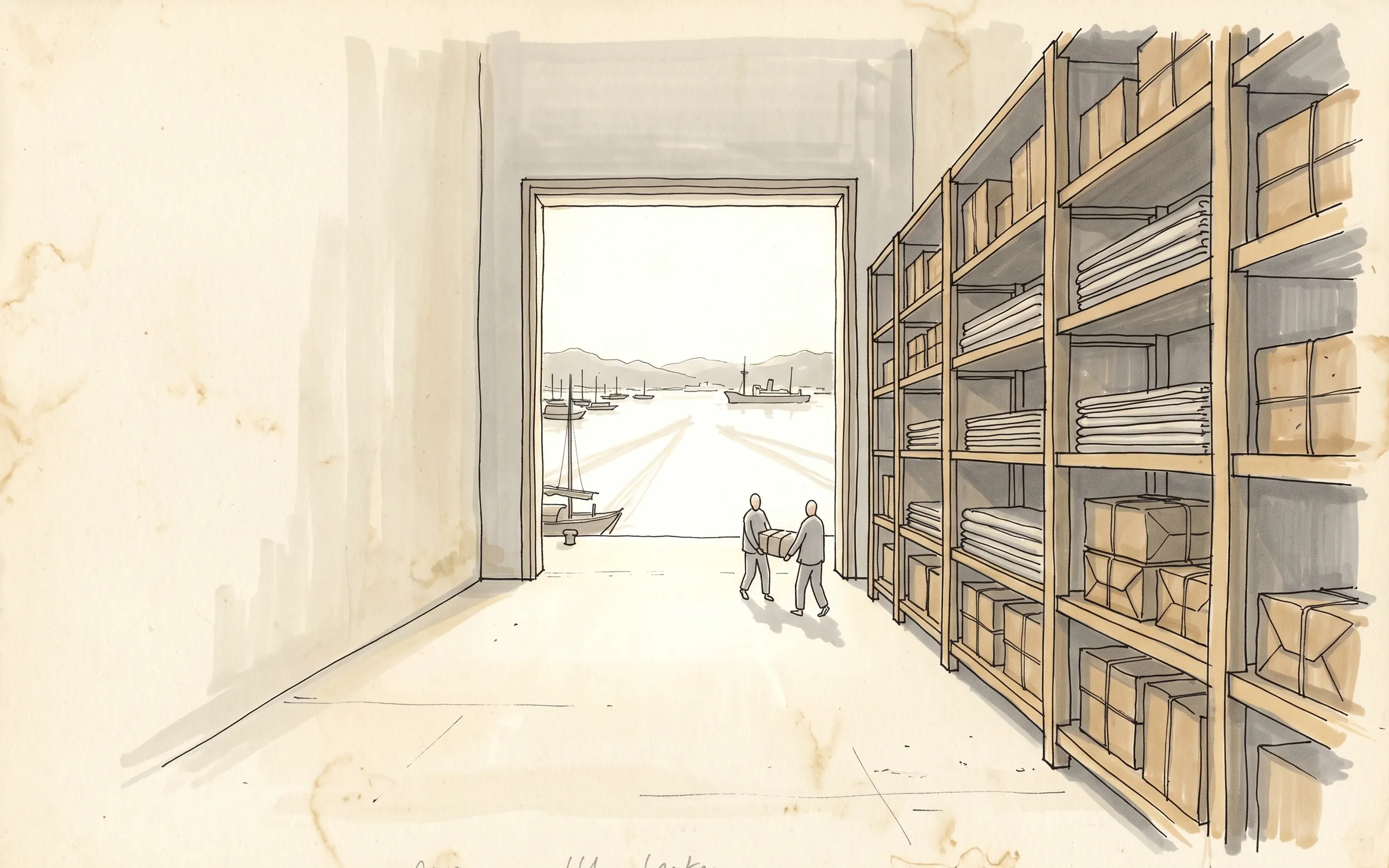
If your products are already manufactured in China, sending an entire collection across the ocean before you can start fulfilling customer orders is not always the only option.
A China fulfillment center lets ecommerce brands store inventory close to production, process orders in China, and ship parcels directly to customers in the US, UK, Europe, Australia, and other markets. For fashion brands, this can be especially useful because inventory is rarely simple: one style quickly becomes dozens of size and color combinations, while launches, replenishment, QC, and returns add more complexity.
The bigger question is not simply whether to fulfill from China. It is where in China your fulfillment operation should sit and how closely it connects to your factories, inventory, systems, and shipping network.
That is where Shenzhen becomes interesting. It combines access to South China’s manufacturing ecosystem with one of the country’s strongest international logistics networks - while giving fashion brands the opportunity to keep production, QC, inventory, and fulfillment much closer together.
Quick Answer
A China fulfillment center can make sense for fashion brands when products are manufactured in China but customers are spread across multiple international markets.
Shenzhen is particularly useful because it offers:
- Strong international air and parcel infrastructure
- Proximity to manufacturing across South China
- Faster movement from factory to warehouse
- Easier supplier communication and quality control
- One inventory pool for multiple global markets
- Access to international carriers and cross-border shipping routes
For fashion brands, however, location is only part of the decision. The warehouse also needs to manage size and color variants, garment handling, QC, packaging, ecommerce integrations, and seasonal order spikes.
What Is a China Fulfillment Center?
A China fulfillment center is a warehouse that stores ecommerce inventory in China, receives customer orders from online stores, picks and packs products, and ships them directly to customers internationally.
The basic model looks like this:
- Factory
- China Fulfillment Center
- International Customer
This differs from the more traditional model:
- Factory
- Ocean Freight
- Customs
- Overseas Warehouse
- Customer
Neither model is automatically better.
An overseas warehouse can offer very fast domestic delivery once inventory arrives. A China fulfillment model can reduce the amount of inventory that needs to be committed to one destination market before demand is known.
For a fashion founder, that distinction matters because inventory is seasonal and fragmented by variant. Sending six months of stock to one market may create a very different cash-flow problem from replenishing based on actual sell-through.
Why Shenzhen Matters for China Fulfillment
Shenzhen is not simply another Chinese warehouse location.
It sits inside one of the country’s most important export and logistics ecosystems. In 2025, Shenzhen recorded RMB 4.55 trillion in goods imports and exports, while its export value ranked first among mainland Chinese cities for the 33rd consecutive year. The city also handled more than 35 million TEUs through its ports. (Shenzhen Municipal Government, 2026)
For an ecommerce brand, those numbers matter because warehouse speed does not begin at the packing table. It depends on the network around the warehouse.
That includes:
- Factories and suppliers
- Domestic trucking
- Airports
- Customs infrastructure
- International carriers
- Parcel consolidation
- Last-mile connections
The international logistics industry is continuing to invest heavily in Shenzhen. In August 2026, DHL announced a €177 million expansion of its Shenzhen “Super Gateway” at Shenzhen Bao’an International Airport - its largest investment in mainland China to date. The expansion tripled the facility’s processing capacity to approximately 900 tons per day. (DHL, 2026)
That does not mean every parcel needs to ship with DHL. It does show why Shenzhen continues to matter as a cross-border logistics hub.
For brands choosing a fulfillment center in China, this surrounding infrastructure can influence how quickly inventory moves from production into the international shipping network.
The Bigger Advantage: Keeping the Warehouse Close to Production
A warehouse can ship an order quickly and still sit inside a slow supply chain.
Imagine a fashion brand producing a new collection in South China.
With an overseas fulfillment model:
Production → QC → export preparation → freight booking → international freight → customs → overseas receiving → inventory available
The customer cannot buy from that stock until several separate stages are complete.
Keeping the inventory in China changes the sequence:
- Production
- QC
- nearby fulfillment center
- inventory available
The international movement happens after the customer places an order rather than before the inventory becomes sellable.
This is where proximity creates a different type of speed.
It is not only about faster parcel delivery.
It can mean:
McKinsey identifies infrastructure, upstream supplier availability, logistics costs, and market adjacency as key factors companies should evaluate when deciding where manufacturing fits within a global supply chain. (McKinsey, 2026)
For fashion brands manufacturing in China, fulfillment location should be part of that same decision.
Why Fashion Brands Need More Than a Generic China 3PL
This is where China ecommerce fulfillment becomes very different for fashion.
A warehouse may be perfectly capable of shipping phone accessories and still struggle with apparel.
Consider a brand with:
20 styles × 5 sizes × 4 colors.
That is already 400 variants.
Now add a second seasonal collection, bundles, limited colorways, returned inventory, and replenishment arriving from several factories.
The warehouse is no longer storing “400 shirts.”
It is maintaining hundreds of separate inventory decisions.
A Black Medium and a Black Large may look almost identical when folded, but sending the wrong one means a return, replacement shipment, customer-service ticket, and potentially a lost customer.
That is why fashion-focused China fulfillment should include:
DHL’s own retail and fashion logistics guidance highlights inventory management, seasonal capacity, returns, distribution centers, and production-cycle management as central issues in fashion supply chains. (DHL, 2026)
The point is simple: fashion fulfillment is not generic pick and pack with nicer packaging.
Silk Road’s guide to apparel fulfillment services goes deeper into apparel-specific SKU management, garment handling, and order accuracy.
China Fulfillment Center vs Overseas Warehouse
Neither model wins in every situation.
The useful question is what happens to your inventory before and after a sale.
| Factor | China Fulfillment Center | US/EU Local Warehouse |
|---|---|---|
| Distance from China factory | Short | Long |
| Inventory available after production | Faster | Requires international inbound |
| Domestic customer delivery | Slower | Usually faster |
| Global inventory pool | Easier | Often split by market |
| Replenishment from China | Faster | Longer |
| Upfront inventory positioning | Lower | Higher |
| Factory/QC coordination | Easier | More distant |
| Local returns | Requires local solution | Easier |
| Best suited to | Global, China-made brands | High-volume single-market brands |
A fashion brand selling 80% of its orders in the United States at very high volume may eventually benefit from keeping significant inventory inside the US.
A younger DTC brand selling across the US, UK, Germany, Australia, and the Middle East may prefer not to split inventory five ways before knowing where products will sell.
This is one reason Silk Road’s current model uses one inventory pool in China to serve multiple international markets. Its Shopify integration keeps products, variants, orders, inventory, and tracking synchronized between the store and warehouse.
The better model depends on where your demand actually exists - not where you hope it will exist.
Why One Global Inventory Pool Matters for Fashion
Fashion makes inventory positioning unusually difficult.
Imagine you produced 1,000 units of a new collection and divided them between:
- 400 units in the US
- 250 in Europe
- 200 in the UK
- 150 in Australia
Then the collection unexpectedly goes viral in Australia.
You may have plenty of inventory globally while still stocking out where demand actually appears.
The problem is not total stock.
The problem is where the stock sits.
A centralized China warehouse can allow several markets to draw from the same inventory pool instead of committing units to individual countries before demand is clear.
That becomes particularly valuable for fashion because demand is rarely evenly distributed across:
- Sizes
- Colors
- Styles
- Countries
- Seasons
The same principle applies inside the warehouse.
If you own 1,000 hoodies but Medium Black is sold out, your total inventory number does not help the customer trying to buy Medium Black.
Fashion inventory should therefore be managed simultaneously at two levels:
Where is demand geographically?
and
Which exact variants are selling?
That is a more useful way to think about China warehouse fulfillment than simply asking how many square meters of storage a 3PL offers.
What to Look for in a China Fulfillment Center
A large warehouse is not necessarily a good fulfillment center.
Before choosing a China 3PL fulfillment partner, ask how the operation actually works.
1. How is inventory received?
Goods should not simply arrive and disappear onto shelves.
You need a clear receiving process covering quantities, SKUs, damage, QC status, and inventory availability.
2. Can the WMS handle fashion variants?
Ask whether size, color, style, and other variants are tracked independently.
For Shopify fashion brands, inventory should match what the customer can actually purchase online.
3. What prevents a wrong-SKU shipment?
“Experienced staff” is not enough.
Ask whether the warehouse uses barcode scanning or another verification step before packing.
4. How are fashion products handled?
Apparel may need folding or steaming. Jewelry may need its correct dust bag or box. Footwear needs the correct pair and undamaged packaging.
Silk Road’s current fashion fulfillment model specifically separates these requirements rather than treating every product as a generic parcel.
5. How does the warehouse connect with suppliers?
For brands manufacturing in China, a problem discovered at receiving may need to go straight back to the factory.
A fulfillment company that can communicate locally with suppliers can sometimes solve the problem before defective inventory reaches customers.
6. What happens with returns?
International returns are one of the main tradeoffs of fulfilling from China.
Shipping a returned hoodie thousands of kilometers back to Shenzhen often makes little economic sense. A serious provider should explain its local returns options honestly rather than pretending the problem does not exist.
Silk Road currently works with local-market return solutions where available, with coverage still developing market by market.
When a China Fulfillment Center Makes the Most Sense
China fulfillment is particularly worth evaluating when:
It may be less attractive when most of your volume is concentrated in one country and customers expect one- or two-day domestic delivery.
Very bulky or heavy products can also change the calculation because international parcel economics become less favorable as chargeable weight increases.
The right question is therefore not:
“Is China fulfillment better?”
It is:
“Which fulfillment model gives this brand the best balance of delivery speed, inventory flexibility, cost, and customer experience?”
Frequently Asked Questions
What does a China fulfillment center do?
A China fulfillment center receives and stores products, synchronizes ecommerce orders, picks and packs customer purchases, and ships them internationally. More advanced providers may also support inventory management, QC, supplier coordination, branded packaging, returns, and ecommerce integrations.
Is Shenzhen a good location for ecommerce fulfillment?
Yes, particularly for brands sourcing or manufacturing in South China. Shenzhen combines proximity to manufacturing networks with significant international logistics infrastructure. DHL’s 2026 expansion of its Shenzhen gateway is one recent example of continued investment in the city’s cross-border logistics capacity.
Can Shopify orders be fulfilled directly from China?
Yes. Shopify orders can flow automatically to a fulfillment center in China, where products are picked, packed, and shipped directly to international customers. Inventory and tracking can also sync back to Shopify when the warehouse system is properly integrated.
Is China fulfillment suitable for fashion brands?
It can be, particularly when products are manufactured in China and sold internationally. Fashion brands should choose a fulfillment center capable of managing size/color variants, garment QC, branded packaging, inventory synchronization, launches, and returns - not simply international parcel shipping.
What Fashion Founders Should Remember
The advantage of a China fulfillment center is not simply that the warehouse is located in China.
The real value comes from shortening the distance between manufacturing, QC, inventory, replenishment, and fulfillment.
Shenzhen strengthens that model because factories and suppliers across South China sit close to an international logistics network that continues to attract major investment.
For fashion brands, however, geography alone is not enough. The operation still has to handle the things that make fashion difficult: deep SKU matrices, uneven demand, product presentation, returns, launches, and fast-changing inventory.
If your products are already manufactured in China, compare the entire supply chain - not just the final shipping rate - before deciding where your inventory should live.