CJdropshipping can do far more than forward a product from a supplier to a customer. Its current 3PL service supports store integrations, pre-stocked inventory, custom packaging and quality checks, while its sourcing tools can help merchants find products from China. That makes it attractive to founders who want fewer systems to manage while they test and scale.
The harder question is what happens when a fashion brand needs more control than an all-in-one dropshipping workflow is designed to provide. A store selling one accessory is simple. A collection with five sizes, four colors, custom labels, gift packaging and repeat production is not. Once the business reaches that stage, CJdropshipping fulfillment is no longer only about convenience; it becomes a question of supplier ownership, inventory accuracy, QC, packaging SOPs and how closely fulfillment is connected to production.
The right answer is not that a dropshipping platform is “good” or “bad.” The useful question is which operating model matches the brand today - and what needs to change when the brand moves from testing products to building a repeatable fashion supply chain.
Quick Answer
- CJdropshipping can combine sourcing, store integration, private inventory, custom packaging and 3PL fulfillment in one platform.
- Its 3PL service also allows merchants to send products from their own suppliers into CJ warehouses, so sourcing and fulfillment do not have to come from the same company.
- Pre-stocking inventory reduces the delay between a customer order and warehouse dispatch because the product is already available for fulfillment.
- Fashion brands usually need more control when private-label changes, deep size/color variants, repeated QC issues or detailed packaging SOPs become central to the customer experience.
- The transition is usually gradual: test through an all-in-one workflow, pre-stock winning SKUs, then separate sourcing, production control and fulfillment when the operation becomes more complex.
What CJdropshipping Fulfillment Actually Includes
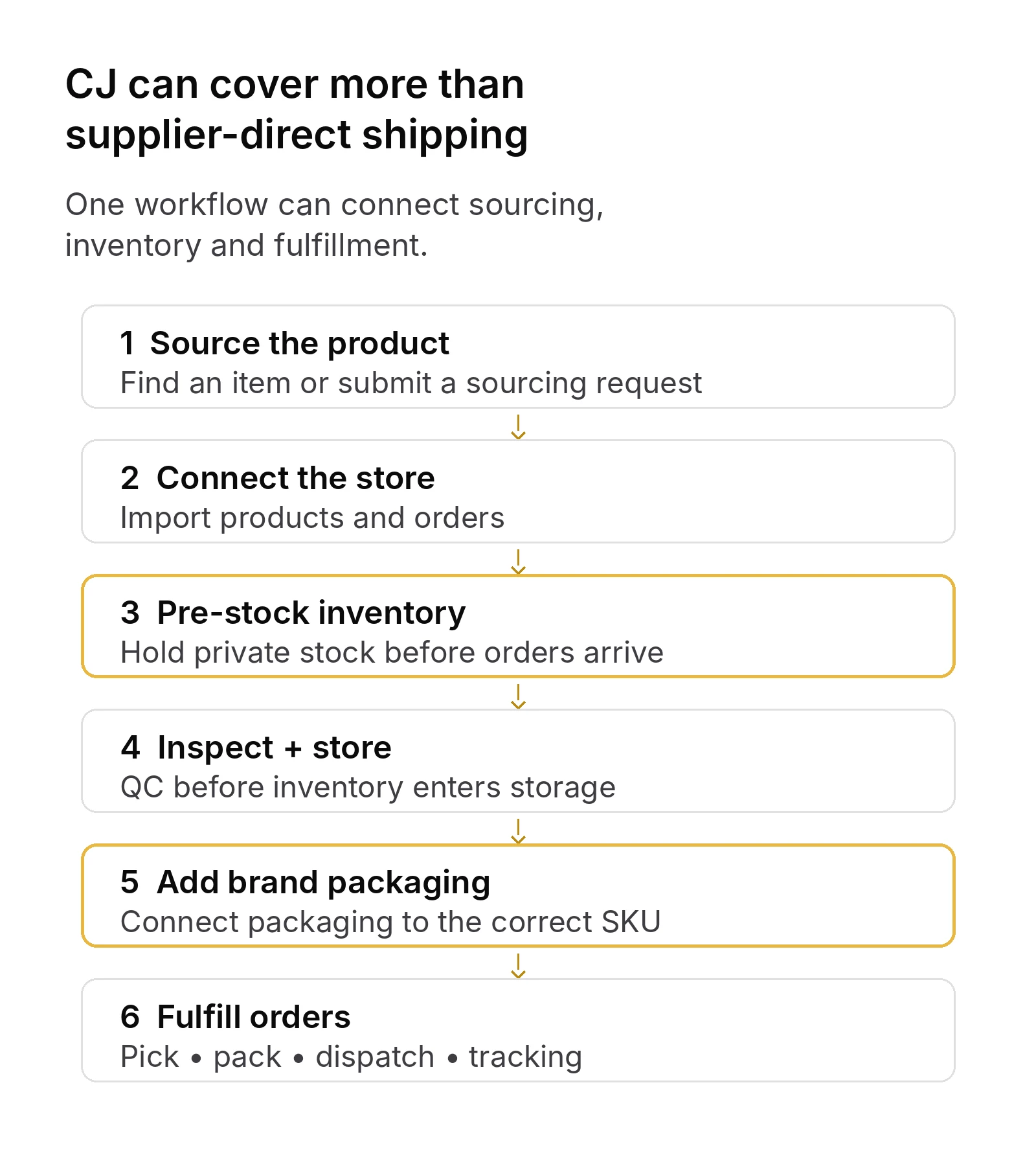
CJ’s current 3PL fulfillment service goes beyond supplier-direct dropshipping. CJ lists integrations with platforms including Shopify, WooCommerce, Etsy and TikTok Shop, and supports manual or automatic order import, custom packaging, pre-stocked inventory and warehouse quality checks.
That matters because “dropshipping” and “fulfillment” are not the same operating model. In a pure supplier-direct flow, the product may only be sourced after a customer order arrives. In a stocked fulfillment model, inventory is already in the warehouse. The warehouse can receive it, count it, inspect it, store it by SKU and release it when the connected store sends an order.
CJ’s help center explains the difference in practical terms: when a product has available CJ inventory, it can be dispatched from the warehouse after payment; when inventory is zero, the product must first arrive from the supplier before packaging and quality inspection.
Why This Model Works Well for Product Testing and Early Growth
An all-in-one platform is useful when the brand is still learning what sells. A founder can source a product, connect a store, fulfill initial orders and then pre-stock the winners instead of committing cash to every idea before launch. That reduces inventory risk while the catalog is still changing quickly.
CJ’s sourcing service says merchants can submit requests when a product is not already available on the platform, including sourcing from 1688, Taobao or AliExpress. That makes the platform useful as a bridge between product discovery and fulfillment, especially for stores testing several categories.
The limitation appears when the product stops being a simple listing. If the founder wants a new fabric, adjusted pattern, custom zipper, exact Pantone, woven label, care label and specific packaging, the job has moved into product development. The supplier now has to follow a specification, samples need approval, bulk production needs to match the approved version, and quality problems must be traced back to the production process rather than only the shipping process.
Your Own Supplier Can Still Use a CJ 3PL Workflow
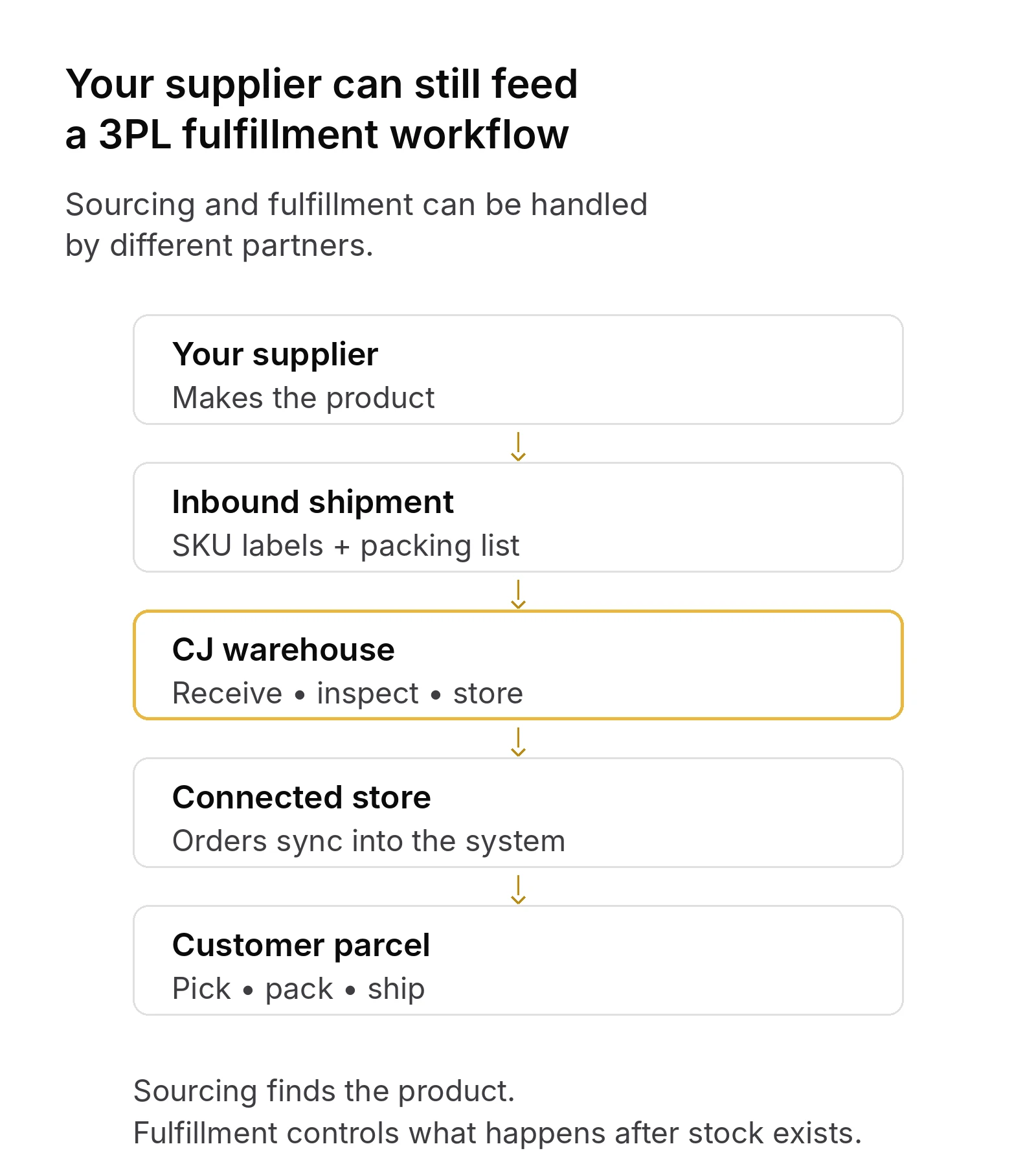
One useful feature of CJ’s 3PL workflow is that merchants can send their own products to CJ warehouses rather than relying only on products sourced through CJ. CJ’s help documentation also requires inbound labeling and inventory information so the warehouse can identify the correct SKUs.
This distinction is important for fashion brands. You may want one factory to manufacture the garment, another supplier to produce packaging, and a warehouse to handle fulfillment. Those roles do not have to sit under one vendor. In fact, separating them can be useful when the brand wants tighter control over the factory relationship while still outsourcing storage, picking, packing and international dispatch.
Where Fashion Complexity Starts to Change the Equation
Fashion becomes difficult because the warehouse is not managing one product name. A legging in five sizes and four colors is already 20 SKUs. Add a matching bra in the same matrix and the set creates 40 inventory positions before the brand adds a second fabric, inseam length or seasonal colorway.
That complexity changes what “good fulfillment” means. The warehouse needs to know which exact variant arrived, which one the customer ordered and which one is running low. A stock count of “200 black leggings” is not enough if Small is overstocked and Medium is almost sold out. The brand needs variant-level receiving, inventory, picking and replenishment decisions.
This is the point where a specialist fashion fulfillment operation can differ from a generic ecommerce workflow. Silk Road tracks inventory by style, color and size, and its order fulfillment process receives, stores, picks and packs inventory around those SKU-level distinctions.
Custom Packaging Is Not the Same as a Private-Label Supply Chain
CJ supports custom packaging, including bags, cards, stickers and other materials. Its guidance makes one operational detail especially clear: packaging has to be purchased, connected to the product and stocked in the correct warehouse before it can be used on an order.
That solves an important part of branding, but packaging alone does not create a private-label supply chain. If the actual product needs fabric approval, trim sourcing, sample revisions, measurements, construction tolerances, care labels or bulk inspection, those controls sit upstream of the warehouse. A nice mailer cannot compensate for a waistband that rolls, a zipper that changed between batches or a colorway that no longer matches the approved sample.
For brands already moving into that stage, Silk Road’s value-added services connect supplier coordination, sample follow-up, QC, packaging, kitting and SKU-level inventory inside the same China operation.
When an All-in-One Platform Stops Being Enough
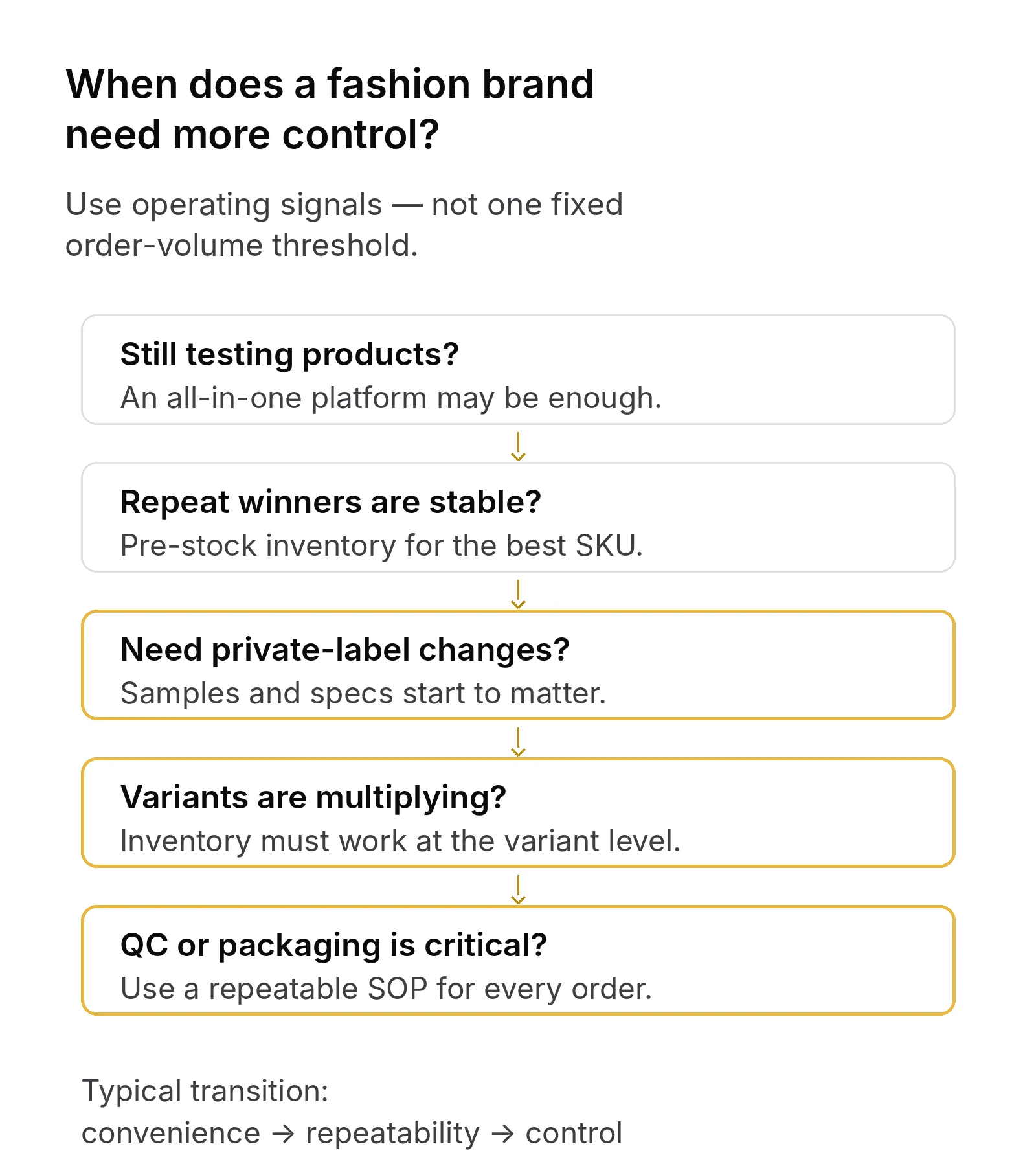
There is no fixed order count at which a fashion brand must leave a dropshipping platform. A simple accessories store may stay in an all-in-one model for a long time. A small activewear label may need a more specialized workflow much earlier because the product, variants and quality requirements are harder.
Private-label development becomes central. Once the brand is approving samples and changing construction, somebody needs to manage the supplier against a defined product standard.
Variant count starts multiplying. Five sizes × four colors is 20 SKUs before matching sets, inseam lengths or seasonal drops are added.
QC needs to happen before stock becomes customer inventory. Repeated shade, stitching, plating, measurement or label errors should be caught before orders start leaving the warehouse.
Packaging becomes an SOP, not an option. If tissue, cards, dust bags, garment bags or bundles must be packed in a precise order, the warehouse needs repeatable instructions.
The brand wants to control suppliers directly. A platform can still fulfill the orders, but the founder may prefer direct factory relationships for pricing, development, negotiation and production ownership.
How to Move From CJdropshipping to a More Controlled Fashion Supply Chain
The transition does not need to happen in one jump. Start by identifying the SKUs that already have repeat demand. Pre-stock those products so customer orders are not waiting on supplier sourcing. Then separate the decisions that belong to sourcing from the decisions that belong to fulfillment.
On the sourcing side, lock the supplier, sample, material, measurements, trims, labels, MOQ and bulk QC standard. On the fulfillment side, decide where inventory should sit, how each variant is identified, what packaging SOP the warehouse follows, how returns are graded and which shipping routes make sense by market. The more clearly those two systems are defined, the easier it becomes to change one partner without rebuilding the whole business.
For brands manufacturing in China, Silk Road’s broader sourcing and fulfillment services are built around that factory-to-warehouse handoff. Its fulfillment-center model uses Shenzhen as the primary hub and adds regional inventory only when demand makes that worthwhile, rather than forcing every SKU into every market from day one.
Frequently Asked Questions
Does CJdropshipping offer 3PL fulfillment?
Yes. CJ currently offers a 3PL fulfillment service that supports store integrations, warehouse stocking, custom packaging and order fulfillment. Its documentation also allows merchants to send their own products into CJ warehouses, so the products do not have to be sourced through CJ itself.
Can I use my own supplier with CJdropshipping?
Yes. CJ’s 3PL workflow allows merchants to send products from their own suppliers into CJ warehouses. That can be useful when you want to keep a direct factory relationship but still use a platform for inventory storage, order syncing, picking, packing and shipping.
Is CJdropshipping enough for a private-label fashion brand?
It can cover many fulfillment functions, but private-label fashion usually adds upstream work: sample development, fabric and trim control, production tolerances, bulk QC, labels and supplier management. The more customized the product becomes, the more important it is to manage production separately from the warehouse workflow.
When should a fashion brand move to a dedicated fashion 3PL?
Consider a specialist setup when size/color variants multiply, product QC becomes brand-critical, packaging requires detailed SOPs, supplier relationships need direct management or inventory planning becomes more complex than simple product-level stock counts. The trigger is operational complexity, not one universal order threshold.
Choose the Model That Matches the Brand You Have Now
CJdropshipping fulfillment can be a practical bridge between supplier-direct dropshipping and stocked ecommerce fulfillment. Its sourcing tools, private inventory, packaging and 3PL features reduce the number of systems a founder has to manage while demand is still being proven. The next stage begins when the product itself becomes harder to control: custom development, deep variants, repeat QC, precise packaging and direct supplier ownership. At that point, the brand should separate sourcing, production and fulfillment responsibilities clearly. The goal is not to change platforms for the sake of it; it is to build enough control that margin, inventory, quality and customer experience remain predictable as the collection grows.