Your approved sample can look perfect and the bulk order can still arrive wrong. That is one of the hardest lessons for a growing fashion brand. Production introduces repetition: hundreds of seams, labels, measurements, color lots, trims, prints, and packing decisions. A small misunderstanding that appears once in a sample can become 800 identical mistakes in bulk.
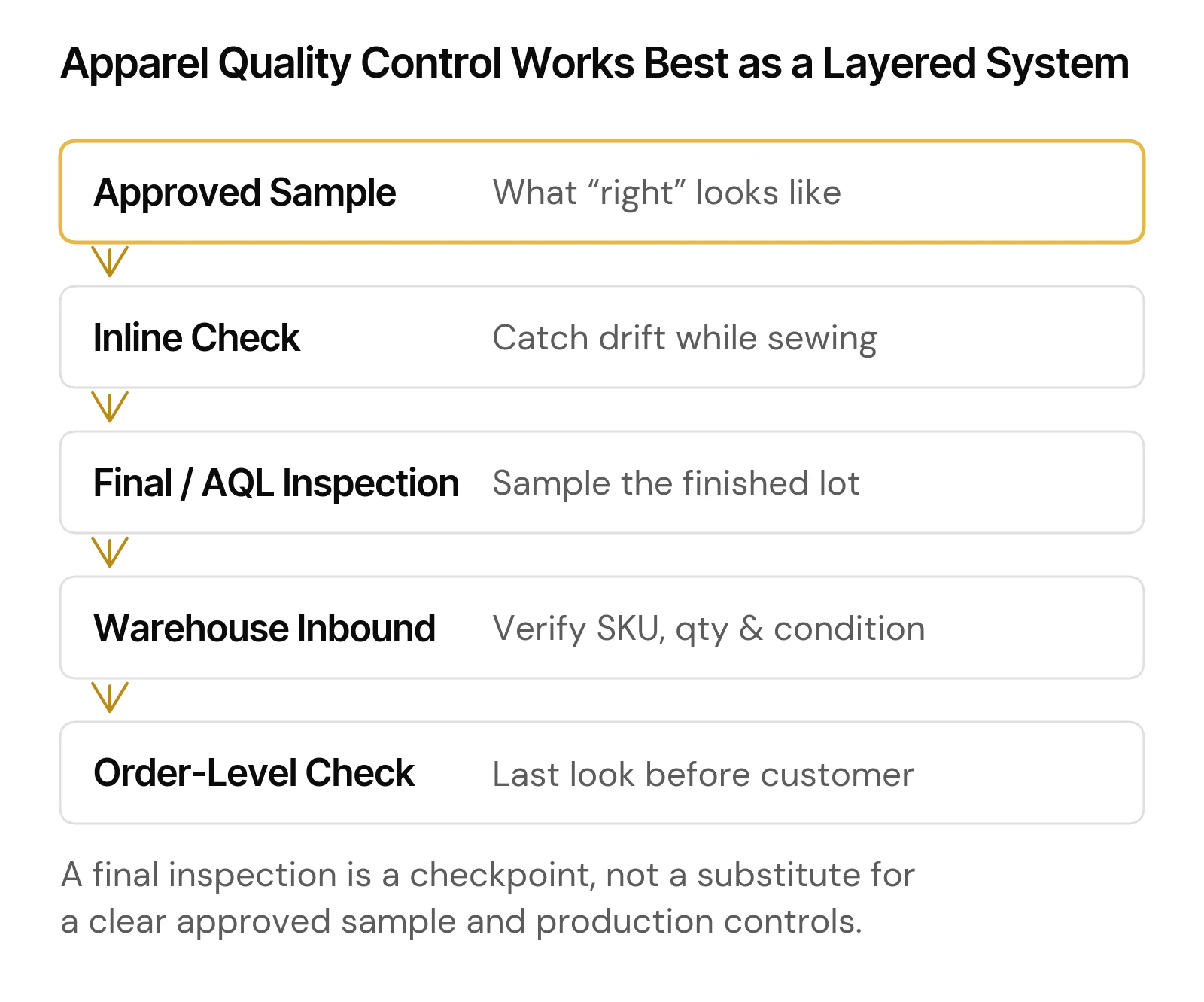
Apparel quality control is the system used to catch that drift before finished goods become customer complaints. For brands manufacturing in China, the strongest process does not wait until cartons are sealed. It connects the approved sample, inline production checks, pre-shipment inspection, warehouse receiving, and the final pick-and-pack check.
The goal is not to make every garment mathematically perfect. It is to define what is acceptable, identify defects that make a product unsafe or unsellable, and stop problems while they are still close enough to the factory to fix.
Quick Answer
- Approve a physical or clearly documented production sample before bulk production, then inspect bulk against that reference - not against memory or a WhatsApp photo.
- Check measurements, workmanship, fabric and color, trims, labels, printing/embroidery, SKU identity, and packing before goods leave the production area.
- Use AQL-based sampling as one inspection tool, not as a substitute for product specifications, regulatory checks, or process control.
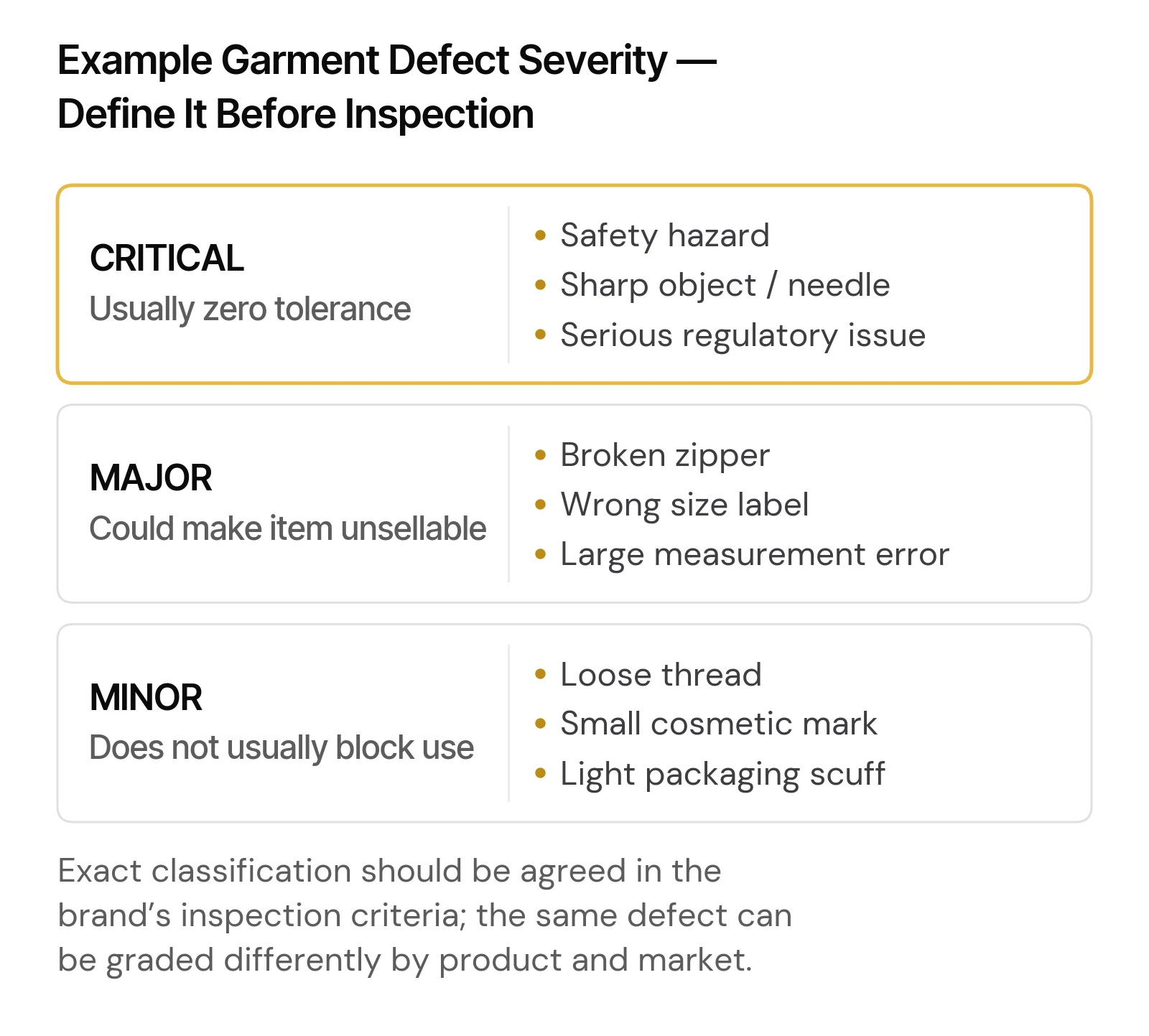
- Define critical, major, and minor defects before the inspector opens the first carton. If the classification is vague, the final report will also be vague.
- Keep QC close to production whenever possible. A defect is cheaper to correct in China before stock is freighted, customs-cleared, and received into an overseas warehouse.
Why an Approved Sample Does Not Guarantee Bulk Quality
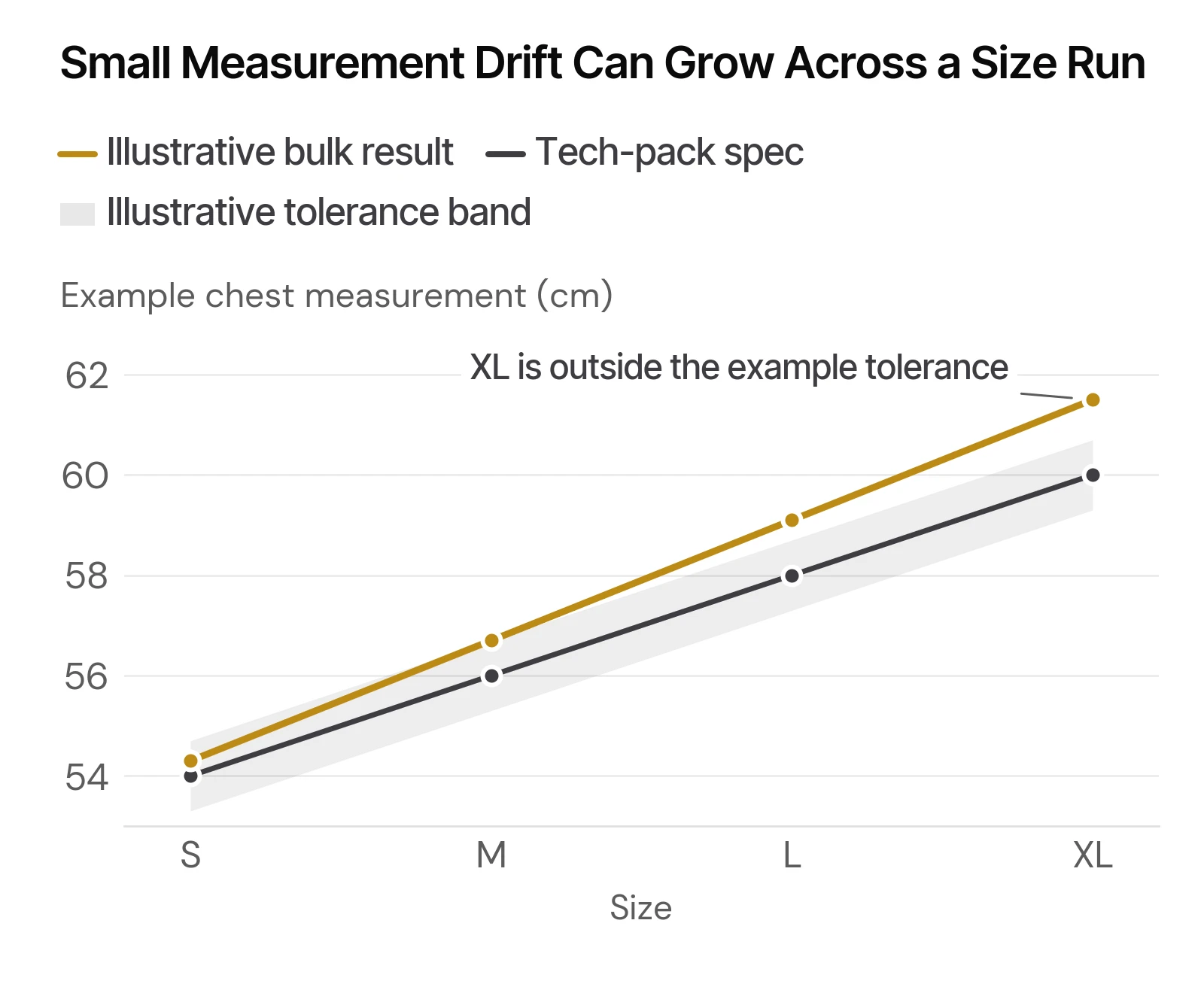
A sample is usually made with more attention than a production run. The factory may use its best operator, cut fabric carefully, and correct issues by hand. Bulk production is different: multiple operators, cutting lays, fabric rolls, machines, shifts, and packing stations all have to repeat the same result hundreds or thousands of times.
That creates production drift. A neckline can gradually stretch. Embroidery placement can move a centimeter. A substitute zipper can appear halfway through the run. A medium can still be labelled medium while measuring closer to the approved large. None of these problems are visible if quality control only asks, “Does this look roughly like the sample?”
For brands working through China, the practical advantage is proximity. Silk Road’s fashion fulfillment operation is built around size, color, style and presentation at the SKU level, while its fashion 3PL services connect factory coordination, sample management, QC and fulfillment inside the same Shenzhen supply chain.
What Should an Apparel Inspection Check?
A useful clothing inspection checklist starts with the product specification and then moves outward. The inspector should know which sample is approved, which tech-pack revision is current, which color standard applies, and what tolerance is allowed for each point of measurement.
| Inspection area | What to check | Typical failure |
|---|---|---|
| Measurements | Key points of measure, grading, symmetry, tolerance | Chest or inseam outside spec; left/right mismatch |
| Workmanship | Stitching, seams, hems, reinforcement, loose threads | Open seam, skipped stitch, puckering |
| Fabric & color | Shade, hand feel, stains, holes, panel consistency | Different dye lots within one garment |
| Trims | Zippers, buttons, snaps, drawcords, hardware | Wrong finish, missing component, broken zipper |
| Branding | Neck label, size label, hangtag, print, embroidery | Wrong size label or artwork placement |
| Packing | Fold, polybag, barcode, inserts, carton assortment | Correct garment packed under wrong SKU/barcode |
The SKU check is especially important for fashion. A carton can contain physically good garments and still be operationally wrong if the size labels, barcodes, or color codes do not match the inventory record. Once those units are received into a warehouse under the wrong SKU, the quality problem turns into a fulfillment problem.
This is why warehouse-side controls matter too. Silk Road’s value-added services include product checks and QC before issues become customer complaints, while the order fulfillment workflow adds receiving and order-level checks after production.
How AQL Inspection Fits Into Apparel Quality Control
ISO 2859-1:2026 is the current third edition of the international standard for acceptance sampling by attributes. It replaced the 1999 edition in January 2026 and provides AQL-indexed single, double, and multiple sampling schemes for lot-by-lot inspection.
In practical apparel QC, AQL is often used to decide how many finished units to inspect and how many classified defects can trigger acceptance or non-acceptance of a lot. The important point is that AQL is an acceptance-sampling framework - not a promise that every unit is perfect, and not a license to knowingly ship a fixed percentage of defective garments.
AQL also cannot rescue a weak specification. If the brand never defined the measurement tolerance, approved color, stitching requirement, or defect classification, the inspector has nothing objective to compare against. Good inspection starts before the sample size is chosen.
Define Critical, Major, and Minor Defects Before Inspection
Defect severity should answer a business question: what happens if this exact unit reaches a customer? A safety hazard or serious compliance issue belongs in a different category from a loose thread. A broken zipper is different again: it may not be dangerous, but it can make the garment unsellable.
The classification should be written before inspection begins. For one brand, a 5 mm embroidery shift may be minor. For a luxury logo placement, the same shift may be major. For children's products, safety-related components can carry much stricter treatment. The inspector should not invent the brand's quality standard on the factory floor.
QC Is Not the Same as Regulatory Compliance
A garment can pass a workmanship inspection and still fail the rules of the market where it is sold. That is why fashion founders should keep product QC and regulatory compliance connected but separate.
For the United States, the FTC Care Labeling Rule requires covered manufacturers and importers to provide regular care instructions for textile wearing apparel. A pre-shipment check should therefore verify that the correct care label is present and attached in the intended place.
U.S. apparel may also be subject to the CPSC Standard for the Flammability of Clothing Textiles under 16 CFR Part 1610. A visual warehouse check cannot replace required product testing or compliance documentation.
For the European Union, Regulation (EU) No 1007/2011 sets rules on textile fibre names and related fibre-composition labelling and marking. That means “correct label” is not only a branding detail; it may also be a market-access requirement.
Why Quality Control Is Cheaper Before Goods Leave China
The financial damage from a defect grows as the product moves farther from the factory. A wrong label caught on a production table may require relabelling. The same wrong label discovered after international freight can require warehouse labor, relabelling, inventory holds, customer-service work, or even a return and replacement.
This is one reason keeping production and fulfillment close together can be useful for fashion brands manufacturing in China. If the warehouse receives the goods soon after production, discrepancies can be photographed, counted, isolated, and taken back to the supplier while the people who made the order are still nearby.
Silk Road’s Shenzhen fulfillment-center model is designed around that handoff: production, quality control, receiving, inventory and dispatch remain inside one supply chain before selected inventory is moved to regional markets when demand justifies it.
A Practical Pre-Shipment QC Sequence
1. Lock the reference. Confirm the approved sample, tech-pack revision, color standard, trims and packaging SOP.
2. Define defect rules. List critical, major and minor defects and identify any zero-tolerance issues.
3. Verify production status. Inspect when enough of the order is finished to represent the lot, but while corrective action is still possible.
4. Inspect product and SKU identity. Check workmanship and measurements together with size labels, barcodes, colorways and carton assortment.
5. Separate compliance checks. Confirm required labels and documentation; arrange laboratory testing where the market or product requires it.
6. Record evidence. Use measurements, photos, defect counts and clear pass / hold / rework decisions rather than “looks OK.”
7. Recheck after rework. A failed lot should not become an accepted lot merely because the factory says the problem was fixed.
Frequently Asked Questions
What is apparel quality control?
Apparel quality control is the system used to verify that garments match approved specifications for measurements, workmanship, fabric, color, trims, labels, branding and packing. It can include sample approval, inline checks, final inspection, warehouse receiving checks and order-level inspection.
What is AQL in garment inspection?
AQL is an acceptance quality limit used within statistical sampling schemes. In garment inspection, it helps structure sample-based acceptance decisions for a production lot. It does not mean every inspected item must be perfect, and it should not replace a brand-specific defect list or product specification.
When should a pre-shipment apparel inspection happen?
It should happen late enough that the inspector can evaluate a representative quantity of finished goods, but early enough that the factory can still rework or replace defective units before shipment. The exact timing depends on production status and the inspection plan.
Can a fulfillment warehouse do apparel QC?
A warehouse can perform useful inbound and order-level checks, especially for SKU identity, visible defects, packaging and handling. More detailed production inspection is usually better performed before goods fully leave the manufacturing process, where corrective action is faster and cheaper.
The Best QC System Starts Before the Inspector Arrives
Apparel quality control is strongest when the brand has already defined what “correct” means. The approved sample, tech pack, tolerances, labels, defect classes and packing SOP should all point in the same direction. AQL sampling can then help test a finished lot, while warehouse receiving and order-level checks provide additional protection before the garment reaches the customer. For brands manufacturing in China, keeping QC close to production shortens the distance between finding a problem and fixing it - protecting margin, inventory, launch timing and the customer experience at the same time.