The expensive time to discover a clothing-label mistake is after 2,000 finished garments already have the wrong label sewn into the side seam. Maybe the approved sample said 100% cotton, but bulk fabric changed to 95% cotton and 5% elastane. Maybe the care instruction was copied from another style. Or the brand planned to sell in the United States but never added the required country-of-origin and business-identification information.
For fashion brands producing in China, clothing label requirements should be treated as part of product development - not a final packaging task. Fabric composition, destination market, care testing, label artwork, placement, and QC all need to line up before bulk production moves too far.
The rules are also not identical across markets. The United States, European Union, and Great Britain place different emphasis on fibre disclosure, country of origin, business identity, and care information. The safest workflow is to decide where the product will be sold first, then build the label specification into the production file before the factory prints thousands of labels.
Quick Answer
- In the United States, most covered textile and wool products must disclose fibre content, country of origin, and the identity of the manufacturer or another responsible business; covered wearing apparel also needs care instructions.
- EU Regulation 1007/2011 focuses on textile fibre names and fibre-composition labelling. It does not create a general EU-wide requirement for US-style care instructions or country-of-origin wording.
- Great Britain requires fibre-content labelling and says manufacturers and retailers are responsible for label accuracy.
- Approve label artwork only after the actual bulk fabric composition and destination markets are confirmed.
- Label QC should check content, placement, size/SKU mapping, permanence, and consistency with the approved product specification.
What Information Does a Clothing Label Actually Need?
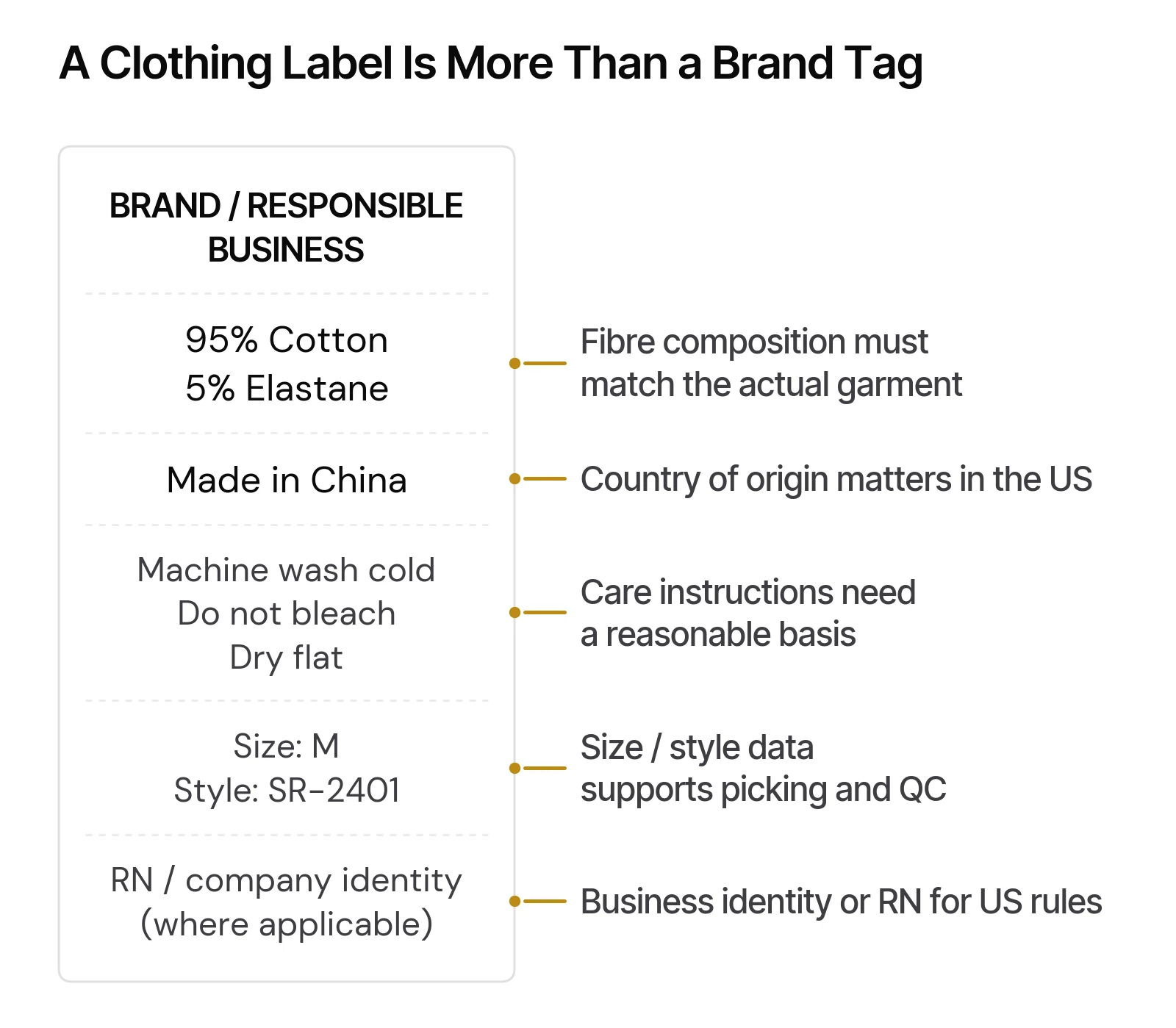
For US sales, the Federal Trade Commission’s textile-labeling guidance says most covered textile and wool products need labels identifying fibre content, country of origin, and the manufacturer or another business responsible for marketing or handling the item. A separate Care Labeling Rule requires manufacturers and importers of covered textile wearing apparel to provide care instructions.
That means a US-bound garment may need several kinds of information working together: what the product is made from, where it was processed or manufactured, who is responsible for it in the market, and how it can be cleaned without damage. The exact application depends on the product category, but the operational lesson is simple: the label specification belongs in the tech pack or production file before bulk labels are ordered.
US Clothing Label Requirements: Four Things Brands Commonly Miss
First is fibre content. The FTC generally requires the generic names and percentages by weight of constituent fibres in descending order for covered textile products. This is why a label reading “100% Cotton” cannot stay unchanged if the final bulk fabric becomes 95% cotton and 5% elastane.
Second is country of origin. The FTC guidance says imported covered textile products must disclose the country where the product was processed or manufactured, with origin determined under applicable Customs rules. “Designed in Los Angeles” does not replace the origin disclosure if the garment was manufactured in China.
Third is the responsible business identity. US textile rules allow the name of the manufacturer, importer, or another covered dealer, and eligible US businesses can use an FTC Registered Identification Number (RN) instead of the company name. An RN is an identification option, not a universal requirement for every fashion brand.
Fourth is care. The FTC Care Labeling Rule requires covered wearing apparel to carry regular care instructions that have a reasonable basis. A care label is not a decorative guess. If a wash method, drying temperature, bleach instruction, or dry-cleaning process can damage the garment, the instruction needs to reflect that reality.
EU and UK Textile Labels Follow a Different Framework
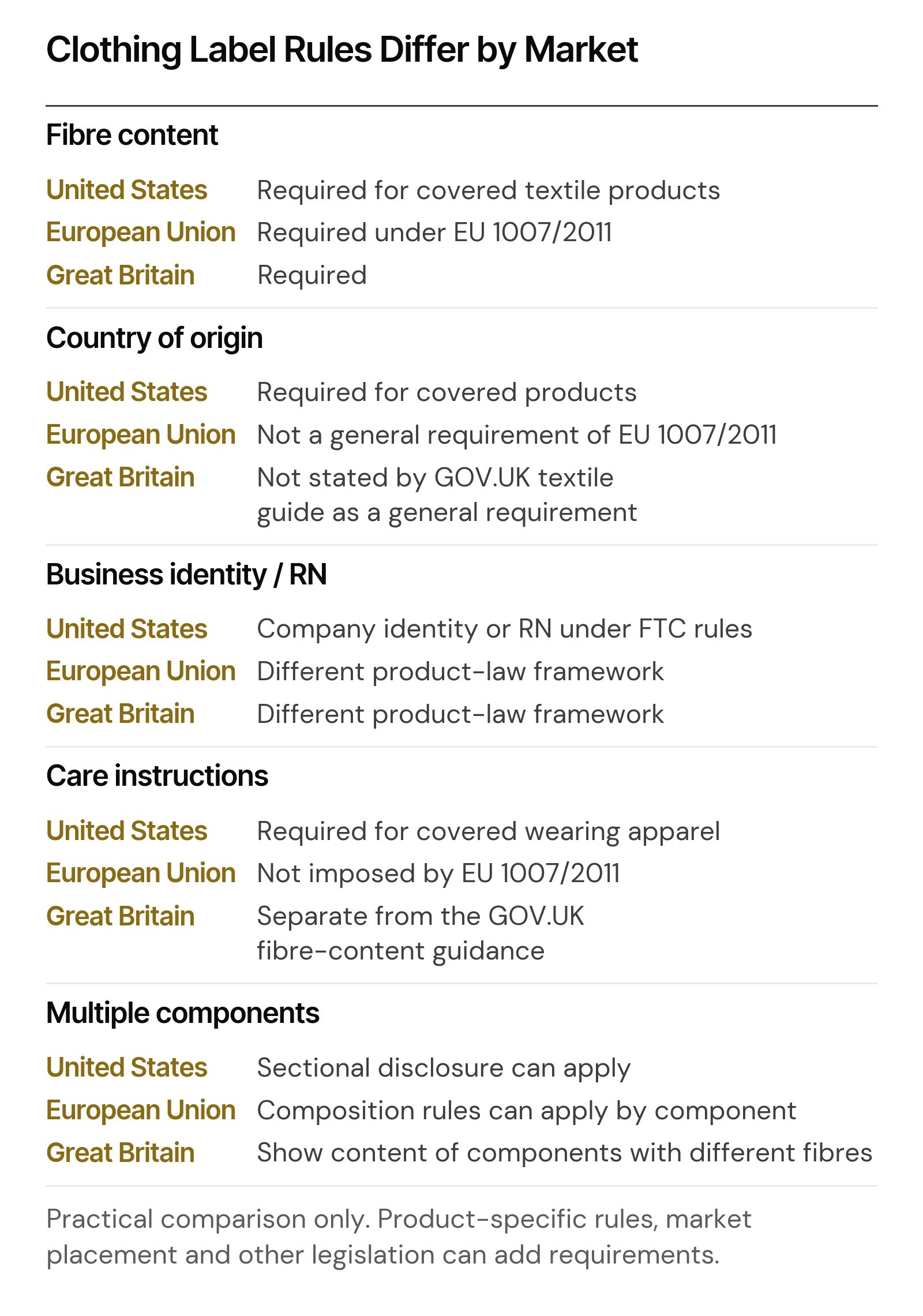
For the European Union, Regulation (EU) No 1007/2011 requires textile products to be labelled or marked with their fibre composition and restricts the fibre names that can be used. For multi-fibre products, the name and percentage by weight of constituent fibres are generally stated in descending order.
The important distinction is what the regulation does not do. Regulation 1007/2011 is a textile-fibre labelling law; it is not the source of a general EU-wide US-style care-label rule, and it does not create a blanket “Made in…” requirement for every textile product. Other product, customs, consumer, language, or national rules can still matter, so brands should not build one global label by copying the US version and assuming it covers Europe.
Great Britain has its own guidance. GOV.UK textile-labelling guidance says textile labels must show fibre content, including fur and other animal parts, and that products with two or more components containing different fibres should show the content of each. The guidance applies to England, Scotland, and Wales.
Why Fabric Approval Must Come Before Label Printing
Labels are downstream of materials. A fashion founder may approve a development sample made from 100% cotton, then change the production fabric because the first mill cannot meet MOQ, color, lead-time, or cost requirements. If the label artwork was already released, the factory can produce perfectly sewn garments carrying inaccurate composition information.
This is why fashion-grade fulfillment and handling starts upstream of the parcel. The product record should match the physical garment: style, colour, size, composition, packaging instructions, and any label information that the warehouse needs to verify.
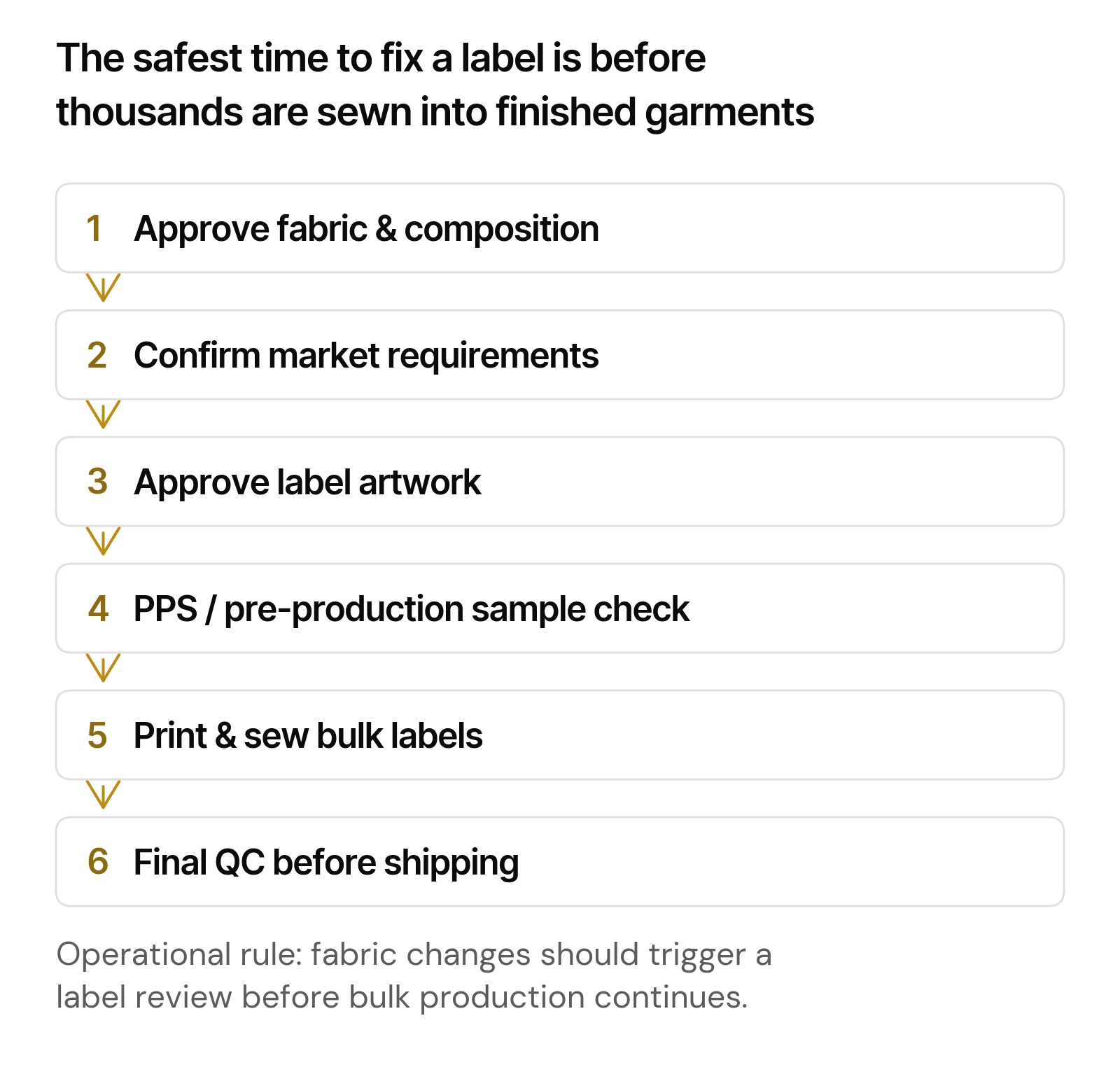
A practical rule is to freeze the label after three things are stable: the approved bulk fabric specification, the target sales markets, and the approved care method. If any of those change, the label goes back into review. That sounds slower during development, but it is far cheaper than unpicking and resewing thousands of finished units.
Labels Should Be a QC Check, Not Just a Factory Instruction
A factory can sew the label exactly where you asked and still ship the wrong information. Label QC therefore needs two layers: physical execution and data accuracy. Physical checks include placement, orientation, legibility, attachment, and whether the label is durable enough for the product. Data checks compare the printed information with the approved specification.
For a style with five sizes and four colours, the QC team should also verify that size labels and SKU mapping are not mixed. A beautifully printed Medium label sewn into a Large garment is still a fulfillment problem: the barcode, shelf location, ecommerce variant, and customer expectation all point to a different product.
Silk Road’s value-added services include QC, supplier coordination, kitting, and packaging work in China, while its order fulfillment operation tracks inventory by SKU and variant after goods enter the warehouse. That makes the production-to-fulfillment handoff a useful final point for catching label and SKU inconsistencies.
A Simple Pre-Production Clothing Label Checklist
1. Confirm the selling markets. Do not approve one “global” label before knowing whether the product will be sold in the US, EU, Great Britain, or elsewhere.
2. Lock the bulk fibre composition. Use the actual production fabric specification, not an early sample or supplier quotation.
3. Confirm the responsible business identity. For US products, decide whether the label uses an eligible company name or an RN where appropriate.
4. Substantiate care instructions. Use fabric/garment testing and supplier knowledge rather than copying care wording from a visually similar product.
5. Approve label artwork and placement. Check spelling, percentages, origin wording, size, style code, language needs, readability, and attachment position.
6. Verify the PPS or pre-production sample. Confirm the final garment carries the exact approved label before bulk sewing begins.
7. Recheck during final QC. Compare random finished pieces against the approved label master and SKU list.
Labels Are Becoming Product Data, Not Just Fabric Tags
For modern fashion brands, the information behind a label increasingly lives in several systems: the tech pack, fabric specification, factory purchase order, QC record, ecommerce product page, WMS, and compliance file. If those systems disagree, the sewn-in label becomes the visible symptom of a deeper data problem.
Silk Road’s broader 3PL and sourcing services connect factory coordination, quality checks, inventory, packaging, and fulfillment in one China-based operation. That same discipline also prepares brands for the direction of travel in product traceability: cleaner supplier records and product data are easier to reuse for future compliance needs.
Frequently Asked Questions
Does clothing made in China need a “Made in China” label for the US?
For covered textile products sold in the United States, FTC rules require country-of-origin disclosure, with origin determined under applicable Customs rules. If the garment’s origin is China, the required origin statement should accurately communicate that fact.
Do I need an RN number on clothing sold in the US?
Not necessarily. The FTC allows eligible businesses to use a Registered Identification Number instead of the company name on covered textile labels. The label still needs the required responsible-business identification, but an RN is one permitted method rather than a universal requirement.
Does the EU require care instructions on clothing?
EU Regulation 1007/2011 governs textile fibre names and composition labelling. It does not itself create a general EU-wide care-instruction requirement comparable to the US FTC Care Labeling Rule. Other laws, standards, national practices, or retailer requirements may still apply.
When should a fashion brand approve clothing labels?
After bulk fabric composition and target markets are confirmed, but before bulk label printing and sewing. A pre-production sample should then be checked to make sure the physical label matches the approved artwork and product specification.
Treat the Label as Part of the Product
A clothing label is small, but fixing it late can be expensive. The reliable sequence is to confirm the market, approve the real bulk material, substantiate care instructions, finalize label artwork, check it on the pre-production sample, and verify it again during QC. Fashion brands producing in China should make label data part of the same operating system as fabric, tech packs, SKU mapping, and fulfillment. That reduces rework, protects customer trust, and makes future product-data requirements easier to manage. When the label changes, the product specification should change with it - and vice versa.