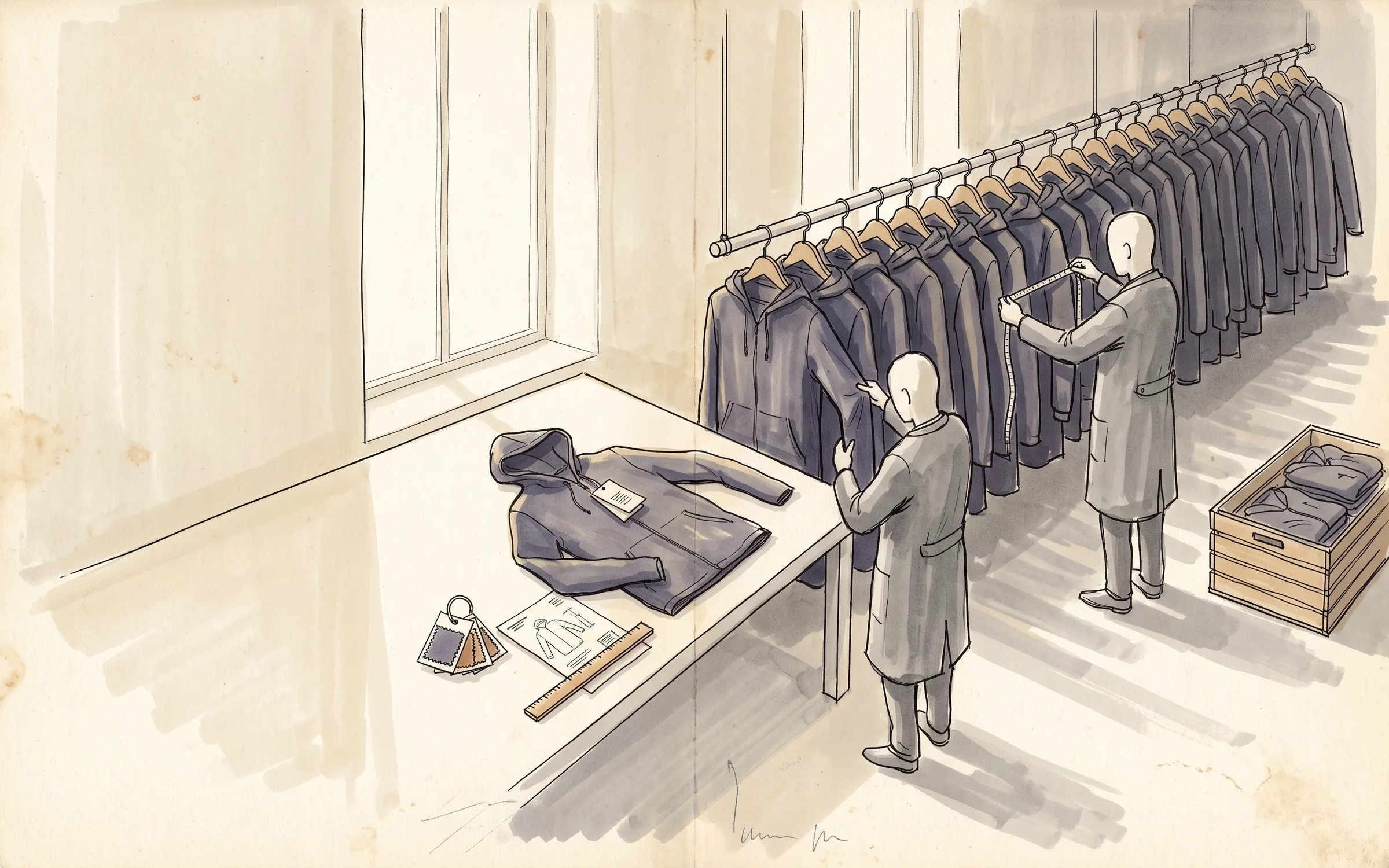
Your clothing sample arrives and looks almost perfect. The fabric feels right, the fit is approved, the wash is exactly what you wanted, and the embroidery sits in the correct position.
Then 1,000 units of bulk production arrive - and somehow the product feels different.
The black is slightly darker. Medium sleeves are longer. Some embroidery sits a few millimeters off-center. One production batch uses a zipper that does not feel quite like the approved version.
This is one of the most frustrating parts of fashion manufacturing, but it is not unusual.
The key difference between sample vs bulk production is scale. A sample proves that a factory can make one garment to a specification. Bulk production tests whether the factory can reproduce that specification hundreds or thousands of times across different workers, material lots, machines, sizes, and production days.
For fashion brands, the objective is therefore not simply to approve a good sample. It is to turn that sample into a controlled production standard.
Quick Answer
To reduce differences between clothing samples and bulk production:
- Approve a clearly identified final sample before bulk production
- Keep the tech pack, measurements, materials, trims, and sample aligned
- Define acceptable production tolerances in advance
- Confirm bulk fabric, colors, labels, and trims before cutting
- Inspect production while goods are still being made
- Use a final inspection before the order leaves the factory
The biggest mistake is treating sample approval as the end of product development. It should be the beginning of bulk production control.
What Is the Difference Between Sample and Bulk Production?
Sample production creates a small number of garments to confirm design, fit, construction, materials, and finishing before full manufacturing. Bulk production is the repeat manufacturing of the approved product at commercial scale across the complete order quantity.
The two processes may use the same specification, but they do not necessarily use the same production conditions.
A sample might be made:
- By an experienced sample machinist
- One piece at a time
- With extra attention
- Using available sample fabric
- Without production-line pressure
Bulk production may involve:
That transition creates more opportunities for variation.
A useful way to think about it is:
A sample tests whether the product can be made. Bulk production tests whether the process can repeat it.
Why a Perfect Clothing Sample Can Become Inconsistent in Bulk
There is rarely one single reason bulk production differs from the approved sample.
Usually, several small changes accumulate.
Imagine a streetwear brand approves a 450 GSM washed-black hoodie.
The approved sample has:
The factory then produces 1,000 units.
During bulk production, the fabric comes from a different dye lot. The washing process behaves slightly differently at scale. Medium and Large garments are cut on different lays. A second embroidery machine is used during the final production days.
None of those changes automatically means the factory is bad.
But together they can create a product noticeably different from the approved sample.
This is why a sample cannot be the only quality standard.
The factory also needs documentation explaining what exactly made that sample acceptable.
| Sample Risk | What Can Change in Bulk | What to Control |
|---|---|---|
| Fabric | Weight, shade, hand feel | Bulk fabric approval |
| Fit | Measurements across sizes | Measurement tolerances |
| Wash | Color and finish | Wash standard/reference |
| Trims | Zippers, buttons, hardware | Approved BOM |
| Decoration | Print/embroidery position | Placement specification |
| Labels | Size/care/brand labels | Label checklist |
| Workmanship | Stitching consistency | Inline and final QC |
Lock the Approved Sample Before Bulk Production Starts
Fashion sampling often involves several revisions.
Sample 1 has the right fabric but the wrong fit.
Sample 2 fixes the fit but uses the wrong zipper.
Sample 3 is approved after changing the sleeve length.
Now imagine the factory production team receives a mix of:
- An old tech pack
- Photos from Sample 2
- Messages about Sample 3
- A trim list that was never updated
The founder believes everything is clear because they remember the development process.
The production line sees conflicting instructions.
That is how avoidable mistakes enter bulk clothing production.
Before approving production, there should ideally be one clear reference package containing:
The physical approved sample is often called a reference or “golden” sample in quality-control workflows. QIMA likewise defines a reference sample as a benchmark used during inspection (QIMA).
The point is not terminology.
The point is making sure the factory, inspector, and brand are all comparing bulk production against the same approved product.
Production Tolerance Matters More Than Perfect Measurements
Clothing is not machined metal.
There will be some variation in bulk production.
The question is how much variation your brand considers acceptable.
Suppose the tech pack specifies:
Chest width: 58 cm
If one garment measures 58.2 cm, that is probably not a meaningful quality problem.
If another measures 61 cm, it probably is.
This is where production tolerances matter.
QIMA’s garment inspection guidance recommends defining points of measurement and acceptable tolerances so inspectors can compare finished garments against the specification consistently. It also notes that the same numerical deviation may matter differently depending on where it occurs on the garment (QIMA).
Fashion founders should therefore avoid vague QC instructions such as:
“Measurements should be close to the sample.”
Instead, specify what variation is acceptable for important points such as:
- Chest
- Body length
- Sleeve length
- Shoulder width
- Waist
- Inseam
- Neck opening
The same thinking applies beyond measurements.
You may accept a tiny variation in internal label placement but reject a visibly crooked chest embroidery.
Quality control becomes much easier once “good enough” has an objective definition.
Fabric and Trims Can Change Even When the Pattern Does Not
Some of the biggest differences between clothing sample vs production have nothing to do with sewing.
Materials change.
A sample may be produced using fabric from an available roll. Bulk production might require the mill to manufacture or dye an entirely new lot.
That can affect:
- Shade
- GSM
- Shrinkage
- Surface texture
- Stretch
- Hand feel
- Wash behavior
The same problem applies to trims.
If the approved zipper is unavailable when production begins, replacing it with something “similar” might seem minor to the factory. For a premium fashion brand, the difference can be immediately noticeable.
That is why the bill of materials matters.
If a product depends on a particular:
fabric + zipper + rib + thread + label + drawcord + hardware
those components should be controlled rather than left open to substitution.
This connects directly with Clothing MOQ: What Fashion Founders Need to Know. Sometimes the factory is willing to make 300 garments, but the fabric or trim supplier needs a larger production run. Changing materials to achieve a lower MOQ can unintentionally change the finished product.
Don’t Wait Until Production Is Finished to Start QC
Finding a defect on garment number 40 is useful.
Finding the same defect after 4,000 garments have been completed is expensive.
That is why garment production quality control should happen at more than one point.
A practical workflow can look like:
- Approved Sample
- Pre-Production Check
- Inline Production Check
- Final Inspection
- Warehouse Receiving
Early checks answer questions such as:
- Is the correct fabric being used?
- Are the correct trims available?
- Does the production team understand the approved specification?
- Are early garments measuring correctly?
QIMA describes initial production checks as a way to verify raw materials, factory setup, and understanding of buyer specifications before problems spread through the production run (QIMA).
Inline inspection is especially useful for repeatable errors.
If every Medium sleeve is being sewn 1.5 cm too long, discovering that while only 15% of production is complete creates a very different problem from discovering it at 100%.
The closer QC happens to the moment a defect is created, the cheaper that defect usually is to correct.
What AQL Can - and Cannot - Tell You About Bulk Quality
For larger orders, brands commonly use statistical sampling rather than inspecting every finished unit.
One widely used framework is AQL, or Acceptance Quality Limit.
ISO 2859-1:2026 defines AQL-indexed sampling schemes that allow a production lot to be evaluated using a statistically determined sample rather than examining every unit (ISO).
QIMA explains that inspectors typically classify findings as:
- Critical defects
- Major defects
- Minor defects
and use the selected AQL and lot size to determine sample quantities and accept/reject thresholds (QIMA).
But AQL does not decide what your brand considers a defect.
You still need to define the standard.
For one premium hoodie brand:
- Wrong size label may be major
- Broken zipper may be major
- Serious safety issue may be critical
- Loose internal thread may be minor
Another brand may classify those differently.
AQL is therefore a sampling framework, not a substitute for your tech pack, approved sample, measurement tolerances, or QC checklist.
The Warehouse Can Be the Last Quality Check Before the Customer
Production QC should happen at the factory, but the warehouse still has an important role.
Imagine 2,000 garments pass final inspection and move into fulfillment.
During receiving, the warehouse discovers:
- Carton quantities do not match the packing list
- Two size barcodes are reversed
- Some garments have damaged polybags
- Several shoe boxes were crushed in transport
- One jewelry colorway has the wrong dust bag
These are not always manufacturing defects.
But they can still create customer problems.
For fashion brands manufacturing in China, keeping the factory, QC team, and fulfillment operation geographically close can make these issues easier to resolve.
Instead of:
- Factory
- International Freight
- Customs
- Overseas Warehouse
- Problem Found
the issue may be discovered while the supplier is still nearby.
That is one reason Silk Road combines sourcing, supplier communication, QC, inventory, and fashion fulfillment from Shenzhen.
This stage sits inside the wider process described in Silk Road’s guides to fashion sourcing in China and finding clothing manufacturers in China, and what happens to the goods once they are approved is covered in China Fulfillment Center: Why Shenzhen Matters for Fashion Brands.
Bulk Production Control Matters Even More When Supply Chains Change
Fashion sourcing is becoming less predictable.
For growing brands, that makes process discipline more valuable.
If you move production between suppliers, add a second factory, or shift some manufacturing to another country, an undocumented standard is difficult to reproduce.
A well-controlled product is portable.
The tech pack, reference sample, material specifications, tolerance sheet, and QC checklist explain what the product is supposed to be even when the production environment changes.
That matters much more as a fashion brand scales beyond one factory relationship.
Frequently Asked Questions
Why does bulk production look different from the sample?
Bulk production introduces more variables than sampling, including different workers, larger fabric lots, multiple machines, size grading, production speed, and material batches. Differences become more likely when the approved sample, tech pack, trims, tolerances, and production standards are not clearly locked before manufacturing begins.
What is a pre-production sample in clothing manufacturing?
A pre-production sample is a garment approved before the main production run begins. It should reflect the final materials, construction, fit, trims, colors, labels, and other agreed specifications as closely as possible, providing a reference for the factory and quality-control team during bulk manufacturing.
Should every garment be inspected during bulk production?
Not necessarily. Some products or high-risk requirements may justify 100% inspection, but larger production orders commonly use statistical sampling. ISO 2859-1 provides AQL-based sampling plans designed to assess production lots without examining every unit.
What should I check before approving bulk clothing production?
Confirm the final sample, tech pack, measurement chart, tolerances, fabric, trims, colors, labels, packaging, SKU requirements, production timeline, and QC plan. If any of those are still changing, the product is not really ready for bulk production.
What Fashion Founders Should Remember
The biggest lesson from sample vs bulk production is that approving one good garment does not guarantee one thousand consistent garments.
Sampling proves the design. Production control protects the result.
Fashion brands need one approved reference, clear specifications, realistic tolerances, material control, and quality checks before defects spread through the full order. Those decisions affect much more than factory quality: they influence launch timing, inventory value, returns, margin, and customer trust.
For brands manufacturing in China, keeping production, QC, and fulfillment connected can also make problems easier to identify and correct before finished inventory travels further down the supply chain.