A supplier offers your brand two fabrics for the same pair of leggings: a nylon and spandex knit that feels smooth in the hand, and a polyester and spandex knit with a lower quote. Which one should you buy? The fiber names alone cannot answer. The fabric's construction, weight, stretch recovery, opacity, dyeing and tested performance determine how the garment behaves after a workout and repeated washing.
This guide compares the three fibers, then shows how to turn a promising China sample into a repeatable production specification. The central rule is simple: approve the finished fabric and its test results before approving bulk cutting.
Quick Answer
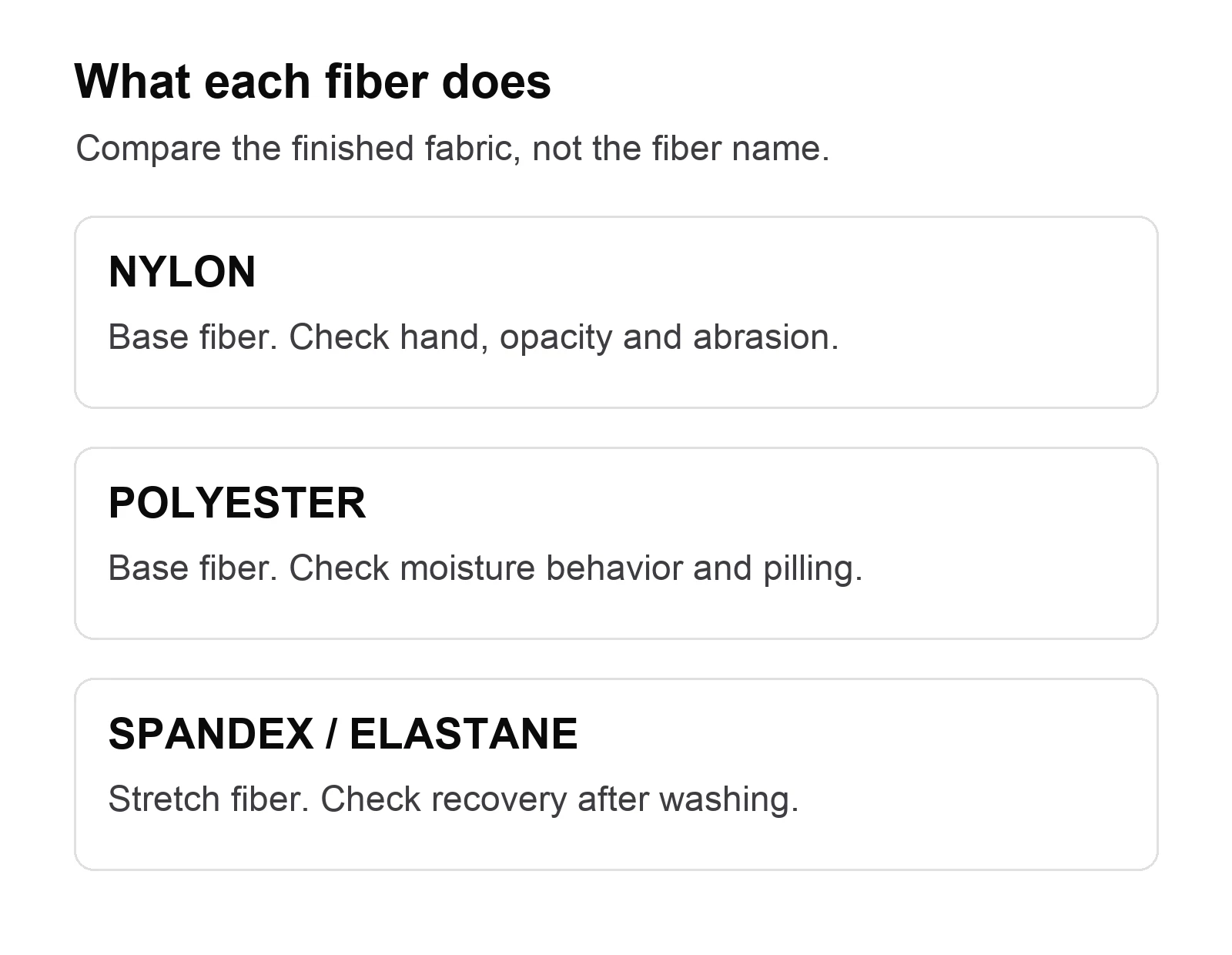
- Nylon and polyester are usually the main fibers that give activewear fabric its body. Spandex, also called elastane, is typically blended in to provide stretch and recovery.
- Nylon can suit a smooth, close-fitting legging; polyester can suit a lightweight training top. Neither choice guarantees comfort, moisture management or durability without testing the actual fabric.
- Set performance targets by garment and end use, then compare swatches of the same construction and similar weight. A price comparison between unlike fabrics is misleading.
- Ask the mill and garment factory to identify the production lot, confirm test methods and approve a preproduction sample before bulk cutting.
Nylon, Polyester and Spandex Do Different Jobs
The distinction starts with fiber identity. The EU textile regulation lists polyamide or nylon, polyester and elastane as separate fiber names. In US terminology, spandex and elastane refer to the same generic stretch fiber. LYCRA is a brand name, not a generic fiber name. That matters when a supplier quotation, a lab report and a care label use different words for the same component. See the EU fiber-name regulation, FTC textile labeling guidance and LYCRA's terminology explanation.
For sourcing, think of nylon and polyester as possible base fibers and spandex as a stretch component. A mill can knit the same nominal blend into a dense interlock, a light jersey or a rib. Those fabrics will not fit, cover or dry identically. Finishes and yarn design can also change the result. The comparison that counts is a comparison between production-ready fabrics made for the same garment.
Nylon for a smooth, hard-wearing hand
Nylon is often selected when a brand wants a soft, sleek surface in fitted bottoms or swim and studio wear. Its abrasion resistance is a useful starting point for garments exposed to repeated rubbing. Yet a silky swatch is not proof that finished leggings will pass a squat test, retain their shape or keep their color after perspiration. Fiber properties do not replace fabric and garment testing. The University of Georgia's fiber reference describes nylon's strength and abrasion resistance while also noting its heat sensitivity.
Compare nylon candidates at the same finished weight and construction. Ask whether the quoted fabric is polyamide 6 or 6.6 if that distinction affects the approved spec. Record the exact blend, yarn, gauge or knit structure, usable width, finish and color standard. If a supplier substitutes yarn or finishing chemistry later, require reapproval.
Polyester for versatile, scalable styles
Polyester appears in running tees, training tops, shorts, linings and outer layers because it can be made into many fabric structures and finishes. It is not automatically a better moisture manager than nylon. AATCC TM195 measures liquid moisture management in the fabric, and engineered polyester yarns can behave differently from ordinary yarns. A supplier should support a wicking claim with a test on the actual finished fabric, ideally after agreed wash cycles.
For lightweight tops, check whether the fabric becomes clingy when damp, shows sweat marks, pills under a backpack strap or changes appearance after washing. For leggings, check opacity and recovery as closely as price. Polyester can be a good choice in either product when its construction meets the brief. The fiber name is only the first line of the specification.
Spandex supplies stretch, not the whole performance story
Spandex, or elastane, gives a blend its ability to extend and return. More spandex is not a universal shortcut to a better legging. Support also depends on knit density, yarn tension, pattern, seams and garment sizing. Too little recovery can create bagging at the knees or waistband; a fabric that feels tight on the hanger may still lose shape after repeated wear.
Request stretch and recovery data in both fabric directions. Ask how the mill measures growth after extension and how performance changes after washing. If your brief includes heat-setting, printing or high-temperature finishing, confirm the process against the chosen elastane and approve a finished sample. The ISO textile test catalogue includes methods for elastic properties; agree on the precise method and acceptance threshold with your testing partner.
Compare Fabrics by Garment, Not by Fiber Ranking
A nylon-rich interlock can be a strong candidate for premium studio leggings if it passes opacity, stretch recovery, abrasion and colorfastness checks. A polyester-rich jersey may work better for a light running tee if its measured moisture management, drape and drying behavior suit the intended use. A sports bra may need a different modulus, lining and construction from leggings even when both share the same nominal blend. A woven warm-up jacket may need little or no spandex if the pattern supplies enough ease.
These are starting hypotheses, not fixed recipes. Ask each supplier to provide a sample made to your target garment and a written test report. Compare candidates with the same size, color and wear conditions. A black fabric that passes opacity can behave differently in a pale color, so approve the actual colorway when coverage matters.
Build a Fabric Specification That a Mill Can Repeat
Before requesting a bulk quote, put these fields into one approved fabric sheet:
The sheet should travel with the tech pack. Silk Road's fabric sourcing in China guide explains why swatches, sample yardage and bulk-lot approval need separate checkpoints. The same discipline should apply when a garment factory purchases fabric from a mill on your behalf. Know the mill and lot behind the finished garment, not just the factory's style code.
Test the Risks That Customers Will Notice
Set the pass criteria before testing. An ISO or AATCC method describes how to test; it does not automatically set a universal acceptable grade for every activewear product. A running top and a compression legging may need different limits.
For leggings, prioritize opacity at stretch, elastic recovery, pilling and abrasion where thighs or equipment rub, and dimensional change after washing. For tops, emphasize moisture behavior, shape retention, surface appearance and colorfastness. Perspiration can reveal dye transfer even when a dry swatch looks stable. Useful method references include ISO 12947-2 for abrasion, ISO 12945-2 for pilling, ISO 105-E04 for perspiration colorfastness, ISO 5077 for dimensional change and AATCC TM195 for moisture management.
Keep one sealed reference sample and its report for each approved fabric and color. During production, compare bulk rolls with that reference, then inspect finished garments. See Silk Road's apparel quality control in China guide for the broader inspection sequence. A lab pass on sample yardage does not prove that every later dye lot or sewing batch matches it.
Source in China Without Losing Control of the Fabric
Start with a product brief, not a request for the supplier's cheapest "high-quality sports fabric." Send target garments, customer use, reference swatches, required colorways, expected order volume and the test list. Then compare mills and garment factories separately. A factory with excellent stitching may still buy fabric from a mill you have never approved. Silk Road's guides to fashion sourcing in China and clothing manufacturers in China can help structure those two conversations.
China has specialist sportswear-fabric suppliers, including exhibitors in Intertextile Shanghai's Functional Lab and performance-fabric zones. An exhibition listing is a discovery route, not a qualification certificate. Request traceable samples, mill details, current test reports and a bulk production plan. Check whether the quoted minimum is per fabric, per color or per dye lot. The clothing MOQ guide explains why minimums change with materials and colors.
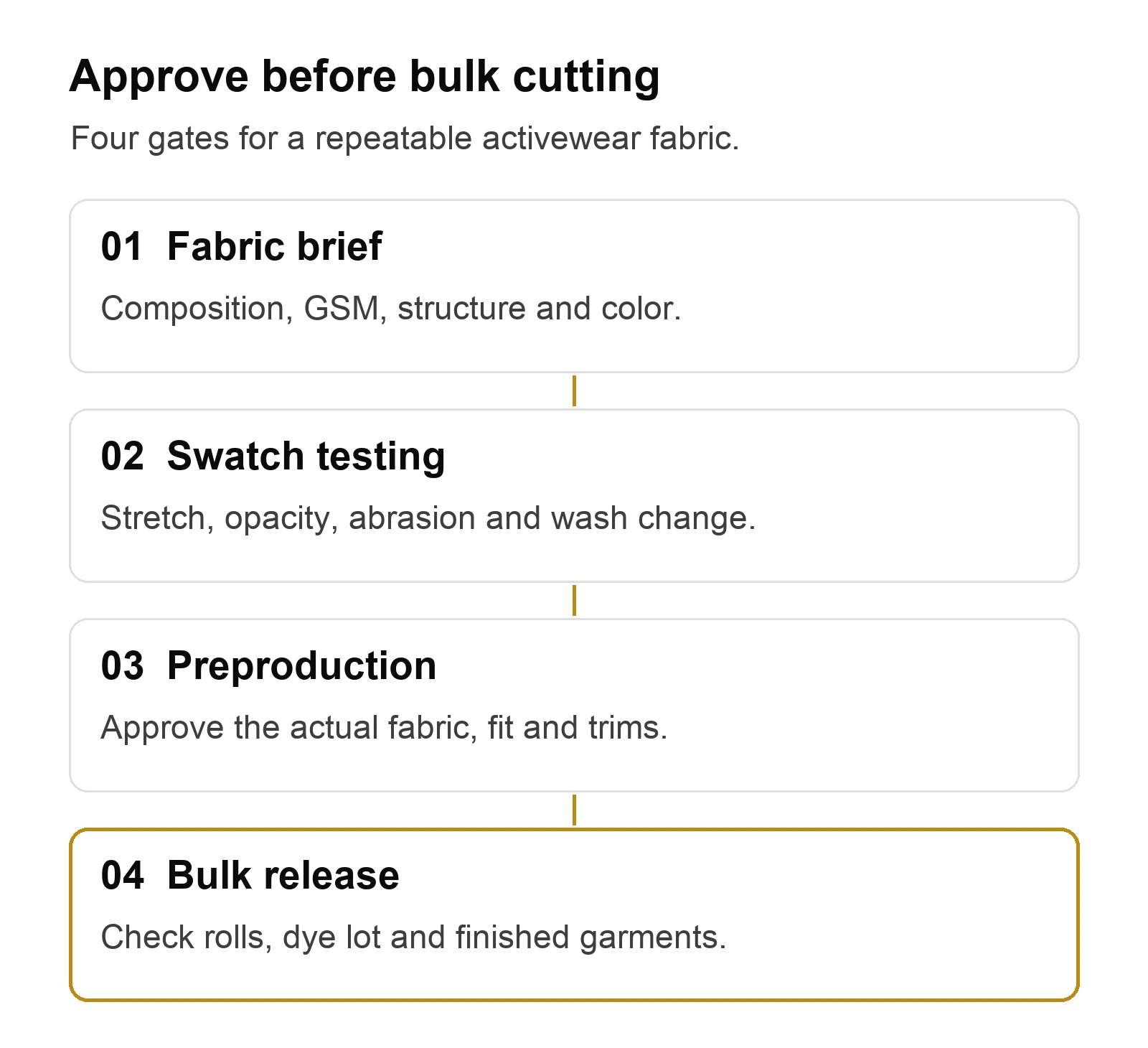
Use a four-gate approval flow: shortlist and test swatches; make a garment prototype; approve a preproduction sample from the intended fabric and trims; then release bulk only after roll and color checks. Put reapproval triggers in the purchase order for changes to mill, yarn, blend, weight, finish or dye process. Keep surplus fabric and lot data linked to size and color SKUs so replenishment can match the first run. That also connects fabric decisions to fashion inventory management.
Treat Sustainability and Labels as Evidence Questions
Recycled polyester or nylon may fit a brand's material strategy, but a recycled-content claim needs traceable evidence. The Global Recycled Standard addresses recycled content and chain of custody, along with additional processing requirements. It does not certify that a fabric will wick sweat or survive a given number of washes. OEKO-TEX STANDARD 100 addresses testing for harmful substances, which is a different question again.
Blending elastane into nylon or polyester can make useful performance fabric, but it can complicate fiber-to-fiber recycling. Textile Exchange explains this challenge for elastane blends. The European Environment Agency also identifies microplastic release as an issue for synthetic textiles. Avoid calling a fabric "eco-friendly" on fiber content alone. Make the specific claim you can document, and match the final composition and care wording to each destination market. Review clothing label requirements before printing labels.
Frequently Asked Questions
Is nylon always better than polyester for leggings?
No. Nylon can offer a smooth hand and useful abrasion resistance, but the finished fabric's construction, opacity, recovery and test results decide whether it suits your legging. Compare equivalent samples at the target color and weight.
Is spandex the same as elastane?
Yes. They are generic names for the same stretch fiber, although market labeling terminology differs. LYCRA is a brand name. Confirm the composition printed on the final label against the fabric and the destination market's rules.
Does a higher spandex percentage mean better compression?
No. Compression also depends on fabric structure, yarn, pattern and fit. Ask for extension, recovery and garment fit tests rather than buying by percentage alone.
Which certificate proves a fabric wicks sweat?
No single recycled-content or harmful-substance certificate proves wicking. Ask for a moisture-management test on the finished fabric, with the method and conditions stated, and test again after the agreed washing treatment if the claim must last.
The Sourcing Decision
Choose the fabric that meets the garment brief with a repeatable production route. For a new activewear line, that means a written spec, physical reference, measured performance, identified mill and lot, preproduction approval and a plan for replenishment. Nylon, polyester and spandex describe the ingredients. Your customers experience the finished garment.
Choosing fabrics for a new activewear line? Talk to Silk Road about fabric and trim sourcing, sampling, quality checks and fulfillment from Shenzhen before you commit to bulk production. You can also review our sourcing and fulfillment services.