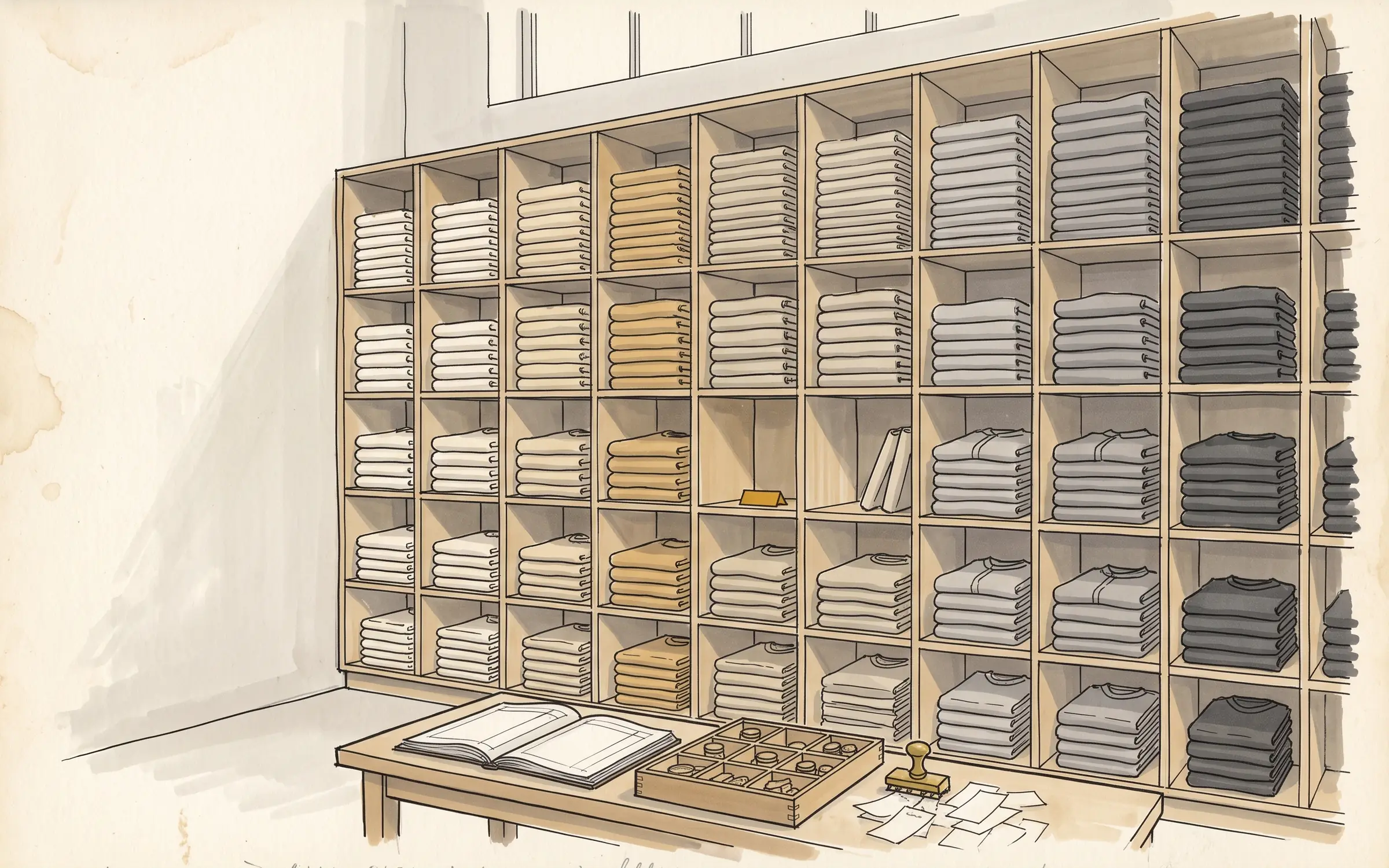
You can have 2,000 units sitting in a warehouse and still be out of stock.
That sounds contradictory until you look at fashion inventory by size and color. A brand may have hundreds of Large and XL units left while Medium Black - the variant driving most of the sales - is already gone. The total inventory looks healthy, but the inventory customers actually want is disappearing.
That is what makes fashion inventory management different from managing a catalog of simple products.
Shopify’s apparel inventory guidance highlights the same problem: a single shirt offered in five colors and six sizes already creates 30 separate SKUs. Fashion brands must then deal with seasonality, returns, changing trends, and uneven demand across those variants (Shopify).
For founders, the goal is not simply to keep more stock. It is to know which stock is sellable, which variants are moving, when to replenish them, and how much cash is trapped in everything that is not selling.
Quick Answer
Good fashion inventory management means:
- Tracking every size, color, style, and variant independently
- Knowing sellable inventory rather than just physical stock
- Replenishing high-velocity sizes before they stock out
- Avoiding excess stock in slow-moving variants
- Connecting Shopify, the warehouse, returns, and incoming production
- Using sell-through and actual demand instead of buying every size equally
- Keeping factory lead times and collection dates inside the inventory plan
The biggest mistake is managing inventory by product instead of by variant.
What Is Fashion Inventory Management?
Fashion inventory management is the process of ordering, receiving, tracking, allocating, replenishing, and controlling apparel, footwear, jewelry, and accessory inventory across individual styles, sizes, colors, and other variants.
The objective is to have the right variant available when customers want it without tying excessive cash up in unsold stock.
That sounds straightforward until the SKU math begins.
Consider a clothing brand with:
20 styles × 5 sizes × 6 colors
That creates 600 individual SKUs.
Add two seasonal collections and you may be managing more than 1,000 distinct inventory positions without significantly increasing the number of designs customers see.
This is one reason Shopify describes apparel inventory management as particularly challenging: variant proliferation, seasonality, and returns create operational complexity that does not exist to the same degree in simpler product categories.
Fashion Inventory Problems Start With the Size-and-Color Matrix
Fashion founders often think about inventory at style level.
The warehouse cannot.
Imagine you produce 500 units of a new hoodie:
| Variant | Units Left | Demand | Action |
|---|---|---|---|
| Black M | 12 | Very high | Reorder now |
| Black L | 28 | High | Monitor closely |
| Bone M | 70 | Medium | Healthy |
| Green XL | 110 | Low | Stop replenishing |
| Green XXL | 95 | Very low | Consider promotion |
The brand still has plenty of hoodies.
But commercially, it may already be losing sales.
If Black Medium is the variant customers want, the other 483 units cannot replace it.
This is the first important principle of apparel inventory management:
Inventory balance matters more than total inventory.
Buying 100 units of every size because it looks tidy on a purchase order is rarely the best approach. Fashion brands need to understand their actual size curve - the percentage of demand typically coming from XS, S, M, L, XL, and other sizes.
That curve may also change by product.
An oversized streetwear hoodie can have a different size distribution from a fitted dress. Men’s footwear can behave differently from women’s footwear. Even the same garment may sell differently across countries.
A good fashion inventory system therefore needs to show demand at the level where the purchasing decision actually happens.
Physical Stock Is Not the Same as Sellable Stock
Another common inventory mistake happens when the warehouse says:
“We have 250 units.”
The better question is:
“How many units are available to sell?”
Suppose there are 250 dresses physically inside the warehouse:
The brand owns 250 units.
It can only safely sell 185.
That distinction becomes increasingly important during a product drop or influencer campaign. If Shopify shows all 250 units as available, customers may buy stock that cannot actually be fulfilled.
Shopify’s current inventory tools distinguish inventory states and emphasize keeping stock accurate as products are purchased, received, sold, and returned. Its 2026 inventory updates also focus on connecting purchasing, receiving, inventory accuracy, returns, and replenishment within one inventory lifecycle.
For a fashion warehouse, the practical rule should be simple:
Inventory should change status before it changes availability.
A return should not become sellable merely because the parcel reached the warehouse.
A production batch should not become sellable merely because the truck arrived.
Returns Are Part of Fashion Inventory Management
Fashion returns create a second inventory flow that many brands underestimate.
A returned jacket can be:
Putting every returned unit directly back into A-grade stock corrupts the inventory count.
A better flow is:
- Return received
- inspection
- grading
- preparation
- inventory status updated
For example:
A-grade: Return to normal sellable inventory
B-grade: Outlet, sample sale, or discounted inventory
Damaged: Remove from available stock
This is especially important because fashion brands tend to experience return pressure associated with size, fit, and customer preference. Shopify’s clothing inventory guide specifically treats returns as one of the factors that complicate apparel stock management (Shopify).
At Silk Road, returns that come back into the fulfillment system are inspected and graded before inventory is treated as available again. The same principle is reflected in the company’s fashion-specific fulfillment model.
Returns should therefore feed back into fashion inventory tracking, not sit in a separate customer-service spreadsheet.
Replenishment Should Follow Velocity, Not Gut Feeling
The next problem is deciding what to reorder.
Many young fashion brands do this emotionally.
A founder sees that a style is selling well and orders another 500 units.
But the more useful questions are:
A basic reorder point can be thought of as:
Expected demand during lead time + safety stock
But fashion requires another layer: product lifespan.
A core black T-shirt may still sell six months from now. A seasonal lime-green jacket may not.
This means safety stock should not automatically be generous.
Holding too little creates stockouts. Holding too much can create markdowns and dead stock.
Shopify recommends using sales history, demand forecasting, reorder points, safety stock, and regular inventory analysis rather than relying on manual judgment alone.
For fashion founders, the more useful measure is often sell-through:
How much of the inventory received has actually sold?
If one colorway reaches 75% sell-through while another sits at 20%, replenishing both equally makes little sense.
Your Fashion Inventory System Needs One Source of Truth
Inventory becomes harder when several systems disagree.
Imagine:
Shopify says Black Medium: 42
The warehouse spreadsheet says: 38
The WMS says: 35
A wholesale order has another six reserved.
Which number should marketing use before launching a campaign?
None of these systems should operate independently.
For fashion brands, every unique size and color should have a consistent SKU that follows the product through:
Factory → purchase order → receiving → WMS → Shopify → picking → return
Shopify’s inventory guidance specifically recommends consistent SKU identifiers across the ecommerce platform, warehouse management system, suppliers, and purchase orders.
Silk Road’s Shopify integration follows the same principle: products and variants sync with the warehouse, while stock levels, order status, and tracking are written back so the store and physical inventory stay aligned.
See how Silk Road connects Shopify inventory with fulfillment.
For a fashion brand, this matters because “in stock” needs to mean the same thing everywhere.
Manufacturing Location Changes the Inventory Equation
Inventory planning does not stop at the warehouse door.
If your clothing is manufactured in China but stored in the United States, your replenishment lead time may include:
- Production
- QC
- export booking
- international freight
- customs
- warehouse receiving
A reorder placed today may not become sellable inventory for weeks.
Keeping fulfillment close to production changes that sequence:
- Production
- QC
- China warehouse
- available inventory
International transportation happens after the customer order rather than before the stock becomes available.
That does not automatically make China fulfillment the right choice for every brand. A business with concentrated US demand and strict one- or two-day delivery expectations may still benefit from domestic inventory.
But for a DTC fashion brand selling across the US, UK, Europe, Australia, and other markets, keeping one inventory pool near production can reduce the need to forecast how much stock should be committed to each country before demand is known.
Silk Road currently operates this model from Shenzhen, maintaining fashion inventory in China and using the same stock pool to serve multiple international markets.
The China fulfillment center guide explains the geographic and supply-chain side of this inventory decision.
What Good Fashion Inventory Control Looks Like
A growing brand does not need a complicated enterprise system on day one.
It does need disciplined inventory rules.
A practical setup should include:
- One unique SKU for every sellable variant.
- Barcode or system verification when inventory is received and picked.
- Separate inventory statuses for available, reserved, returned, damaged, and incoming units.
- Variant-level sales velocity and sell-through monitoring.
- Reorder points that include actual supplier lead time.
- Regular cycle counts for high-volume SKUs.
- A clear source of truth between Shopify and the warehouse.
- Returns inspected before they re-enter sellable inventory.
The warehouse also matters.
A strong fashion 3PL should understand that a Black Medium hoodie and a Black Large hoodie are not “basically the same product.” They are two different pieces of inventory tied to two different customer orders.
Choosing a partner that handles this properly is covered in the fashion 3PL guide.
The apparel fulfillment guide covers the connection between inventory accuracy and correct picking, garment handling, packaging, and returns.
Frequently Asked Questions
What is fashion inventory management?
Fashion inventory management is the process of controlling stock across styles, sizes, colors, seasons, and sales channels. It includes purchasing, receiving, tracking, forecasting, replenishment, fulfillment, and returns. Fashion brands usually need more detailed variant-level control than businesses selling simple, single-SKU products.
How should clothing brands manage size and color inventory?
Each size-and-color combination should have its own SKU and inventory count. Brands should monitor sales velocity and sell-through by variant rather than assuming every size and color sells evenly. Replenishment should follow actual demand patterns and supplier lead times.
What is the biggest inventory problem for fashion brands?
One of the biggest problems is having too much total inventory but too little of the variants customers actually want. Popular sizes can stock out while slower sizes remain on shelves, creating both lost sales and excess stock at the same time.
Can Shopify manage fashion inventory?
Yes. Shopify can track products, variants, quantities, locations, purchase orders, sales, and returns. For brands using a 3PL, the warehouse system should synchronize accurately with Shopify so inventory movements are reflected in the store without relying on manual spreadsheets.
What Fashion Founders Should Remember
Good fashion inventory management is not about having the biggest stock count.
It is about having the right sizes and colors available at the right time while keeping as little cash as possible trapped in inventory customers are not buying.
As the catalog grows, the unit that matters becomes the SKU - not the style. Returns need grading, replenishment needs real demand data, and Shopify must agree with what is physically on the warehouse shelf.
For brands manufacturing in China, where inventory is stored can also affect how quickly new stock becomes available.
Control those pieces early, and inventory becomes a growth tool rather than something that quietly consumes cash.