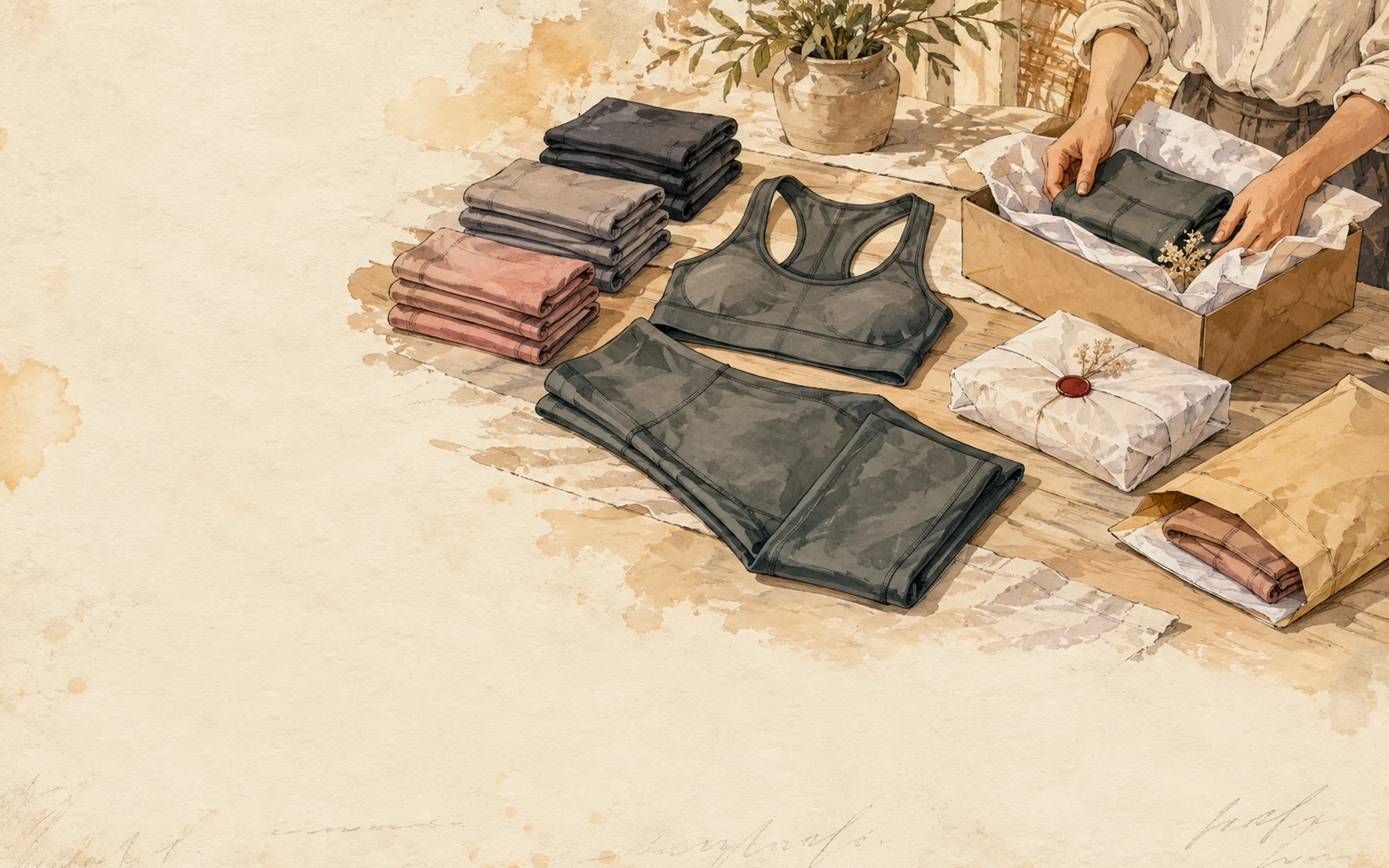
A customer orders cobalt leggings in Medium and a matching sports bra in Small. The warehouse picks the correct color, but the bra is Medium. Both pieces look right in a quick visual check. The mistake becomes obvious only when the customer opens the parcel, and a profitable set turns into an exchange, another shipment and a disappointed buyer.
Activewear is often sold as a coordinated look but stocked as separate garments with different sizes, colors and conditions. Fulfillment must preserve the customer's exact combination from the product page through packing and any return.
Quick Answer
- Give every sellable size and color combination a unique SKU and a scannable identifier. A style-level stock total cannot tell you whether the customer's size is available.
- Decide whether a matching set is assembled after an order or prepacked as its own item. Document the component SKUs, permitted size combinations and what happens when one component is unavailable.
- Approve a physical pack sample with folding, protection, inserts and parcel size. Test the pack for both appearance and safe delivery.
- Treat a return as unavailable until its exact variant and condition are checked. Use fit-related return reasons to improve size information and future buying.
- Before launch, test a single item, a mixed-size set, a partial stockout and an exchange. Confirm that store and warehouse data agree.
Why Activewear Needs More Than a Generic Pick-and-Pack Rule
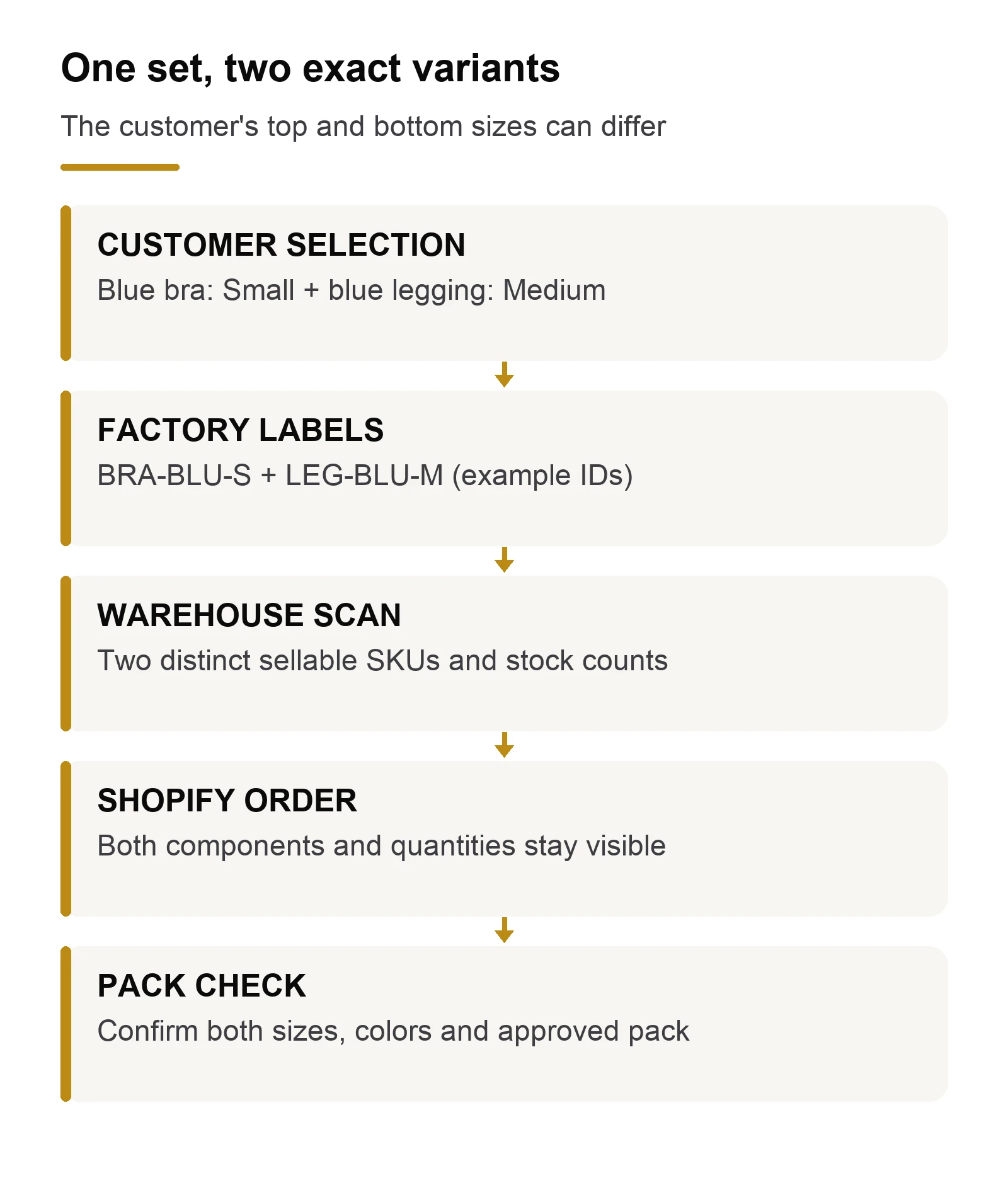
Consider one legging style in six sizes and five colors. That is 30 variants, not one product. Add a matching bra with its own size range, and customers may select a different size for each half of the outfit. An order described as a "blue set" is therefore incomplete for the warehouse. It needs the exact legging SKU, bra SKU, quantities and a rule for combining them.
Shopify treats each size and color combination as a product variant and lets merchants manage its inventory separately. If a brand uses GTINs, GS1 states that each size and color variation needs its own GTIN. A brand can use its own internal SKU alongside that identifier, but the key is a one-to-one match among the product page, factory label, warehouse record and physical garment.
Compression fabrics can pick up lint, pale leggings can show marks, and a set can look mismatched across color lots. The final check must cover identity and condition. Silk Road's fashion fulfillment service describes variant control and packing to a brand's specification, useful standards for any written procedure.
Build a Variant Master Before Stock Reaches the Warehouse
One product record should follow each garment from factory to store: style, color, size, SKU, barcode if applicable, photograph, weight, care label, packaging rule and sellable quantity. Add a production-lot reference when replenishment might differ visibly.
"Blue M" must not mean leggings in one system and a bra in another. Verify that the physical barcode resolves to the right record. For mixed cartons, count individual variants rather than trusting the carton label.
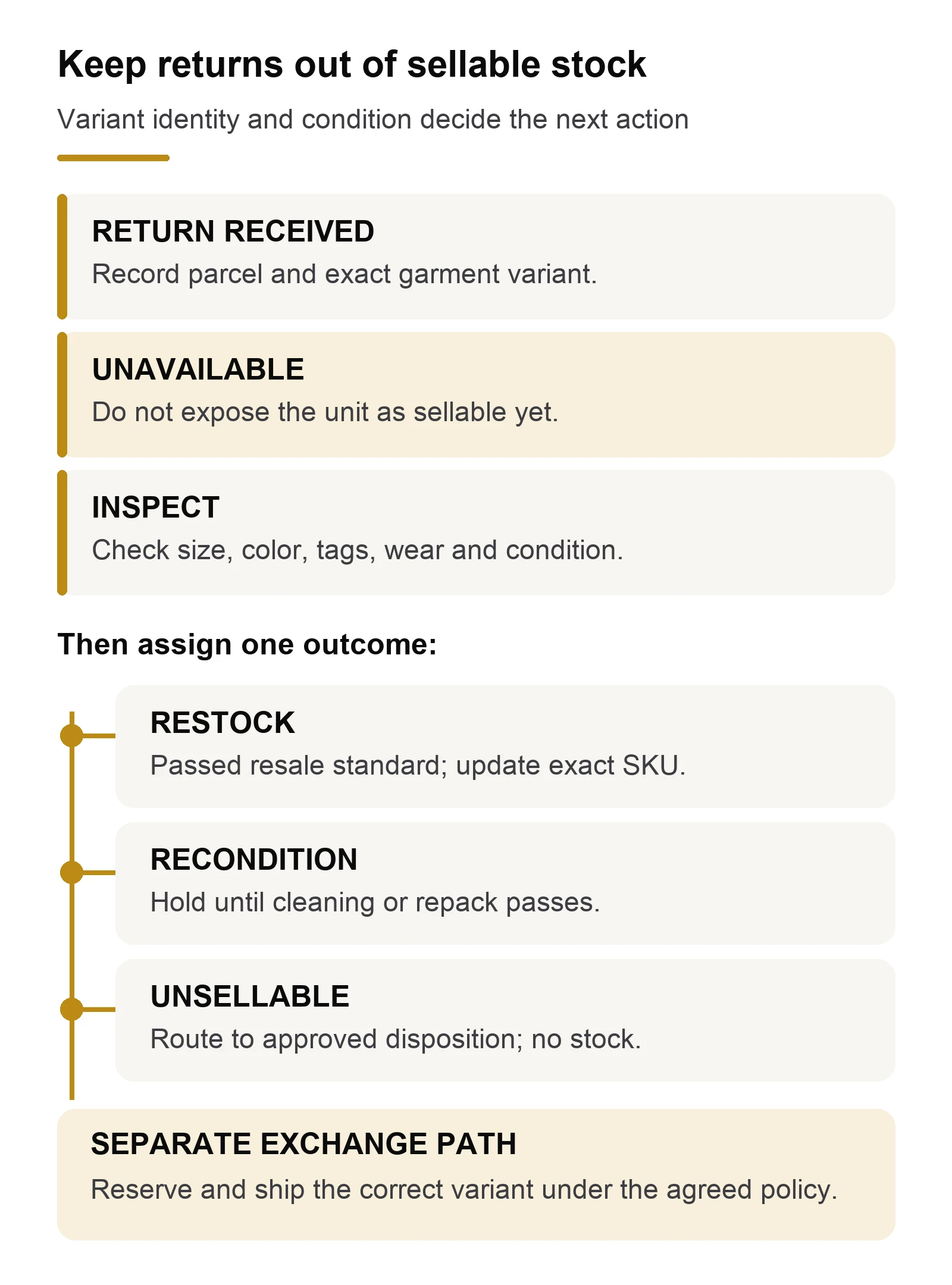
Check incoming stock against approved samples, especially adjacent sizes and similar colors. Hold discrepancies before stock becomes available online. Shopify separates available, committed, unavailable and on-hand inventory, so a physical unit need not be ready for sale.
Size charts and fit notes should match the approved production sample. If grading or fabric stretch changes, update the product page. The activewear fabric sourcing guide explains why the nominal fiber blend alone cannot guarantee fit.
Choose How Matching Sets Will Be Stocked and Sold
In a virtual set, the bra and leggings remain separate until an order arrives. The warehouse picks both SKUs, allowing individual sales and mixed sizes. The checkout and warehouse must pass both choices correctly.
In a prepacked set, both pieces are stocked as one item. Picking can be simpler, but size changes require breaking a pack. Early assembly can trap stock in slow combinations. Use it when the combination is fixed and packaging is part of the offer.
For a virtual set, calculate availability from the limiting component. If 28 Small bras and 12 Medium leggings are sellable, you can promise at most 12 Small-top/Medium-bottom sets, assuming one of each per order. You do not have 40 sets. Shopify's bundle guidance uses the lowest component availability after accounting for required quantities. It also says bundles have specific exchange limitations, so test your actual return and exchange workflow before launch rather than assuming a set can be swapped as one line item.
The set rule sheet should list component SKUs, allowed size combinations, color matching, substitutions and missing-piece handling. Require brand approval for substitutions. The pick ticket must show both sizes for the final check.
Run a Launch Test That Includes the Awkward Orders
Before a collection or influencer drop, run five gates with live products and packaging:
- Receive and reconcile: compare the factory packing list with counted units by SKU and hold unknown or defective stock.
- Sync inventory: confirm that the warehouse's sellable quantity matches the storefront for several sizes and colors, including a low-stock variant.
- Pick a mixed-size set: order a top and bottom in different sizes, then inspect the actual picked items and the packing slip.
- Trigger an exception: test a missing component, damaged garment and partial stockout. Know whether the order is held, split or escalated.
- Complete the loop: inspect a delivered test parcel, process a simulated return and confirm that inventory changes only after the return is graded.
Photograph the approved parcel and record its weight and dimensions. Share the launch date and likely order mix with the 3PL. Silk Road's fashion inventory planning guide explains why popular sizes can stock out while total inventory looks healthy.
Make Packaging a Written Specification
"Premium packaging" is too vague. Specify the fold, inner protection, tissue, insert order, outer package and any separation rule. Photograph a correct single-item pack and set pack. For removable bra pads, define how they are secured and counted.
Test the parcel. UPS's clothing shipping guidance gives examples of inner protection and outer packaging. Check the actual carrier's rules when switching pack types or adding accessories. Presentation fails if the garment arrives damaged.
If a limited color gets a special insert, define that at SKU or campaign level. Check both set components against the order before sealing.
Design Fit Exchanges and Returns Before the First Sale
Fit returns can expose upstream problems. "Too small" may signal a size-chart issue, grading inconsistency or compression preference. "Wrong size sent" points to data or picking. Track reasons by exact variant. Shopify records apparel-specific reasons such as Too big and Too small for analysis.
A returned legging should remain unavailable until its SKU, hangtag, wear, stains, seams and packaging are checked. Mark it approved for resale, needing reconditioning or unsellable, then update availability. Silk Road's fashion returns management guide explains why grading speed matters.
Pair the customer policy with a physical route. Decide when exchange stock is reserved, where returns go and who pays shipping. Cross-border returns may use a local address, consolidation point or China, depending on value and destination. Shopify's return rules control windows, costs and exceptions; the warehouse needs a matching procedure.
Measure the Process at Variant and Order Level
Track pick accuracy as correct orders divided by checked orders; set completeness as complete sets divided by sets shipped; and inventory accuracy as variants with matching counted and system quantities divided by variants counted. Decide how split shipments count.
For returns, track fit-related reasons by variant, receipt-to-disposition time and sellable recovery rate. If Medium repeatedly comes back as too small, inspect the chart, production measurements and lot before reordering.
Set targets from your own baseline. Use a weekly exception list to assign fixes such as correcting a barcode, pack instruction, fit note or production lot.
What to Verify With an Activewear 3PL
Ask the provider to demonstrate a mixed-size set order. Can it show both component scans, the approved pack sample and the resolution when one piece is missing? Ask when a returned garment becomes sellable and which return destinations serve your main markets. For brands manufacturing in China, also walk through the factory handoff and a real test order before launch. Silk Road's apparel fulfillment guide gives the broader service context.
Frequently Asked Questions
Should matching activewear sets have their own SKU?
A fixed, prepacked set should have a distinct sellable identifier. A virtual set can be sold as one storefront offer while the warehouse picks separately identified component SKUs. The best design depends on whether customers can mix sizes, whether pieces also sell alone and how exchanges will work. Test the exact system behavior before launch.
Can I use the same barcode for every size of a legging?
No, if it is intended to identify the sellable variant. A scan must distinguish Small from Medium and one color from another. GS1 requires a distinct GTIN for each size and color variation when GTINs are used. Your internal SKU should make the same distinction.
Should returned activewear be restocked automatically?
No. A returned item needs a condition and identity check first. Only garments that meet the brand's resale standard should move back into sellable inventory. The route for worn or damaged items should be decided in the return procedure.
What is the best packaging for activewear orders?
There is no universal format. Choose protection and presentation for the garment, order size, destination and carrier. Approve a physical pack sample, test a shipped parcel and write down the fold, inner protection, inserts and outer package so repeated orders match.
The Fulfillment Decision
The activewear order is correct only when the customer gets the exact sizes and colors selected, every part of the set, the approved presentation and a clear path for a fit exchange if needed. Give each variant a clean identity, define set logic before it goes live, test the awkward orders and keep returns out of sellable stock until checked. Those controls protect both the customer experience and the inventory you already paid to make.
Planning an activewear launch or moving fulfillment closer to a China factory? Talk to Silk Road about variant setup, set assembly, packaging, test orders and returns for the markets you serve.