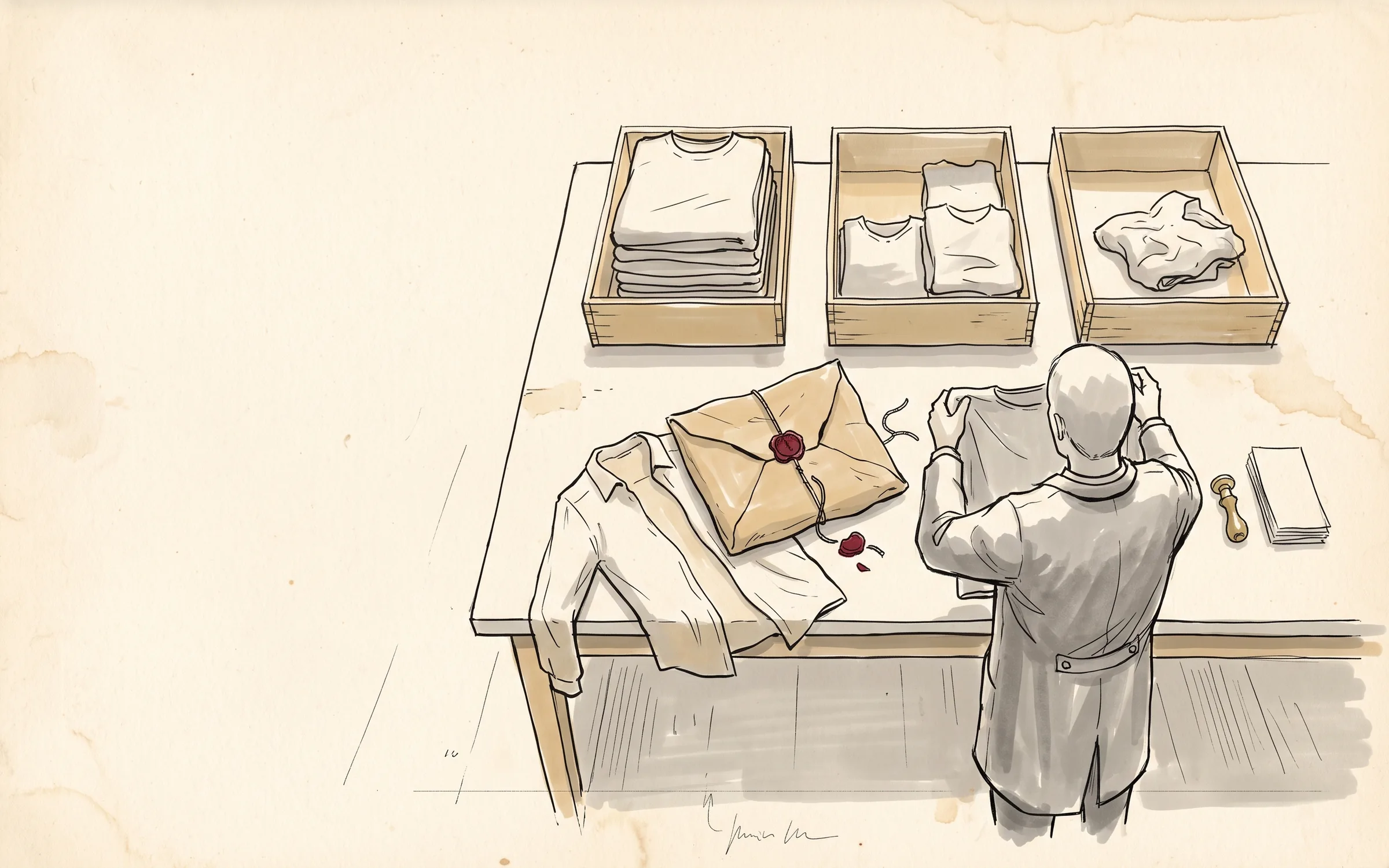
A customer returns a dress. The parcel reaches the warehouse, so your inventory system adds one unit back to stock.
That sounds logical—but it can be wrong.
The dress may have been worn, the hangtag may be missing, the garment may need steaming, or it may have a stain that makes it unsuitable for full-price resale. Until someone checks it, you do not really have one unit of sellable inventory. You have one returned unit waiting for a decision.
That distinction is central to good fashion returns management.
Returns are especially important in fashion because size, fit, color, condition, seasonality, and product presentation all affect whether returned merchandise can generate revenue again. NRF estimated that 19.3% of online sales were returned in 2025, compared with 15.8% of overall retail sales. Apparel and footwear tend to sit above the ecommerce average because customers cannot physically try products before ordering. (NRF 2025 Retail Returns Landscape)
The goal is therefore not simply to process refunds faster. It is to recover as much inventory value as possible while learning why products came back in the first place.
Quick Answer
Separate returned stock from sellable inventory until inspection
Grade garments by condition before restocking
Track return reasons at SKU and variant level
Recover A-grade products quickly before seasonal value falls
Use exchanges where appropriate to preserve revenue
Feed sizing, quality, and product-data problems back into sourcing and production
Choose return locations based on product value, customer market, and shipping economics
A return is not recovered inventory until the product is sellable again.
What Is Fashion Returns Management?
Fashion returns management is the process of receiving, inspecting, grading, refunding, exchanging, restocking, repairing, reselling, or disposing of fashion products returned by customers. It connects customer service, reverse logistics, warehouse operations, inventory management, and product data.
That last part matters.
Returns management is broader than reverse logistics.
Reverse logistics describes the physical movement:
- Customer
- Return location
- Warehouse
Fashion returns management continues after the parcel arrives:
Return received → Product identified → Condition checked → Grade assigned → Refund/exchange → Inventory status updated → Restock/resale/disposition
Shopify similarly separates returns management from the physical reverse-logistics movement and identifies inspection, grading, inventory placement, refunds, and exchanges as parts of the returns process. (Shopify ecommerce returns management)
For fashion brands, this process should happen at variant level. A returned Black Medium hoodie cannot simply become “one hoodie” in the inventory system.
It needs to become the correct SKU in the correct condition.
Why Fashion Returns Are More Expensive Than the Refund
A return costs more than the money sent back to the customer.
There may also be:
Return shipping
Warehouse receiving
Inspection labor
Steaming or refolding
New garment bags
Replacement labels
Customer-service time
Exchange shipping
Lost original shipping cost
Inventory depreciation
Markdown risk
Then there is the biggest hidden cost: time.
A returned black core T-shirt may still be valuable three months later.
A returned party dress from a Christmas collection may not be.
Fashion inventory loses value differently from evergreen ecommerce products because collections, seasons, drops, and trends move quickly.
This creates an important operational rule:
Return recovery speed matters more when product value is time-sensitive.
DHL's 2026 returns analysis describes returns as increasingly strategic rather than simply a logistics cost. It also reports that return behavior driven by ordering multiple sizes or colors can push rates above 50% in some apparel segments, with particularly high rates reported for certain dress categories. (DHL 2026 reverse logistics analysis)
For fashion founders, recovering a garment two days after the return arrives can be economically different from letting it sit in an unprocessed returns cage for three weeks.
A Return Should Be Graded Before It Becomes Inventory
Imagine 100 dresses come back after a collection launch.
Your accounting system may say:
100 units returned.
The warehouse could find something very different:
| Returned condition | Units | Next action |
| Unworn, tags attached | 62 | Restock as A-grade |
| Needs steaming/refolding | 18 | Recondition, then restock |
| Missing packaging/tag | 9 | Repack or relabel |
| Visible wear/staining | 7 | B-grade or secondary sale |
| Damaged | 4 | Repair, claim, recycle, or write off |
The brand received 100 products back.
It did not immediately recover 100 sellable units.
This is why a strong clothing returns warehouse should use inventory states such as:
Return in transit → Return received → Awaiting inspection → A-grade → Reconditioning → B-grade → Damaged
Only units that pass the required standard should return to available inventory.
This matters especially for premium fashion. Putting a returned garment with perfume, creasing, or damaged packaging into a new customer's order may turn one return into another return.
The warehouse is therefore making a commercial inventory decision, not simply checking whether the item physically exists.
Return Reasons Should Change What Happens Upstream
Many brands collect a return reason because the returns portal requires one.
Then nobody looks at the data again.
That wastes one of the most useful signals in fashion ecommerce.
Suppose one dress generates the following returns:
That is not primarily a warehouse problem.
It may indicate:
Too small → measurement or sizing issue
Too short → fit/specification issue
Different from photos → merchandising/content issue
Quality problem → factory/QC issue
Shopify introduced more category-specific return reasons in 2026, including apparel-specific options such as “Too big” and “Too small,” specifically so merchants can use returns data to improve products and inventory decisions. (Shopify enhanced return reasons)
This creates a useful feedback loop:
- Return
- Reason
- SKU analysis
- Product decision
That product decision may mean:
Adjusting a size chart
Changing grading on the next production
Improving fit notes
Updating product photography
Checking a factory defect
Reducing the next reorder
Increasing another size
Changing packaging
Some customer returns are symptoms of manufacturing variation that should have been identified earlier.
Likewise, return data can improve future size curves and replenishment decisions.
Exchanges Can Preserve Revenue—but Only If Inventory Is Accurate
A customer saying:
“Medium is too small”
does not necessarily mean they want their money back.
They may want Large.
That difference matters.
A refund takes revenue out of the business.
An exchange can keep the sale while correcting the customer's product choice.
But exchanges introduce another inventory problem.
If Shopify says Large is available while the warehouse has no sellable Large units, the brand can turn one disappointing experience into two.
Variant-level inventory therefore needs to distinguish:
New stock
Reserved stock
Sellable returns
Returns awaiting inspection
Damaged stock
Shopify's current returns tools support exchanges and category-specific return reasons, while its 2026 returns guidance emphasizes connected order and inventory data throughout the process. (Shopify ecommerce returns management)
This is another reason a fashion 3PL needs deeper SKU control than a warehouse handling simple products.
How Fashion Brands Can Reduce Returns Before They Happen
The best return is sometimes the one that never enters the reverse-logistics network.
DHL's 2026 data says shoppers most frequently point to poor product quality and incorrect sizing among major reasons for ecommerce returns. (DHL 2026 reverse logistics analysis)
For fashion brands, reducing avoidable returns should therefore start before fulfillment.
Improve sizing information
Do not rely only on S / M / L.
Useful product pages can include:
Garment measurements
Model height and worn size
Fit description
Stretch information
Oversized/slim/regular fit notes
Improve product representation
If the actual beige is warmer than your studio photograph, customers are making a purchasing decision based on the wrong product.
Accurate color, fabric texture, length, transparency, and fit reduce expectation gaps.
Fix repeated production problems
If several customers return the same zipper, seam, measurement, or trim issue, the answer is not a faster returns portal.
It is a production correction.
That connects returns directly back to Fashion Sourcing in China, Clothing Manufacturers in China, and your Sample vs Bulk Production process.
Improve picking accuracy
If the customer ordered Small Black and received Medium Black, that is not a customer return problem either.
It is a fulfillment error.
Barcode verification and accurate apparel fulfillment prevent the return before it leaves the warehouse.
International Fashion Returns Need Different Economics
International returns make the calculation harder.
Suppose a US customer returns a $35 fashion accessory that was fulfilled from China.
Sending it individually:
US customer → China warehouse
may cost enough that recovering the product makes little commercial sense.
But a $250 jacket has different economics.
Possible models include:
Direct return to origin: Useful when the product value justifies international movement.
Local return address: Products stay in the destination country until a decision is made.
Consolidated returns: Multiple products are accumulated and sent back together.
Returnless refund: Occasionally appropriate when recovery costs exceed the product's remaining value.
Local resale/disposition: Useful for selected inventory where returning it internationally creates little value.
The correct model depends on:
Product value
Product weight
Return volume
Destination country
Resale probability
Seasonality
Local warehouse options
International shipping cost
This is one of the genuine tradeoffs brands should consider when evaluating a China fulfillment center.
China fulfillment can provide advantages around manufacturing proximity, inventory consolidation, and global shipping, but the reverse flow should be designed just as carefully as the outbound flow.
What Should a Fashion 3PL Do With Returns?
Ask more than:
“Do you accept returns?”
Instead ask:
How is a returned SKU identified?
Is it automatically blocked from sellable inventory?
What condition checks are performed?
Can garments be steamed, refolded, or repacked?
How are missing tags or packaging handled?
Are A-grade, B-grade, and damaged units separated?
How quickly does returned stock update in the WMS?
Can return reasons be reported by SKU?
How are exchanges handled?
What happens to products that cannot be resold?
The answer should resemble an operational process rather than:
“We put it back on the shelf.”
The brands that handle this well are not necessarily those offering the most generous policy. They are the ones that connect policy, customer experience, warehouse processing, and inventory recovery.
Frequently Asked Questions
What is fashion returns management?
Fashion returns management covers the complete process after a customer decides to return apparel, footwear, jewelry, or accessories. It includes return approval, transportation, warehouse receiving, inspection, grading, refunds or exchanges, inventory updates, reconditioning, restocking, and disposition of products that cannot be resold.
Why are fashion return rates high?
Fashion customers cannot physically try on products when buying online, making size, fit, appearance, and expectation mismatches more common. Apparel shoppers may also order multiple sizes or colors and return the options they do not keep—a behavior often called bracketing.
Should returned clothing go straight back into inventory?
No. Returned clothing should normally be inspected before becoming sellable inventory. The warehouse may need to verify condition, SKU, tags, stains, damage, packaging, and signs of wear. Some garments may need steaming, folding, or repacking before they can be sold again.
How can fashion brands reduce ecommerce returns?
Start by analyzing return reasons at SKU level. Improve sizing information, product descriptions, photography, QC, and fulfillment accuracy based on recurring patterns. Returns caused by fit, misleading product presentation, manufacturing defects, or incorrect picking require different solutions.
What Fashion Founders Should Remember
Good fashion returns management is not about moving parcels backward as quickly as possible.
It is about protecting customer trust while recovering inventory value.
A returned garment should be inspected before becoming stock again. Return reasons should feed back into sizing, sourcing, QC, content, and replenishment decisions. And international brands need to decide whether each product is worth moving back across borders at all.
For fashion brands, the real metric is not simply return rate. It is how much sellable value you recover, how quickly you recover it, and how much you learn from why products came back.