
Your factory has finished 1,200 hoodies. The cartons reach your new 3PL, and the store is ready to launch. Then the warehouse finds that Black Medium and Black Large share a carton label, while Shopify shows both sizes as available. The first order has not shipped, but the brand already has a customer problem.
This apparel 3PL onboarding checklist connects production, physical stock and the storefront. The handoff is complete when the warehouse can identify every variant, the store shows correct available stock, and a test order returns the right item and tracking. It covers the China factory to first live order. For partner selection, see Silk Road's apparel fulfillment guide.
Quick Answer
Before releasing orders to a new apparel 3PL:
- Approve one master list that maps each style, color and size to a unique SKU and scannable identifier.
- Send a carton-level packing list and agree how mixed cartons, shortages and damaged pieces will be recorded.
- Complete receiving and quality checks before making stock available to sell.
- Confirm which Shopify location owns each variant and how orders, quantities, status and tracking move between systems.
- Run controlled orders for a normal item, similar-looking sizes, a multi-item order and an exception.
- Sign off the packing standard and launch owner. Watch the first live orders until records match on both sides.
The key rule: a physical delivery is not the same as approved, sellable inventory.
Gate 1: Freeze the Variant Master Before the Factory Packs
An apparel catalog is a matrix, not a collection of product names. A hoodie in three colors and five sizes is 15 stock positions. The factory, warehouse and store must describe those positions the same way.
Create one variant master: style code, color, size, store variant ID, SKU, barcode or scan value, product image, packaging and quantity ordered. Add production lot, weight and pack configuration where relevant. A two-piece set should not silently share a single garment's identifier.
HD24-BLK-M and HD24-BLK-L are different SKUs even when folded garments look identical. Shopify recommends unique SKUs by variant; duplicates can disrupt integrations. A SKU is an internal code, while a barcode is a separate scan identifier. Some channels require a GTIN. GS1 US says apparel color, size and pack variations can each have a distinct GTIN. Agree on unique scan values for warehouse handling without assuming every DTC unit needs a GS1 GTIN.
Before cartons close, scan sample labels from the actual run and compare each result with the master and garment label. Silk Road's clothing label requirements guide covers separate legal and product-label checks before bulk production.
Gate 2: Send a Carton-Level Handoff File
The warehouse needs to know what is coming before a truck appears. Ask for an advance packing list that ties each carton ID to the exact SKU and unit count inside it. A style-level total is insufficient when one size is missing or two colors have been mixed.
| Factory handoff field | What it lets the 3PL verify |
|---|---|
| Purchase order and production lot | Which approved run the goods belong to |
| Carton ID and carton count | Whether every physical carton arrived |
| SKU, color, size and units per carton | Whether received variants match the master |
| Gross weight and carton dimensions | Whether the shipment and storage plan match the paperwork |
| Mixed-carton flag and contents | Which cartons require individual sorting |
| QC status and hold instructions | Which units must remain unavailable |
| Product and carton-label photos | Whether labels can be read and scanned at receiving |
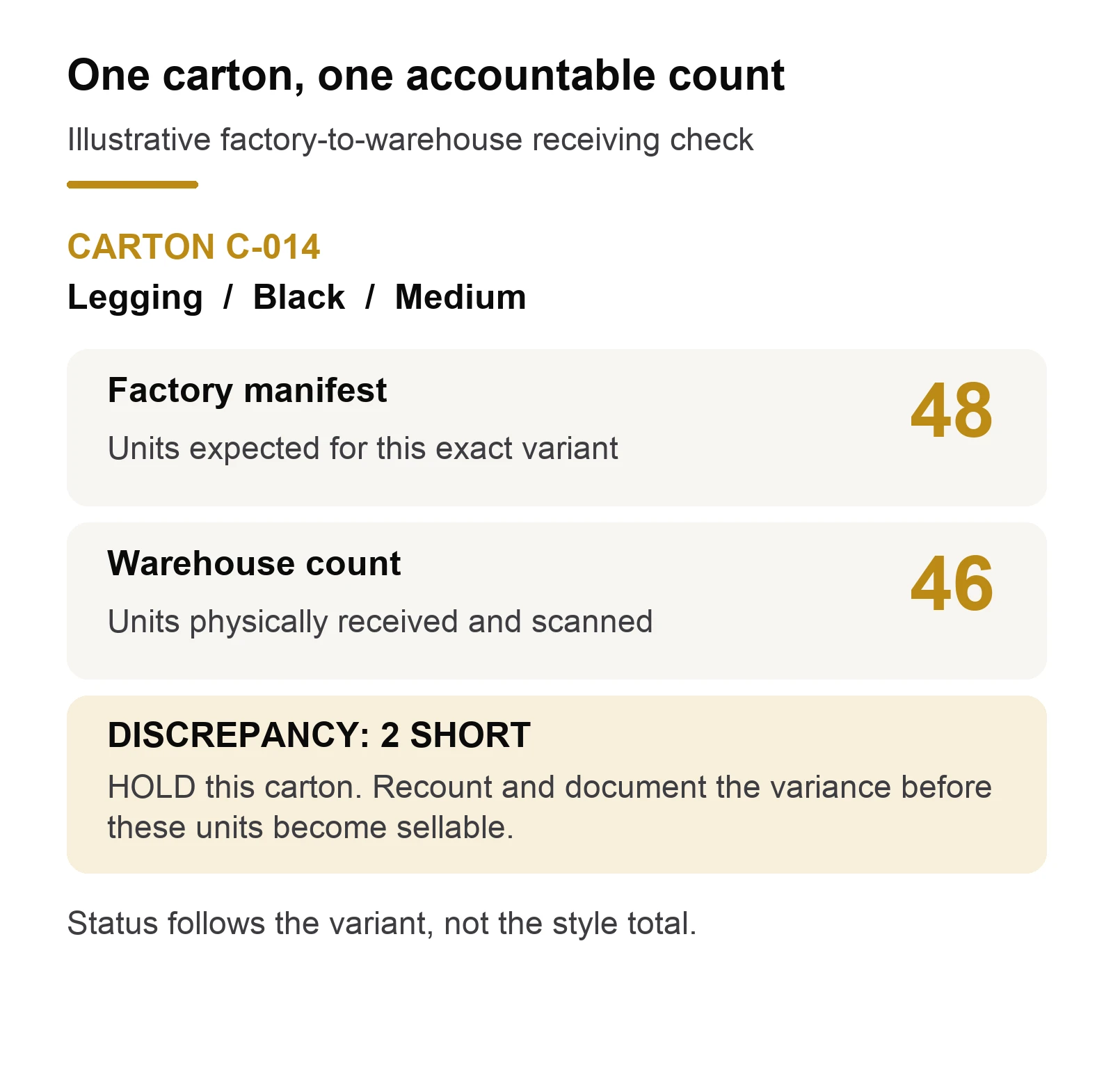
Agree on exception rules before pickup. If a carton lists 48 pieces but contains 46, will the 3PL accept 46 and report the shortage, hold the carton, or count the whole shipment first? Preserve the discrepancy rather than overwriting the expected quantity.
Keep the factory QC record linked to the shipment. QC checks product against the approved standard; receiving checks what arrived and how it maps to stock.
Gate 3: Receive, Reconcile and Quarantine
At arrival, compare the truck or courier delivery with the carton list, scan carton IDs, and count units by variant under the agreed sampling or full-count plan. Record overages, shortages, damage and wrong labels against the original manifest. For any suspicious carton, photograph the outer label and affected units before relabeling or repacking.
Use three handoff states: expected, received but unavailable, and approved to sell. Your system's names may differ. Shopify distinguishes incoming, available and unavailable stock; transit stock is not sellable. Shopify supports transfers from external suppliers, although a 3PL integration may record receipts differently.
Do not upload the factory's planned quantity as live sellable inventory before the warehouse has resolved the count. If 40 units of a legging fail a label check, hold those exact units and variants, not an arbitrary 40 from the whole style. This is why variant-level fashion inventory control matters at onboarding, not just during annual stock counts.
Gate 4: Approve the Pack-Out and Exception SOP
Have the warehouse pack and photograph a representative item from each handling group. Approve fold, tissue or bag, insert position, size sticker, shipping container, seal and allowed substitutions. A brand mockup does not tell a picker what to do when tissue is out of stock.
Specify what happens when a hangtag detaches, a bag tears, an insert is missing, or the scan disagrees with the item. Which faults can staff correct, and which block shipment? Silk Road offers fashion handling, packaging and kitting; agree on your exact pack-out before live orders.
For matching sets, define whether the bundle is preassembled or picks component SKUs. Track packaging and inserts separately so a garment does not create an unfulfillable branded order.
Gate 5: Connect Shopify Without Creating Two Versions of Stock
Shopify treats warehouses and some third-party fulfillment apps as inventory locations. Stock at one location is tracked separately from stock at another; order routing decides where an online order is assigned. Before connecting a new 3PL, write down the answer to four questions:
- Which location owns the newly received stock for every variant?
- When does a warehouse count update Shopify, and which system has authority to correct a discrepancy?
- Can another location fulfill the same product, and what rule prevents an unintended split shipment?
- How do cancellation, partial fulfillment and tracking updates return to the customer order?
Test the actual integration. Silk Road says its Shopify connection syncs variants, orders, stock, status and tracking. Shopify says app behavior varies, and tracking appears automatically only when the service sends it. Verify those flows against your catalog.
Before switch-on, compare ten variants across physical accepted stock, warehouse records and Shopify, including similar sizes and low-stock colors. Record corrections at the source rather than changing both systems independently.
Gate 6: Test the Order Path Before Customers Do
A good test proves more than checkout. It follows a known SKU through routing, pick, pack, dispatch and tracking write-back.
| Controlled test | Pass evidence |
|---|---|
| One common variant | Correct SKU, count decrement, pack and tracking |
| Two adjacent sizes in the same color | Scans select the requested size, not the neighboring bin |
| Two-item order or matching set | Both components and inserts appear once; stock changes correctly |
| Low-stock or out-of-stock variant | Store availability and warehouse availability agree |
| Cancellation before dispatch | Hold or cancellation reaches the warehouse without an accidental shipment |
| Order routed across locations | Assignment follows the intended location rule; no surprise split |
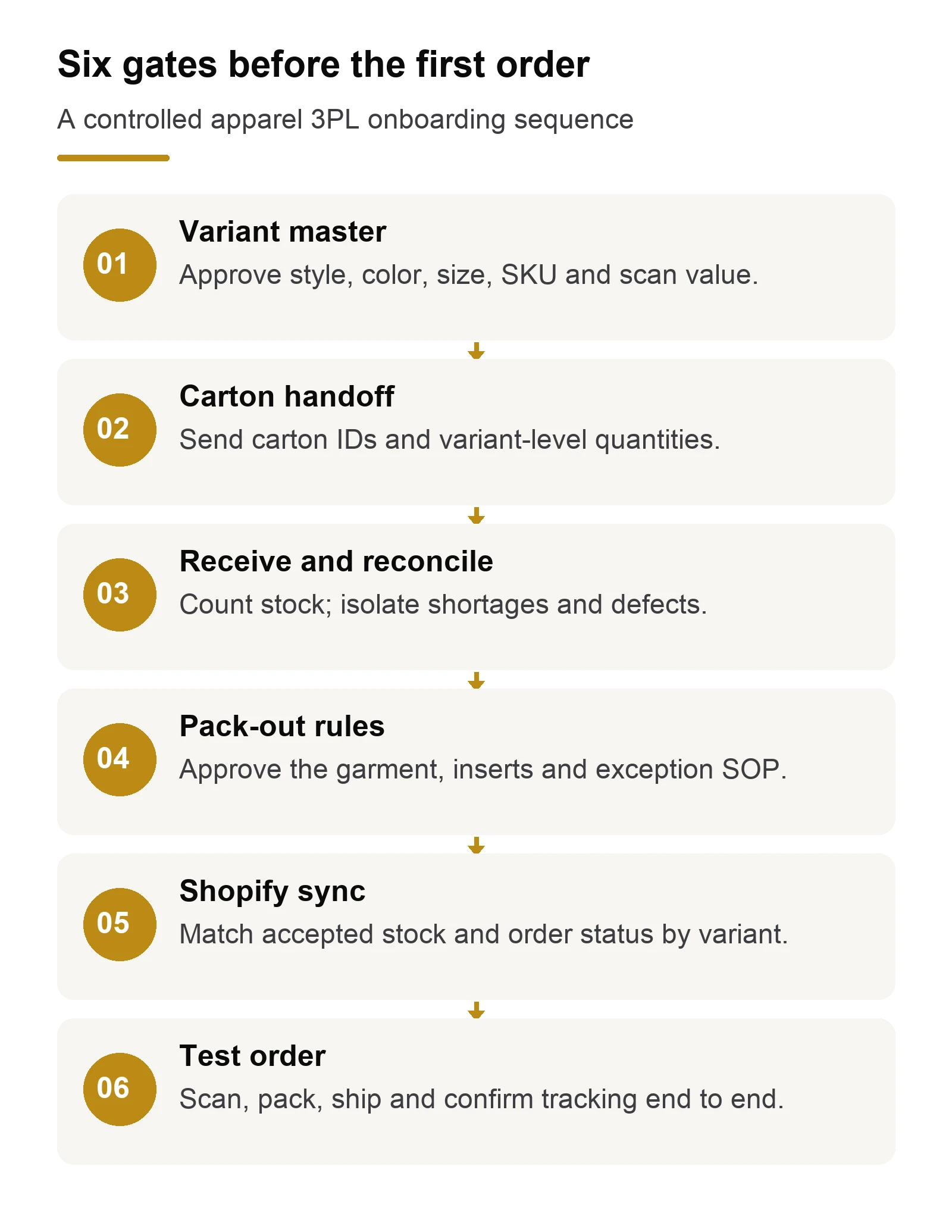
Shopify recommends test orders for checkout, inventory, shipping and notifications. Payment test mode prevents live orders while enabled, so restore live settings after the test. A controlled live transaction can involve fees and a refund. Agree whether the physical parcel is intercepted or shipped to your team.
Do not sign off from a dashboard screenshot alone. Compare the delivered or intercepted garment and packaging with the order, then check that Shopify has the expected fulfillment status, carrier and tracking link. If any test fails, keep that flow off until the cause is fixed and retested.
The Go-Live Decision and the First Orders
Use a simple release meeting rather than an assumed launch date. The brand owner and 3PL operator should both confirm: variant master approved; cartons reconciled; holds isolated; pack-out approved; stock aligned; order routing understood; and test orders passed. Record the person who can pause dispatch or hide a variant if a mismatch appears.
For the first live batch, compare ordered SKU, warehouse scan, packed item, stock decrement and tracking. Repeated Black Medium errors may point to a bin or mapping fault. Pause that SKU, correct physical and digital records, then retest.
The same framework helps when changing 3PLs. Run down old-location inventory and new-location inventory separately until each carton is accepted. Do not treat stock in transit as available at both sites. Shopify's multi-location inventory guidance explains why location quantities and order routing have to be coordinated during a move.
Frequently Asked Questions
How long does apparel 3PL onboarding take?
There is no universal number of days. Agree on dates for data approval, dispatch, receiving, discrepancy resolution and testing. Base launch on passed gates rather than a quoted setup speed.
Does every garment need a GS1 barcode?
Not necessarily for your own DTC store. The 3PL needs a reliable variant identifier, and some channels require a GTIN. Agree on identifiers before labels are printed.
When should inbound stock become available on Shopify?
After units are received, counted, mapped and approved. Transit, damaged, mislabeled or QC-hold goods should stay unavailable. Reconcile accepted quantities with Shopify before live orders.
What if factory cartons contain mixed sizes?
Flag mixed cartons and list each contained SKU. The warehouse should scan individual units and report differences. Never assign the whole carton to the size on its outer label.
Make the First Order a Controlled Milestone
The first successful order is the result of several records agreeing: the garment in the factory carton, the warehouse scan, the approved stock count, the Shopify variant and the customer-facing tracking event. A launch checklist exposes disagreements while they are still inexpensive to fix.
If your apparel is made in China, talk to Silk Road about coordinating the factory handoff, receiving, quality checks, Shopify integration and fashion-focused fulfillment from Shenzhen. Share a variant list, a sample carton manifest and your target launch date so the team can assess the actual onboarding work.