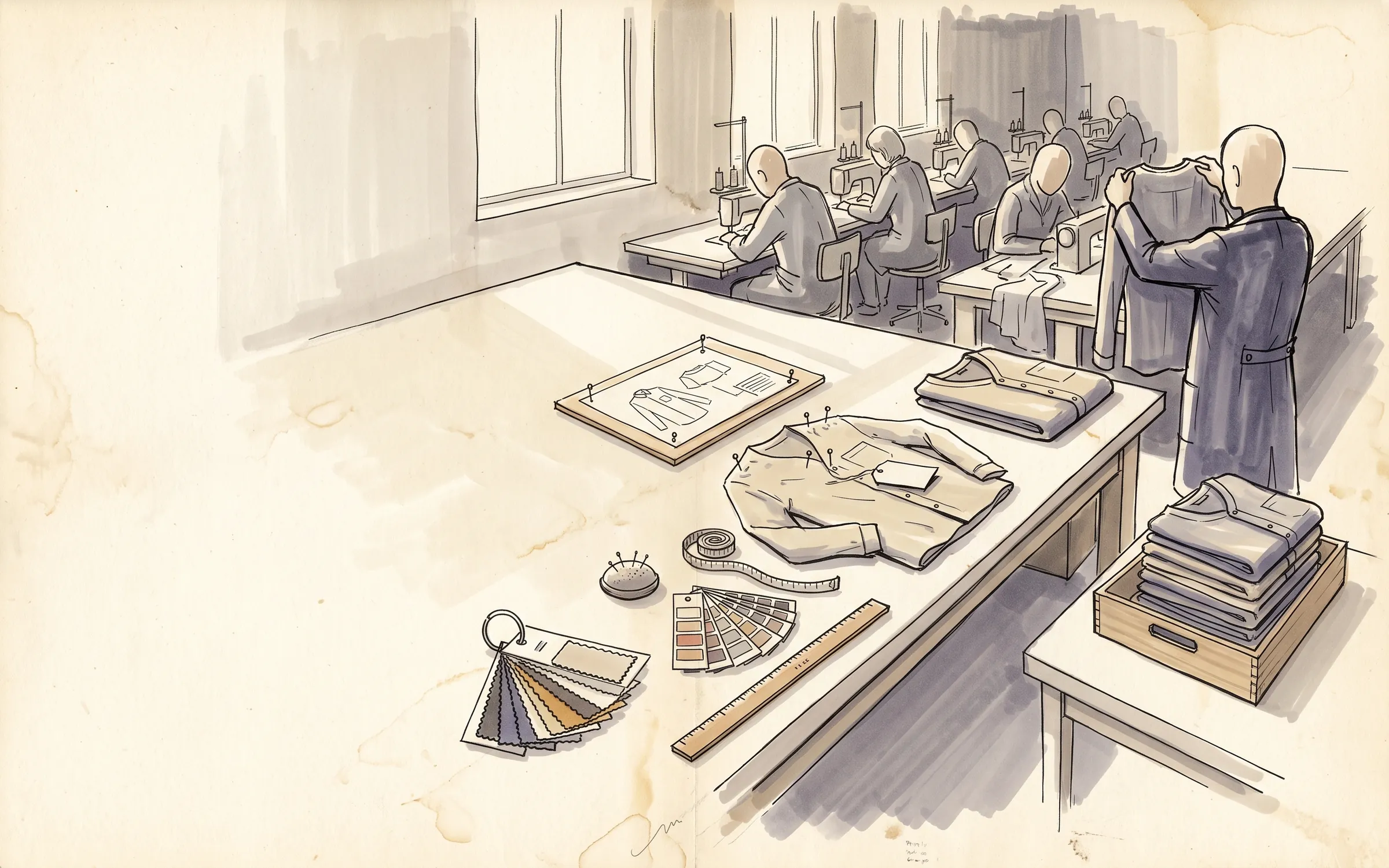
Finding clothing manufacturers in China is easy. Finding one that can reproduce your design accurately, work with your fabric and trims, meet your MOQ, protect your launch date, and still deliver consistent bulk quality is much harder.
That is where fashion founders often get caught.
A factory may quote the lowest price and still become the most expensive supplier once you add sample revisions, delayed production, incorrect labels, inconsistent sizing, or inventory you cannot sell.
China also remains a major part of the global fashion supply chain even as brands diversify production. WTO analysis found that Chinese industries contributed more than 40% of the value added in global textiles and clothing exports in 2022, reflecting not just garment factories but the wider materials, distribution, transport, and service ecosystem around them (WTO).
The right question is therefore not simply, “Where can I find a factory?”
It is: Which manufacturer fits my product, order volume, quality standard, inventory strategy, and fulfillment model?
Quick Answer
When choosing clothing manufacturers in China, fashion brands should evaluate:
- Product specialization before unit price
- Sample quality before bulk production
- MOQ against realistic sell-through
- Fabric, trim, and packaging access
- Factory capacity and lead time
- Quality-control systems
- Communication and responsiveness
- Whether bulk production matches the approved sample
- How finished goods move into warehousing and fulfillment
The best factory is rarely the one with the lowest quotation. It is the one that can repeatedly produce the product your customer expects.
What Type of Clothing Manufacturer Do You Actually Need?
“Clothing factory” is too broad a category.
A factory producing millions of basic promotional T-shirts may be completely wrong for a premium streetwear brand making 450 GSM washed hoodies.
Likewise, a manufacturer specializing in dresses may not have the machinery, wash processes, or pattern expertise required for denim.
Before contacting China clothing manufacturers, define the product clearly.
At minimum, know:
- Product category
- Fabric composition
- Fabric weight
- Construction
- Fit
- Size range
- Colors
- Prints or embroidery
- Labels
- Trims
- Packaging
- Expected quantity
- Target price range
This allows you to search for manufacturing capability rather than simply factory availability.
A useful rule is:
Match the factory to the product - not the product to whatever the factory happens to make well.
That sounds obvious, but many sourcing problems begin when founders choose a supplier because the price looks attractive and then try to force a technically unsuitable factory to make the collection.
For a broader view of this process, Silk Road’s Fashion Sourcing in China: A Guide for Clothing Brands is the main sourcing pillar behind factory selection.
Factory, Trading Company, or Sourcing Agent?
Not every company calling itself a manufacturer owns the factory.
When sourcing from China, you may deal with:
- A direct factory can work well when your product is stable and you know exactly what you need.
- A trading company may be useful when a collection requires several categories, but you should understand who actually manufactures the goods.
- A China sourcing agent becomes more useful when you need someone on the ground to evaluate suppliers, coordinate samples, negotiate terms, monitor production, or visit factories.
Silk Road’s Shenzhen sourcing model, for example, combines factory sourcing, tech-pack review, sample coordination, fabric and trim sourcing, production follow-up, and QC rather than simply forwarding supplier introductions.
The important question is not which structure is theoretically best.
It is how much visibility and operational control you need.
Start With a Tech Pack, Not a Screenshot
A supplier cannot manufacture what you have not clearly defined.
Sending a Pinterest image with “Can you make this?” may be enough to start a conversation. It is not enough to control production.
A proper tech pack can include:
- Technical drawings
- Measurements
- Size grading
- Fabric specifications
- GSM
- Color references
- Stitch construction
- Print or embroidery placement
- Labels
- Hardware
- Packaging
- Tolerances
The more ambiguity you leave, the more decisions the factory has to make for you.
That is risky.
If you simply request “heavy cotton,” your definition of heavy may be 320 GSM while the supplier assumes 260 GSM.
If you write “oversized,” you may mean wider shoulders and a cropped body while the factory simply grades the garment one size larger.
These are not necessarily quality failures.
They are specification failures.
Good fashion manufacturing in China starts by removing room for interpretation before sampling begins.
Sample Quality Matters More Than the First Quote
The sample stage is where you should want problems to appear.
A wrong sample costs time and a sample fee.
A wrong production run can cost an entire season.
When reviewing samples from fashion manufacturers in China, check more than appearance.
For apparel, that may include:
- Fit and measurements
- Fabric hand feel
- Fabric weight
- Shrinkage
- Color
- Stitching
- Wash
- Print quality
- Embroidery
- Zippers
- Buttons
- Labels
- Packaging
Then document the approved version.
The factory should know which sample becomes the reference for bulk production.
This is especially important when several sample rounds exist. “Use sample number three except the zipper from sample two” is the type of instruction that becomes dangerous if it lives only in a chat history.
The approved sample, tech pack, and agreed revisions should all point to the same product.
MOQ Is Really a Cash-Flow Decision
Factories often quote MOQ as a production constraint.
Fashion founders should treat it as an inventory decision.
Imagine a manufacturer offers:
500 pieces per color
Your collection has:
4 colors × 5 sizes.
That means 2,000 garments before you know how demand will split across those 20 variants.
The cheapest unit price may require the largest cash commitment.
And the inventory risk does not distribute evenly.
Black Medium may sell out while Green XXL remains untouched.
This is why MOQ should be evaluated against:
- Expected demand
- Size curve
- Color popularity
- Product lifecycle
- Launch plan
- Replenishment speed
- Available cash
- Discount risk
A smaller order at $13 per unit can sometimes be healthier than a larger order at $10 if the extra inventory eventually needs a 40% markdown.
Silk Road’s Fashion Inventory Management guide connects here, because manufacturing volume and inventory risk are really the same decision at different stages.
How Do You Know a Factory Can Handle Bulk Production?
A good sample does not guarantee a good production run.
Sampling is controlled and slow. Bulk production is not.
Production may involve:
- Multiple sewing lines
- Different workers
- New fabric lots
- Different trim batches
- Higher output targets
- More opportunities for measurement drift
This is where founders should ask about factory capacity and process.
A useful supplier discussion includes:
- Monthly capacity
- Current production load
- Expected start date
- Production timeline
- Material lead time
- Inline QC
- Final inspection
- What happens if production misses tolerance
Do not assume that a large factory is automatically safer.
A factory running at full capacity can create more scheduling risk than a smaller supplier with room in its line.
Likewise, placing a tiny order with a huge manufacturer can sometimes mean your production receives less attention than the factory’s larger accounts.
Factory fit matters on both ends.
Quality Control Should Happen Before Goods Travel Far
Quality problems become more expensive as inventory moves away from the manufacturer.
Suppose 800 hoodies have the wrong neck label.
If they are still close to the China factory, the supplier may be able to collect the garments, replace the labels, and return them.
If you discover the problem after:
- Factory
- Export freight
- Customs
- Overseas warehouse
the same defect is now much more expensive to correct.
That is why QC should be built into the production flow.
A practical process can include:
- Sample approval
- Production monitoring
- Final inspection
- Warehouse receiving
- Fulfillment QC
This does not mean inspecting everything five times.
It means catching different risks at the stage where they are easiest to fix.
For brands manufacturing in South China, keeping QC and fulfillment close to production can also reduce handoff problems. Silk Road’s Shenzhen operation combines sourcing support, QC, inventory, and fulfillment under one team.
Is China Still the Right Manufacturing Market?
Not automatically.
Fashion sourcing is becoming more diversified.
McKinsey’s State of Fashion 2026 reports that US apparel imports from China were down 30% from 2019 levels by the end of 2024, while Cambodia had gained significant momentum. Brands and suppliers are adjusting sourcing footprints in response to tariffs and changing trade conditions (McKinsey).
Earlier McKinsey research also showed that Bangladesh, India, and Vietnam are important growth markets for apparel sourcing, while China remains one of the world’s largest apparel producers (McKinsey).
So why still consider China?
Because manufacturing cost is only one part of the decision.
China can remain competitive when a brand values:
- Dense supplier networks
- Fabric and trim access
- Product-development speed
- Complex manufacturing capability
- Packaging suppliers
- Local QC
- Export infrastructure
- Factory-to-warehouse coordination
WTO data also shows how deep the ecosystem remains: Chinese textile and clothing production is supported by significant domestic contributions from agriculture, chemicals, wholesale, transportation, finance, and other services.
The better question is therefore:
Does China make sense for this product and this supply chain?
Not:
Is China always the cheapest place to manufacture?
What Happens After Production Matters Too
Many brands spend weeks choosing a manufacturer and almost no time planning what happens when production ends.
That is a mistake.
Before bulk production begins, decide:
This is where manufacturing and fulfillment start overlapping.
If your factory uses labels that do not match your WMS, thousands of garments may need relabeling.
If retail packaging is unnecessarily large, international parcel cost may increase.
If inventory has to cross an ocean before becoming available for sale, replenishment takes longer.
For brands already manufacturing in China, Silk Road’s China Fulfillment Center: Why Shenzhen Matters for Fashion Brands explains why keeping production and fulfillment closer together can sometimes reduce these handoffs.
Its current Shopify fulfillment setup also synchronizes product variants, orders, inventory, and tracking so warehouse stock and storefront data operate from the same record.
Questions to Ask Clothing Manufacturers in China
Before placing a bulk order, ask practical questions:
- What product categories do you specialize in?
- What is your MOQ by style and color?
- Can you source the required fabric and trims?
- How long does sampling take?
- How many sample revisions are typical?
- What is the bulk production lead time?
- How do you control measurements and tolerances?
- What QC happens during production?
- Can we inspect before final payment or shipment?
- Who owns the patterns, molds, or custom development?
- How do you handle defective production?
- Can you apply our SKU labels and packaging requirements?
Notice how few of these questions are simply: “What is your price?”
Price matters.
But price only makes sense once you know what you are actually paying for.
If you are still deciding who receives that production, the fashion 3PL guide covers what to ask a warehouse before the first container leaves, and the apparel fulfillment guide covers how garments are handled once they arrive.
Frequently Asked Questions
How do I find reliable clothing manufacturers in China?
Start by narrowing suppliers to factories with proven experience in your exact product category. Review samples, production capability, MOQ, materials, lead times, QC processes, communication, and commercial terms before placing a bulk order. Factory visits or local supplier checks can add another layer of verification.
What is a good MOQ for a new clothing brand?
There is no universal MOQ. A useful quantity is one your brand can realistically sell without creating excessive dead stock. Evaluate MOQ alongside your size curve, number of colors, cash available, supplier lead time, and expected sell-through rather than negotiating only for the lowest unit price.
Should I use a sourcing agent in China?
A sourcing agent can be valuable when you need local supplier research, factory communication, sample management, negotiation, factory visits, production follow-up, or QC. Brands with mature factory relationships and Chinese-speaking teams may be able to manage these tasks directly.
Are private label clothing manufacturers in China suitable for small brands?
Some are, but MOQ and development requirements vary widely. Smaller brands should prioritize manufacturers comfortable with their order size and product complexity rather than approaching factories designed primarily for very large production runs.
What Fashion Founders Should Remember
Choosing clothing manufacturers in China is not primarily a supplier-search problem.
It is a product, inventory, quality, and supply-chain decision.
A factory has to fit your category, reproduce your approved sample, work within realistic MOQ, hit your calendar, and hand finished inventory into the next stage without creating new problems.
The lowest quote can easily become expensive when poor manufacturing creates rework, delayed launches, excess inventory, or customer returns.
For brands already producing in China, the strongest setup often comes from connecting factory selection, sampling, QC, inventory, and fulfillment before bulk production begins - not trying to fix those pieces after the goods are finished.