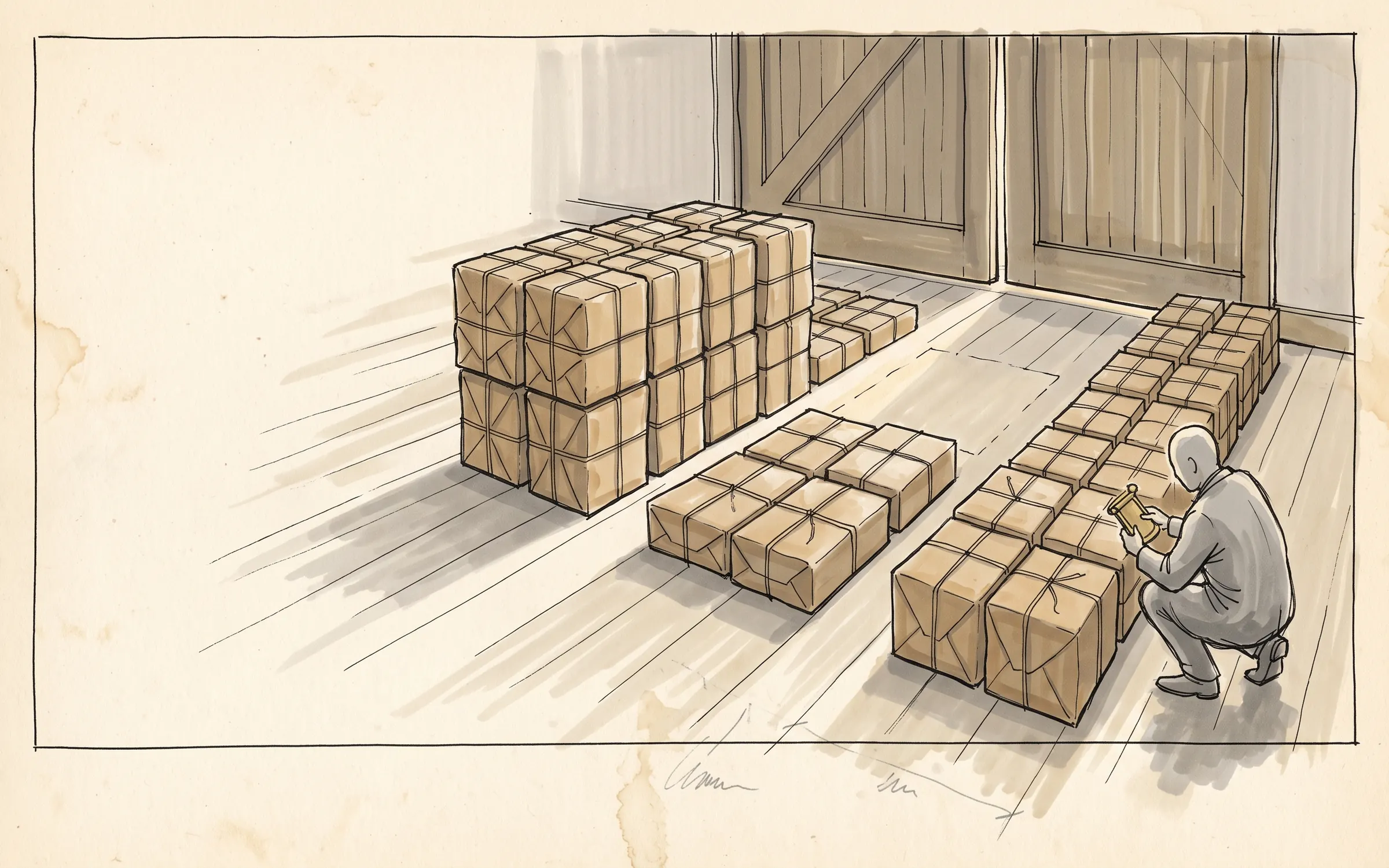
A fashion drop can sell out and still have an inventory problem.
Imagine launching 10 hoodie styles in four colors and five sizes. That is 200 SKUs before a single order is placed. If the brand produces 5,000 units and spreads them evenly, each SKU gets 25 pieces. The spreadsheet looks tidy. Demand probably will not.
Black Medium may sell out on day two while Green XXL barely moves. The brand still has plenty of stock overall, but not the stock customers want. That is the core challenge of fashion inventory planning: deciding not only how many units to produce, but how those units should be distributed across styles, sizes, colors, markets, and time.
For product drops, inventory planning is closely tied to production lead times, MOQ, replenishment speed, campaign timing, cash flow, and fulfillment location. The goal is not to predict demand perfectly. It is to build an inventory position that can absorb uncertainty without turning every surprise into either a stockout or a markdown.
Quick Answer
Plan inventory at SKU level, not only at total-unit level.
Use historical size curves and color sell-through where available; do not split production evenly by default.
Treat new, seasonal, and core products differently because their demand risk and replenishment value are different.
Set replenishment triggers before the drop, using supplier lead time and a realistic safety-stock buffer.
Keep slow or uncertain SKUs in a flexible inventory position instead of copying proven bestsellers into every market.
Review the drop after launch and feed actual sell-through back into the next production order.
Fashion inventory should follow demand curves, not spreadsheet symmetry.
What Is Fashion Inventory Planning?
Fashion inventory planning is the process of deciding how much stock a brand should produce or buy, how that stock should be divided across variants, when it should be replenished, and where it should be held to meet expected demand without tying up unnecessary cash.
Shopify describes inventory planning as the strategic process of setting inventory targets, managing lead times, and optimizing stock for a period or season, while inventory management handles the day-to-day execution of tracking and moving stock. Shopify’s inventory planning guide also emphasizes demand forecasting, supplier lead times, replenishment plans, tracking, warehouse capacity, and ongoing adjustment.
For fashion brands, one more layer sits on top of all of that: the SKU matrix. A product is rarely just “one product.” It is style × color × size, sometimes multiplied again by wash, fit, pack, or regional assortment.
Why Product Drops Become an SKU Allocation Problem
Suppose a streetwear brand prepares a limited drop with 8 styles, 4 colors, and 5 sizes. That creates 160 SKUs. If the production order is 4,000 units, the founder is not making one 4,000-unit decision. They are making 160 smaller inventory decisions that add up to 4,000.
| Variant | Expected Demand | Opening Stock | Risk |
| Black / M | Very high | 40 | Likely stockout |
| Black / L | High | 40 | Tight |
| Bone / M | Medium | 40 | Balanced |
| Green / XXL | Low | 40 | Likely overstock |
Equal allocation is simple, but demand rarely distributes equally. If Black Medium sells five times faster than Green XXL, a 40/40 split creates both a stockout and excess inventory at the same time.
This is why Silk Road’s fashion fulfillment operation is organized around style, color, and size rather than only total units. Variant-level visibility is what allows a brand to see that one size is almost gone while the style still looks well stocked overall.
Build a Size Curve Before You Build the Purchase Order
A size curve is the expected percentage of demand that will fall into each size. The exact curve varies by product, fit, market, and customer base, but it is usually a better starting point than dividing stock evenly.
For example, a brand with enough history might estimate a hoodie size mix of:
Those percentages should not be copied blindly to every product. An oversized unisex hoodie, fitted women’s top, and structured jacket can all produce different curves.
For a new brand without historical data, the goal is to reduce the cost of being wrong. Start with smaller test quantities where MOQ permits, use preorder or waitlist signals carefully, compare similar prior products, and keep more budget available for replenishment instead of spending everything before launch.
This connects directly to Fashion Inventory Management: How to Control Size, Color & SKU Growth and Clothing MOQ: What Fashion Founders Need to Know. MOQ can force a brand to produce more than ideal, so the real question is how to distribute that constraint intelligently across variants.
Core Products and Trend Products Need Different Inventory Strategies
A black logo T-shirt that has sold every week for two years should not be planned like a metallic party top tied to one seasonal drop.
| Product Type | Forecast Confidence | Replenishment Value | Inventory Approach |
| Core bestseller | Higher | High | Deeper stock + earlier reorder |
| New drop | Low | Medium | Controlled opening buy + learn fast |
| Seasonal item | Medium | Low after season | Protect against leftover stock |
| Viral/trend item | Low and volatile | Depends on lead time | Fast signal tracking + flexible reorder |
The key point is that safety stock should not be spread evenly either. A proven Black Medium bestseller may deserve more buffer than a speculative low-volume colorway. Fashion safety stock should protect high-value demand, not simply make every SKU look equally safe.
Use Demand Signals, but Separate Signal From Hype
Fashion drops are often driven by TikTok, Instagram, influencers, email lists, waitlists, and launch campaigns. These signals are useful, but they are not all equally predictive of paid orders.
Ten thousand video views do not mean ten thousand units of demand. A waitlist with size selection is usually more informative than a like. A preorder backed by payment is stronger again. Historical conversion from a creator partnership is more useful than the creator’s follower count.
A practical forecast can combine several layers: historical sales for comparable products, variant-level size and color mix, launch traffic expectations, confirmed preorder demand, campaign calendar, seasonality, and the supplier’s replenishment lead time.
Shopify’s guidance recommends using both internal signals such as historical sales, new launches, and planned promotions and external signals such as trends and seasonality when forecasting demand. Read Shopify’s inventory planning framework.
Plan Replenishment Before Launch Day
A brand should know what will trigger a reorder before the first unit sells.
For a simple example, assume Black Medium opens with 300 units, sells at 50 units per week after launch, and the realistic factory-to-available-stock replenishment time is five weeks. Waiting until only 50 units remain is too late. The brand needs a reorder point that covers expected demand during lead time plus a safety buffer.
Shopify describes reorder points and safety stock as core inventory-planning tools and gives weeks of supply as: on-hand inventory ÷ average weekly units sold. The right buffer depends on how volatile demand is and how reliable the supply side is. Shopify: Inventory Planning
For fashion, lead time should include more than sewing. Fabric availability, trim procurement, sample or color approval, production queue, QC, receiving, labeling, and warehouse processing can all sit between “reorder” and “sellable stock.”
That is why fashion sourcing in China and apparel quality control matter here: faster replenishment is only valuable if the repeat production still matches the approved product.
Where You Hold Inventory Changes the Risk of a Drop
A fashion brand manufacturing in China has another planning decision: should stock stay near production, move to a regional warehouse before demand is proven, or use a mix of both?
Silk Road’s current fulfillment-center strategy explicitly separates new or uncertain inventory from proven bestsellers. Its global fulfillment center model positions Shenzhen as the primary hub for new collections, seasonal drops, slower movers, and long-tail size/color depth, while regional inventory is used when demand is proven and predictable.
That creates a useful rule for fashion inventory planning: do not duplicate uncertainty. If a new collection has not yet proven which styles, colors, and sizes will win, splitting every SKU across the US, Europe, and Australia can multiply the amount of safety stock needed and make rebalancing harder.
A proven bestseller is different. Once weekly demand is stable, putting selected stock closer to the largest market may improve delivery speed without forcing the entire catalog into regional warehouses.
For Shopify brands, Silk Road’s Shopify fulfillment setup is designed around products and variants syncing with live warehouse stock, which is the data foundation needed for SKU-level replenishment decisions.
Why Inventory Discipline Matters More in 2026
The wider fashion industry is carrying more inventory pressure. McKinsey and The Business of Fashion report that fashion companies reached 168 days of inventory outstanding in 2024, up from 147 days in the 2016–2019 average. The report also says inventory management was among the areas executives most frequently identified as under economic pressure, and demand-driven inventory optimization is gaining traction as a way to protect margins. McKinsey & BoF: The State of Fashion 2026
For a growing DTC fashion brand, the lesson is not to copy enterprise forecasting tools. It is to recognize that excess stock has a cash cost, a storage cost, and often a markdown cost. Every extra colorway, size run, and regional inventory pool increases the number of places a forecast can be wrong.
Inventory planning therefore becomes part of margin management. The brand that sells through 800 of 1,000 units at full price can be healthier than the brand that sells 1,500 of 2,500 units after deep discounting.
The Drop Is Also a Data Collection Event
The first 24 hours of a drop can tell you something, but the first week usually tells you more. Track sell-through by SKU, not only by product. Watch which sizes disappear first, which colors lag, where exchanges cluster, and whether demand came from the audience or market you expected.
After the launch, separate products into decisions such as: reorder now, monitor, stop replenishing, bundle, markdown later, or carry forward as core stock. Do the same at variant level when the data supports it.
This prevents a common mistake: reordering the whole style because one variant sold out. If Black M and L are driving the demand while two other colors remain slow, the next production order should reflect that information rather than recreate the original mix.
Returns should also feed back into the plan. A size that appears to sell well but has an unusually high “too small” return rate may not deserve the same reorder quantity.
Frequently Asked Questions
How do fashion brands plan inventory for a product drop?
Start with expected demand, then allocate the total production quantity across styles, colors, and sizes rather than planning only at product level. Use historical size curves where available, consider launch marketing and seasonality, and define replenishment triggers based on production lead time and safety stock.
What is a size curve in fashion inventory planning?
A size curve is the expected share of demand for each size within a product or category. Instead of ordering equal quantities of XS, S, M, L, and XL, a brand uses historical or estimated demand to allocate more inventory to the sizes most likely to sell.
How much safety stock should a fashion brand hold?
There is no universal percentage. Safety stock should reflect demand volatility, supplier reliability, replenishment lead time, product importance, and seasonality. Proven core products may justify a deeper buffer than experimental colorways or seasonal products with a short selling window.
Should new fashion collections be stored in multiple countries?
Not automatically. Splitting an unproven collection across several markets can multiply safety-stock requirements and make slow-moving variants harder to rebalance. A central inventory pool may be more flexible until regional demand becomes predictable, after which selected bestsellers can be moved closer to customers.
What Fashion Founders Should Remember
Good fashion inventory planning is not about having enough units overall. It is about having enough of the right styles, colors, sizes, and SKUs at the moment customers want them. Product drops make this harder because demand is concentrated, marketing can create sudden spikes, and seasonal inventory loses value quickly. Plan the size curve, separate core products from speculative ones, set replenishment triggers before launch, and keep inventory flexible until demand proves where it belongs. For brands manufacturing in China, connecting production, QC, inventory, and fulfillment can shorten the feedback loop between what sells today and what the factory should make next.