
Two 3PL proposals quote the same pick-and-pack fee. One still costs your clothing brand more per order because it bills each extra garment, uses a larger branded box, charges separately for returns, and applies a monthly minimum. The useful comparison is the cost of fulfilling your actual order mix, not the most attractive line on a rate card.
This worksheet turns any provider quote into a comparable per-order number. The worked example uses hypothetical inputs, not Silk Road prices or market benchmarks.
Quick Answer
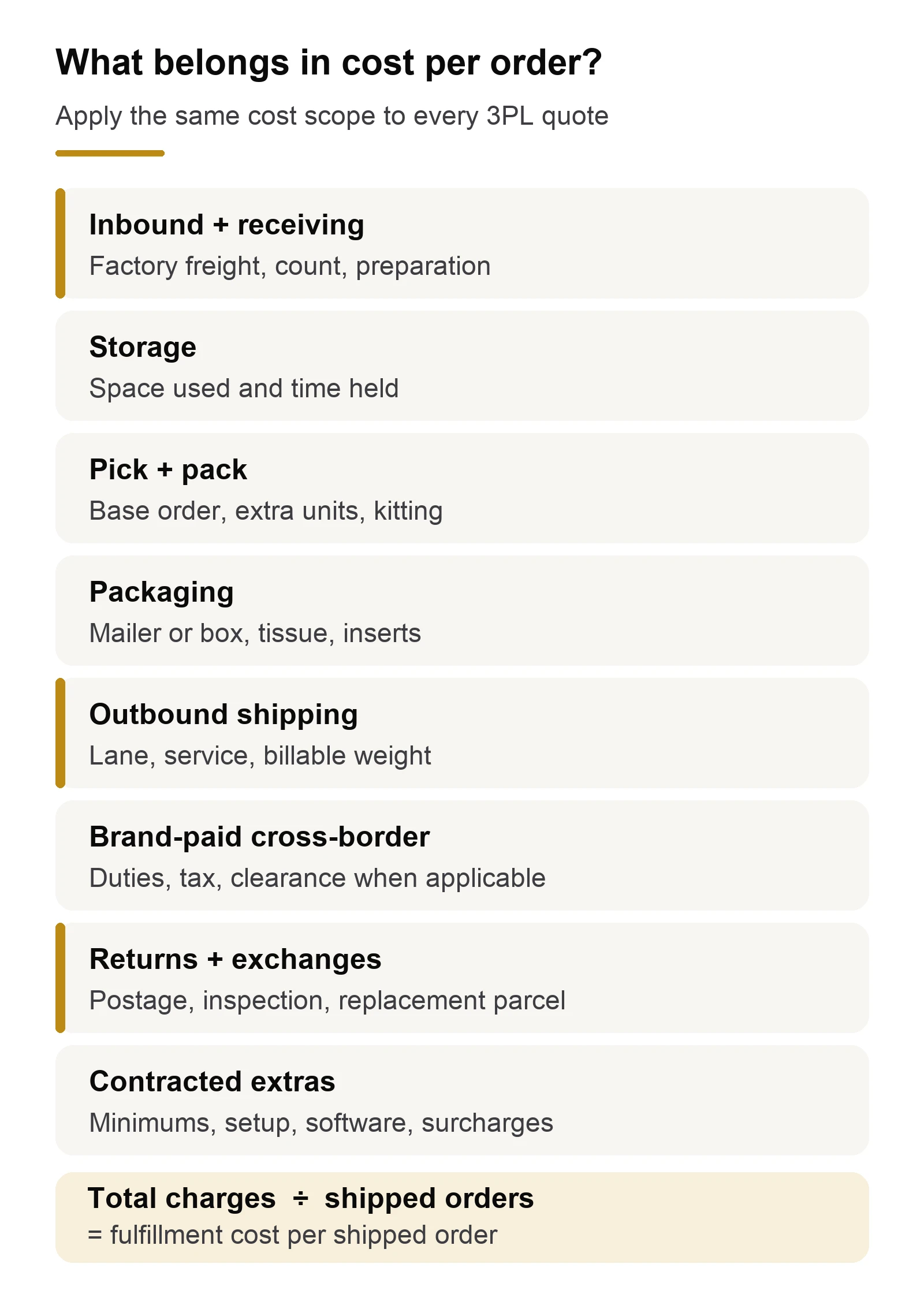
Apparel fulfillment cost per shipped order = all fulfillment expenses attributable to an order cohort divided by the number of shipped orders in that cohort. Include allocated inbound receiving, storage, pick and pack, packaging, outbound transport, applicable duties or taxes paid by the brand, return processing, and contracted minimums or surcharges. Keep product manufacturing and marketing outside this operational measure, then add them separately when calculating contribution margin.
Use a representative mix of single-item, multi-item, international, and returned orders. Request a written, itemized quote for that mix.
Start With the Right Denominator
Compare providers against the same month of expected orders or, ideally, a recent month of actual data. Count shipped customer orders, not the number of garments picked. A two-item order is one outbound parcel if both items ship together, but it may incur two pick charges. An exchange may create another outbound shipment and should be modeled separately.
Allocate shared costs to the orders they support. Spread a six-month setup charge over six months. Estimate later returns for the same shipped-order cohort, then replace the estimate with actuals.
Shopify's 3PL guide identifies transportation, receiving, storage, pick and pack, shipping, and setup as common cost categories. Its 3PL selection guide also calls out returns, minimums, and peak surcharges. Your contract may group these differently, so map every charge to the same worksheet before comparing proposals.
The Apparel Fulfillment Cost Worksheet
| Cost line | Input to request | Monthly calculation |
|---|---|---|
| Inbound freight and receiving | Factory-to-warehouse transport, carton or pallet count, counting and labeling method | Freight plus receiving and preparation fees attributable to the period |
| Storage | Cubic volume or bins/pallets, average inventory held, billing date, free-period terms | Billed storage units × rate, after stated allowances |
| Pick and pack | Orders, units per order, bundles, special handling | Base order fee × orders plus extra-unit and service fees |
| Packaging | Mailer or box, tissue, inserts, garment bags, replenishment | Unit material cost × use, plus assembly charges |
| Outbound shipping | Destination, service, parcel weight and dimensions | Actual carrier or 3PL transport charges, including agreed markups |
| Brand-paid cross-border charges | Destination, product classification and origin, shipping terms | Duties, import taxes, or clearance charges the brand actually bears |
| Returns and exchanges | Return rate, return location, inspection, restocking, replacement shipment | Return postage paid by brand plus processing and exchange outbound costs |
| Other contracted charges | Software, setup allocation, minimums, peak labor, exceptions | Charges actually triggered under the contract |
Worksheet formula:
Per shipped order = (inbound and receiving + storage + pick and pack + packaging + outbound shipping + brand-paid cross-border charges + returns and exchanges + other contracted charges) / shipped orders
For full order-level margin, add product cost, payment fees, customer acquisition, discounts, and brand-absorbed tax or duty. Record customer-paid shipping as revenue, not a cost reduction. Shopify's fulfillment-cost guide also separates storage, packaging, labor, volume, and returns.
1. Receiving and storage
The first invoice can include unloading, counting, barcode or SKU labeling, polybag replacement, and exception handling. Ask whether receiving is charged per shipment, carton, pallet, or labor hour. If the factory has packed mixed sizes into unlabeled cartons, warehouse sorting can change the bill and delay sellable inventory. Prevent that by agreeing on the inbound manifest and variant labels before goods leave production. Silk Road's fashion inventory management guide explains why stock has to stay visible by style, color, and size.
Storage depends on occupied space and dwell time. A slow-moving colorway raises cost per sold unit even if the storage rate stays fixed. Ask which stock qualifies for any free period and what follows. Model both a normal month and a season-end month with leftover sizes.
2. Picking, packing, and brand presentation
Separate the first pick from additional-item picks. A sports bra and legging sold as a set may need two inventory deductions, size verification, a branded insert, and one parcel. Ask whether kitting happens when stock is received or when each order arrives, and which event incurs a charge. A seemingly cheap base fee can change materially when the typical basket contains more than one garment.
Packaging is not just a warehouse consumable. A thin mailer may lower material and dimensional-weight cost but be unsuitable for a premium garment or structured item. A box, tissue, garment bag, and insert protect presentation but can add material, assembly, storage, and shipping cost. Price two approved packaging specifications instead of assuming the cheapest material is the right choice. Silk Road's fashion fulfillment page describes handling by garment and variant, while its apparel fulfillment guide covers the broader operational requirements.
3. Shipping, dimensional weight, and exceptions
Quote outbound transport by destination mix, promised delivery service, and actual packed parcel dimensions. A cost estimate based only on garment weight can miss dimensional weight: carriers may bill a bulky but light parcel using the space it occupies. UPS explains this in its chargeable-weight guide and warns that inaccurate dimensions can lead to shipping-charge corrections. The applicable divisor and rounding rules depend on the carrier and service, so use the contracted tariff rather than a universal formula.
Ask who pays for remote-area delivery, address corrections, fuel adjustments, failed deliveries, and reshipments. Check tracking, insurance, and last-mile service. For cross-border orders, specify whether duties and import taxes are charged at checkout, absorbed by the brand, or collected on delivery. Shopify's international duties guidance explains the role of classification, origin, destination, and shipping terms.
4. Returns and exchanges
Apparel returns have at least two cost layers: getting the garment back and deciding what condition it is in. A return might require a local return label, opening, size and SKU verification, inspection, steaming or repacking, and a stock-state update. A size exchange can also create a new pick, pack, and outbound parcel. Shopify's returns and exchanges documentation distinguishes refund, return, and exchange workflows. Silk Road's fashion returns management guide explains why a received return is not automatically sellable stock.
Ask for a return quote by destination and disposition: restock as new, recondition, secondary sale, or write-off. The cheapest return process may produce a misleading inventory count if garments re-enter available stock without inspection. For cross-border fulfillment, a regional return location can also change the economics, so confirm the actual route available to your markets.
Worked Example: One Hypothetical Month
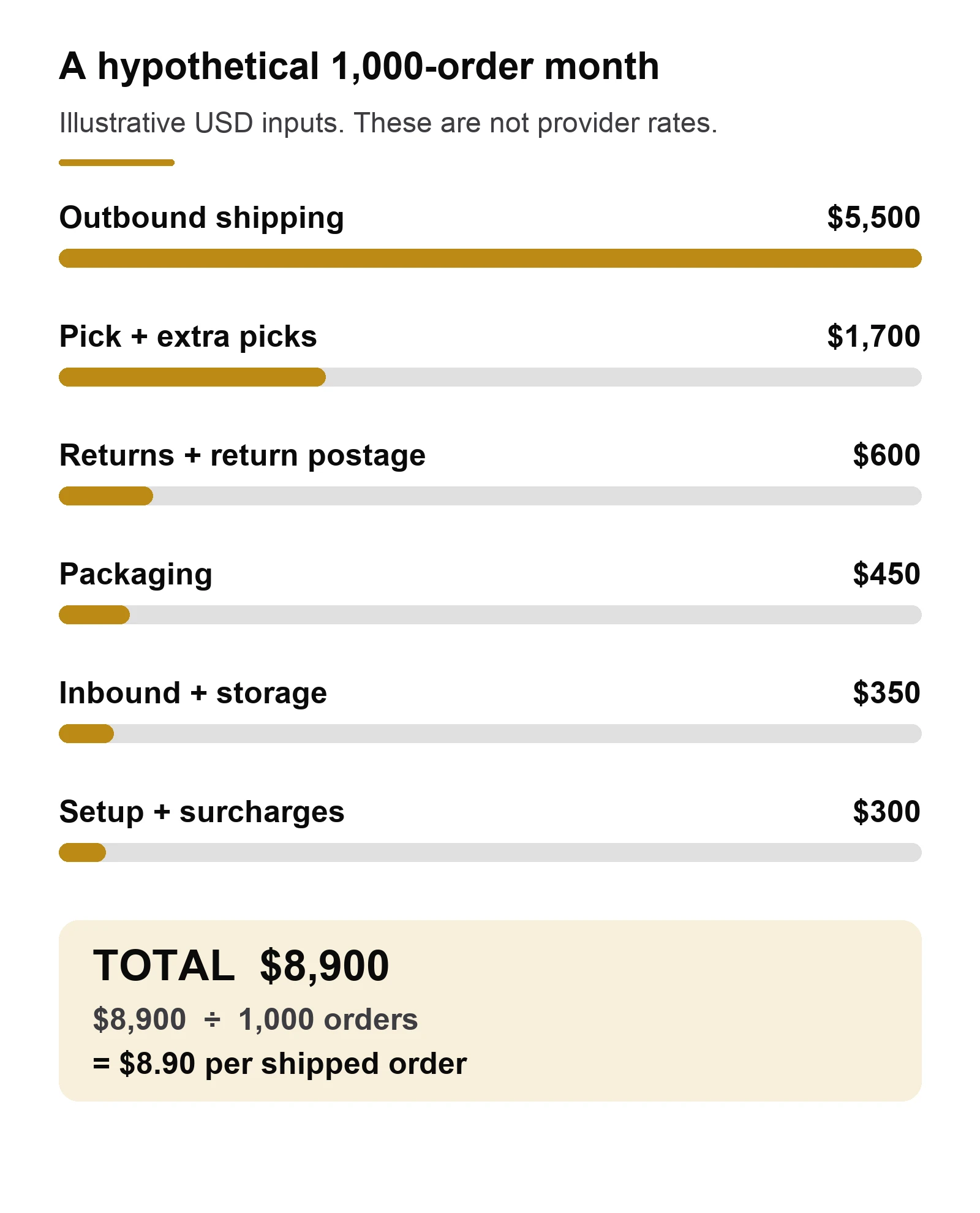
Suppose a fashion brand ships 1,000 orders. It has 250 extra garments beyond the first item in each order, and assumes 120 returns from that cohort. The scenario assumes no brand-paid duties or import taxes. These invented inputs only show how the worksheet works. They are not a quote, a forecast, or typical industry prices.
| Hypothetical line | Calculation | Amount |
|---|---|---|
| Inbound and receiving allocated to month | Entered assumption | $150 |
| Storage | Entered assumption | $200 |
| Base pick and pack | 1,000 × $1.60 | $1,600 |
| Extra garment picks | 250 × $0.40 | $100 |
| Packaging materials | 1,000 × $0.45 | $450 |
| Outbound shipping | 1,000 × $5.50 | $5,500 |
| Return inspection and restocking | 120 × $2.00 | $240 |
| Brand-paid return postage | 120 × $3.00 | $360 |
| Setup or software allocation | Entered assumption | $100 |
| Other contracted surcharges | Entered assumption | $200 |
| Total | $8,900 |
The modeled fulfillment cost per shipped order is $8.90. If the brand adds a rigid box costing $0.70 more than the assumed mailer, the material line alone rises by $700 a month, or $0.70 per shipped order. Transport could also change if the packed dimensions trigger a different billable weight. Conversely, if the customer pays return postage under the brand's policy, remove that $360 from the brand-paid cost line. The point is to change one real input at a time and recalculate.
Compare China-Origin and Destination Warehousing Fairly
For a brand manufacturing in China, direct dispatch from a China-based warehouse and bulk import into a destination-country warehouse create different cost shapes. A destination warehouse may improve domestic transit time on concentrated demand but requires bulk freight, customs handling, local storage, and an inventory allocation before orders arrive. Direct dispatch may keep stock pooled near production and avoid a speculative transfer, while each parcel crosses a border and may have a different transport, tax, and returns profile.
Neither route is universally cheaper. Compare the same customer destinations, service promise, parcel specification, return process, and time horizon. Include inventory carrying time and unsold sizes. A hybrid plan might put proven bestsellers closer to a large customer market while keeping uncertain colorways in one stock pool. Silk Road's product-drop inventory planning guide explains why allocation decisions matter before a launch. Request lane-specific quotes and test delivery experience before moving the whole collection.
Ask for a Quote You Can Audit
Send each provider the same data pack: monthly order count by destination, units per order, SKU and size-color count, typical packed weight and dimensions, expected inventory footprint, planned launches, returns by market, and approved packaging instructions. Then request:
- A full fee schedule with unit of measure, included allowances, minimum monthly spend, and any setup or software fee.
- Carrier services and delivery estimates by destination, plus the method used to pass through fuel, remote-area, address, and dimensional-weight adjustments.
- Separate charges for extra picks, bundles, inserts, gift packaging, relabeling, quality checks, and exchange shipments.
- Return-address options, inspection grades, restock conditions, disposal or rework fees, and the time to update sellable inventory.
- One sample invoice using your actual order mix, including all applicable fees and taxes, and a process for disputing mistakes.
Reconcile the first invoice against order-level data by SKU, destination, dimensions, service, and return status. Repeat after a drop or packaging change.
Frequently Asked Questions
What is included in apparel fulfillment cost per order?
For a useful 3PL comparison, include allocated inbound receiving, storage, pick and pack, packaging, outbound shipping, expected returns and exchanges, and contractual minimums or surcharges. State clearly whether duties, taxes, product cost, payment fees, and marketing are included in your separate contribution-margin calculation.
Why does a two-item order cost more than a one-item order?
It may require an additional pick, verification, and more packaging or shipping capacity. The exact difference depends on whether the two items share one parcel and how the provider bills extra units or kitting.
Is fulfillment from China always cheaper for a fashion brand?
No. The answer depends on destinations, delivery targets, parcel size, shipping lane, duties and taxes, returns, demand concentration, and how much inventory would otherwise sit in destination warehouses. Compare fully specified scenarios rather than warehouse location alone.
How should we account for returns when they arrive later?
Estimate the expected cost for each shipped-order cohort, then replace the estimate with actual return postage, processing, exchange shipping, and write-offs as data arrives. Keep the assumption visible so a launch month's apparent margin is not overstated.
Turn the Worksheet Into a Real Quote
A fashion 3PL should be able to price the orders your customers actually place, including extra sizes, branded presentation, international lanes, and returns. Contact Silk Road with your SKU matrix, order mix, packaging specification, destinations, and return plan to request an itemized fulfillment proposal. See our services for the scope of sourcing, warehouse handling, and shipping support.