
A fashion brand ships a €28 top from China to a customer in France. Its checkout may already account for product cost, parcel shipping, VAT and the temporary EU customs duty. From November, another line belongs in the model: the Union handling fee. The European Commission says the fee will be €2 per customs item, with application expected from 1 November 2026. That sounds small until it is multiplied across a launch, a low-margin accessory line or an order containing several different products.
For ecommerce brands, the question is not simply whether to add €2 to shipping. Teams must know which goods count as one customs item, who declares and pays, whether the fee is built into the customer price, and how direct shipping compares with inventory already released into EU free circulation. The answers change order margin, delivery experience and logistics planning.
Quick Answer
- The Union handling fee is a planned €2 charge per customs item on imported goods sold in distance sales, including consignments above €150.
- It is separate from the temporary €3 customs duty that has applied to qualifying low-value imports since 1 July 2026.
- A customs item is not necessarily one physical unit or one parcel. Classification, description and, where required, origin determine the grouping.
- The fee is non-refundable once the customs declaration is accepted, so returns do not automatically recover it.
- Brands should update landed-cost models, product data and carrier or broker arrangements before the planned start date.
What Is the EU Union Handling Fee?
The Union handling fee pays toward customs work on goods sold in distance sales and released for free circulation in the EU. The European Commission customs guidance dated 5 October 2026 says it covers activities such as checking declaration data, risk analysis and controls. The new Union Customs Code provides the legal basis, while a delegated act sets the amount at €2.
The Commission says the fee is expected to apply from 1 November 2026. Its guidance describes the delegated act as under scrutiny, so a brand should confirm the final commencement position before changing live checkout language. The underlying fee is not temporary. The €3 customs duty, by contrast, is an interim measure scheduled to run until July 2028, when the EU Customs Data Hub is due to take over the ecommerce import process.
How Is the Fee Different From the EUR 3 Customs Duty?
These charges solve different problems. The €3 duty replaced duty relief for qualifying consignments with an intrinsic value up to €150 from 1 July 2026. The €2 handling fee addresses customs processing costs and applies to qualifying distance sales regardless of consignment value. Both use the customs definition of an item, and neither should be described as a flat charge on every parcel.
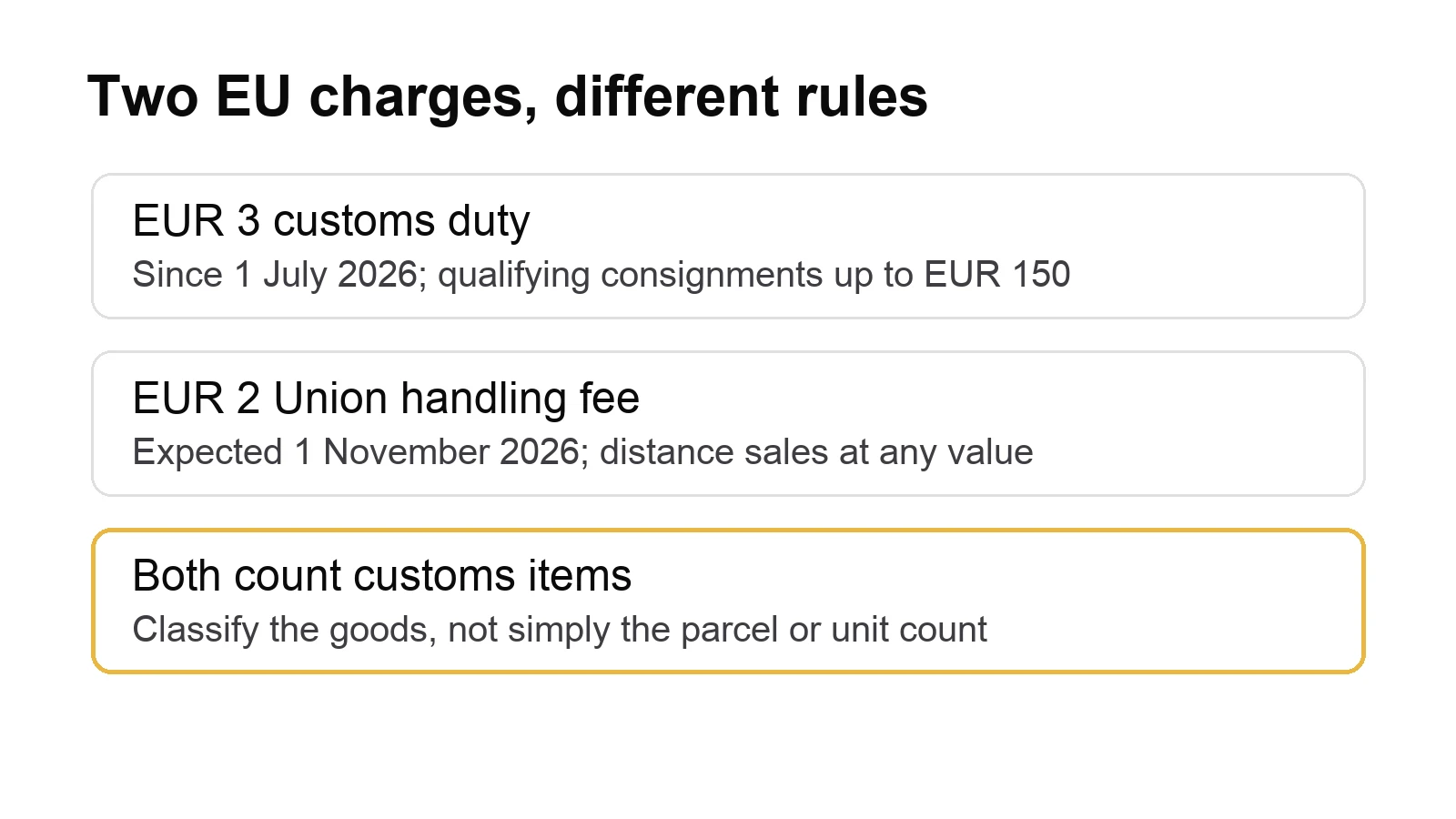
Suppose one order contains two identical cotton T-shirts and one leather belt. If the two shirts share the same tariff classification, description and required origin information, they may form one customs item; the belt is another. On that simplified assumption, the handling fee would be €4, not €6. If the order also meets the temporary duty conditions, that duty would be calculated separately. Actual declaration data, valuation and applicable procedures decide the result.
The Council of the EU overview gives a similar distinction for the €3 duty: the calculation follows product categories rather than the count of units in a box. Fashion brands should therefore map the rule to their declared product lines, not multiply a headline rate by the number of garments.
Why Ecommerce Margins Change Unevenly
A fixed charge takes a larger share of a low-value basket than a premium one. A €2 fee is 10% of a €20 item before shipping and other costs, but 2% of a €100 item. That is simple arithmetic, not a prediction of the final customer price. The merchant may absorb the cost, adjust prices, set a delivery threshold or show a charge at checkout, subject to the tax and consumer rules for the market.
Fashion bundles make the effect less intuitive. A matching set sold as a single commercial offer can still contain goods that require distinct customs item treatment. A cart with a hoodie, cap and belt may carry more charge exposure than a cart with three otherwise identical hoodies. Discounts do not necessarily reduce a fixed per-item fee. This makes the declared assortment, not only average order value, important to contribution margin.
Returns matter as well. The Commission guidance says the handling fee is not refundable once a declaration has been accepted, even if the goods are later returned. A brand with frequent size exchanges should model the original import cost and any cost of sending a replacement. The fashion returns workflow should therefore feed back into pricing, not sit only in customer service.
Who Pays, and What Should Carriers Clarify?
The legal debtor is linked to the import customs debt. In practical ecommerce operations, the seller, platform, importer, carrier or their representative may handle the declaration and pass charges through under their commercial terms. The Commission’s customs reform overview says the wider reform shifts more responsibility for duty payment and compliance toward non-EU platforms and sellers. The exact payment flow for a given shipment still depends on the import arrangement and contract.
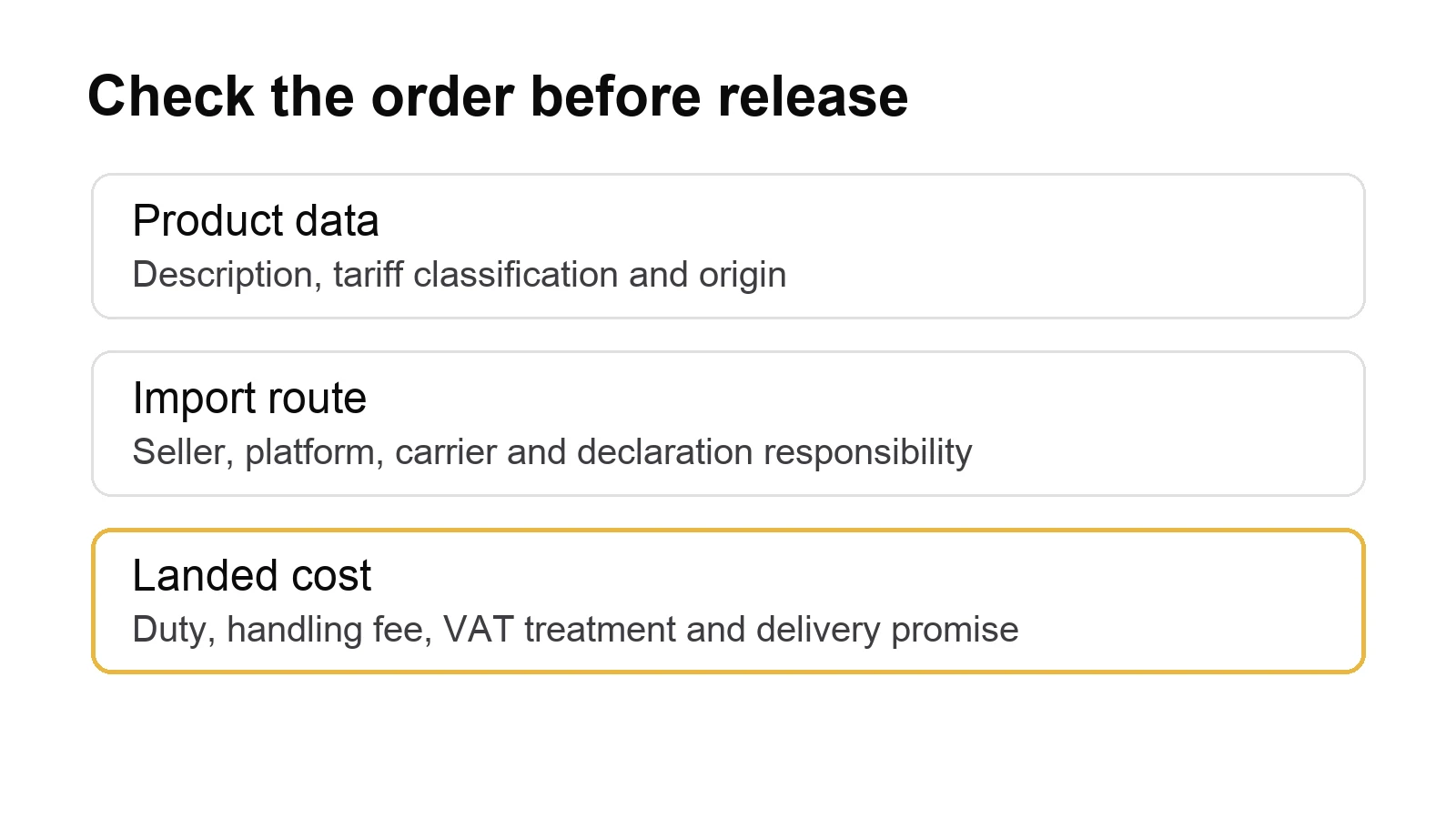
Before November, ask each carrier or customs partner four concrete questions: Which party is the declarant? At what point will the fee appear in invoices? Is the invoice calculated from customs items rather than parcel count? How are corrections, refused declarations and returns handled? Keep the answer beside the SKU margin file so finance and customer support use the same assumption.
Do not confuse the Union handling fee with a courier’s own brokerage or disbursement charge. They can appear on the same invoice, but one is an EU customs fee and the other is a commercial service price. A checkout that hides both inside one vague “tax” line can make reconciliation and customer explanation difficult.
How the Rule Changes China to EU Fulfillment Decisions
A brand manufacturing in China has two broad routes. It can ship each customer order from China into the EU, or import inventory in bulk and fulfill later from stock already in EU free circulation. The handling fee attaches to qualifying distance sales of imported goods at release for free circulation. An EU warehouse address alone does not make the charge disappear: goods held in a customs warehouse can remain outside free circulation, and the Commission guidance specifically discusses sales from customs warehouses.
The useful comparison is the full path of each SKU. Direct China fulfillment can preserve one stock pool for several markets and avoid forecasting every EU size and color months ahead. EU-held, cleared inventory may support faster domestic delivery and simpler local returns, but requires earlier inventory commitment, inbound freight, customs clearance, receiving and storage. The China versus local fulfillment guide explains the inventory-positioning logic in another market; the same decision framework applies here with EU-specific customs rules.
For example, a brand has 12 dress styles in five sizes and four colors: 240 variants. Moving every variant to an EU warehouse may fragment stock before demand is known. Keeping all 240 in China means every direct EU order faces an import event. A measured hybrid can move proven EU bestsellers closer to customers while retaining uncertain sizes, colors and new drops in a central pool. The fee becomes one input in that choice, alongside delivery promise, returns and capital tied up in inventory.
Product Data Becomes a Shipping Cost Control
Because the charge is calculated by customs item, weak product data creates both compliance and margin risk. A Shopify SKU is a warehouse identifier; it is not automatically a customs item. The declaration also needs a defensible goods description, tariff classification and origin information where required. If a color or material change alters the correct classification or description, the product record must be updated before parcels are released.
This is familiar to fashion teams. A “black top” description hides whether the item is knitted or woven, its fibre content and whether it is a top, shirt or jacket. Those differences can matter to customs classification and product compliance. Tie the approved tech pack and supplier record to the SKU master, then pass the needed fields to the shipping system. The same discipline helps the fashion inventory process keep size and color variants accurate.
What Fashion Brands Should Do Before November
Silk Road is a Shenzhen-based sourcing and fulfillment partner for fashion brands. For teams already producing in China, the operational opportunity is to connect factory product data, SKU records, quality checks and international shipping before the first parcel is declared. That is more useful than discovering the new fee only after carrier invoices arrive.
Frequently Asked Questions
Is the Union handling fee EUR 2 per parcel?
No. The Commission guidance describes €2 per customs item. An item may include one or more goods sharing the relevant tariff classification, description and origin data. One parcel can contain several items, and several identical physical units may form one item. The declaration determines the calculation.
Does the fee apply to orders above EUR 150?
Yes, if the goods are qualifying imported distance sales. The Commission guidance says the handling fee applies regardless of value. The €150 threshold belongs to the separate temporary €3 customs duty.
Does an EU warehouse avoid the handling fee?
Stock already imported and released into EU free circulation before a later local sale follows a different flow from a direct imported distance sale. Merely placing goods in a customs warehouse does not necessarily remove the fee. Ask a customs adviser to assess the exact inventory and sale sequence.
Is the fee refunded when the customer returns an item?
The Commission guidance says the fee is non-refundable once the customs declaration is accepted. A return may affect other tax or duty calculations, but brands should not assume recovery of this handling fee.
The Decision for Ecommerce Brands
The Union handling fee is small enough to miss in a headline shipping quote and large enough to change the economics of low-value, mixed-product orders. Fashion brands should treat it as an item-level import cost, keep it separate from the temporary €3 duty and the carrier’s own charges, and check the party responsible for declarations. Then compare fulfillment routes using real product mixes, size and color demand, returns and delivery expectations. A sound answer may keep flexible inventory in China, move proven EU sellers locally, or combine both. The important step is to make the decision from verified customs data and total landed cost.